Theater Review: Legacy Turns Toxic in Branden Jacobs-Jenkins’s “Purpose”
By Bill Marx
The Huntington Theatre Company production brings comic velocity and emotional force to a drama about a famous pastor, his fractured family, and the corrosive cost of obedience.
Purpose by Branden Jacobs-Jenkins. Directed by Josiah Davis. Staged by the Huntington Theatre Company at the Calderwood Pavilion, 527 Tremont St. Boston, through October 11.
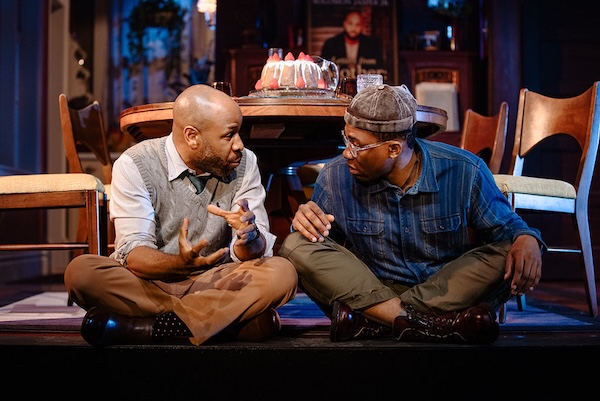
Ugo Chukwu and Omari K. Chancellor in the Huntington Theatre Company production of Purpose. Photo: Marc J Franklin
“Mendacity is a system that we live in,” Brick says in Cat on a Hot Tin Roof. In Purpose, Branden Jacobs-Jenkins updates Tennessee Williams’s ’50s indictment of American hypocrisy, placing it within the dysfunction of a prominent Black family—and, more specifically, in its patriarch’s dynastic ambitions. His ruling fantasy of inheritance, legacy, and obedience makes spiritual as well as psychological survival precarious for anyone unable or unwilling to submit. The Williams comparison holds in other significant respects. This ambitious dark comedy showcases Jacobs-Jenkins’s gifts for vivid characterization, combative humor, and compassion for the family’s most vulnerable members. It also reveals a social vision broad enough to accommodate sharp jabs at civil-rights activism, religion, and political corruption.
The Jasper clan’s Big Daddy and Big Mama are Solomon and Claudine. He is a pastor who achieved national renown marching alongside Martin Luther King Jr.; she has remained passionately, and protectively, at his side. But Solomon’s celebrity is fading, and rumors have begun to circulate about sexual dalliances during his heyday. Bitterly disappointed in his two sons— Solomon “Junior,” a politician recently released from prison after an embezzlement conviction, and Nazareth, a divinity-school dropout turned nature photographer—Solomon has taken up beekeeping along with a crusade against the pervasive deceit he sees around him. The stage action unfolds through the self-deprecating, slyly critical perspective of Nazareth, the younger son, an insider who longs to be an outsider. He arrives for Claudine’s belated birthday celebration with Aziza, a friend whose presence—along with that of Junior’s rage-filled wife, Morgan, who faces imprisonment herself—sets off a family-meal meltdown. It is a theatrical humdinger of an internecine confrontation: a near-farcical eruption of long-suppressed resentments and deflating revelations about fraud, marriage, sexuality, mental illness, faith, and Solomon’s disturbing past.
That slip-sliding interplay of pain and humor is a hallmark of Jacobs-Jenkins’s writing. His plays often balance on a knife’s edge, darting unpredictably from seriousness to silliness and back again. Those tonal switchbacks test both director and performers, and the Huntington Theatre Company production generally negotiates them with agility, keeping pace with the Jaspers’s emotional zigs and zags.
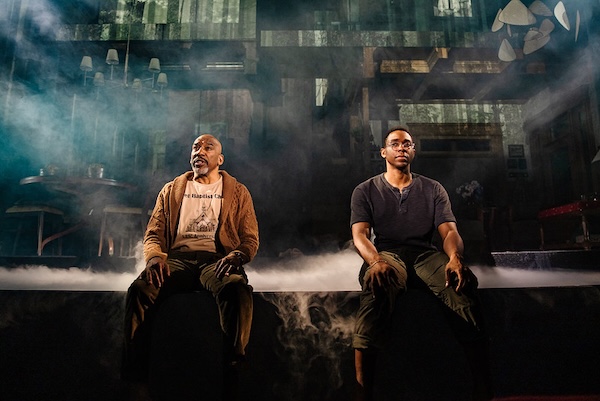
Ezra Knight and Omari K. Chancellor in the Huntington Theatre Company production of Purpose. Photo: Marc J. Franklin
The cast is strong. Ezra Knight encases Solomon in belligerent self-righteousness, allowing his seething frustrations to erupt with unnerving force. Phyllis Yvonne Stickney makes Claudine a vivacious maternal presence that can morph, with ease, into a commanding, fiercely protective guardian of the family brand. In the role of Morgan, desperate to escape the Jasper cage, MarHadoo Effeh parcels out venom with cool precision. Kalyne Ashley Coleman’s Aziza plucky admirer effectively sinks into disillusionment. As the brothers, Ugo Chukwu gives the perpetually bewildered Junior memorable notes of hapless vulnerability, while Omari K. Chancellor has the flexible chops necessary for the pivotal narrator-commentator role. His Nazareth is amusing, self-protective, callous, sensitive, and, in his fashion, spiritual.
Josiah Davis’s staging leans heavily into the comedy, which is especially prominent in the first half, before the dinner’s fallout unleashes more fraught confrontations and confessions, along with plots and counterplots bent on revenge and/or redemption. It is here that the competing currents become less persuasive, as Jacobs-Jenkins tries—admirably but sometimes awkwardly—to steer the family drama into more expansive territory.
Unlike Williams, Jacobs-Jenkins takes a more generous view of the clan’s controlling, strong-willed elders. The patriarch and matriarch are not merely villains but tragic figures, blind to the harm they inflict on others and themselves. The possibility of understanding—if not reconciliation—hovers over the play, as do hints that, once its characters confront their limits, there is the possibility that they might escape the repressive forces that confine them. In this sense, Purpose taps into an agonizing contemporary American anxiety: the struggle, particularly for younger adults and workers, to find meaning in lives and institutions founded on compromised ideals. Jacobs-Jenkins also traces, with striking force, a more destructive fracture in generational connection: Junior’s ruinous, unattainable dream to follow in his father’s footsteps.
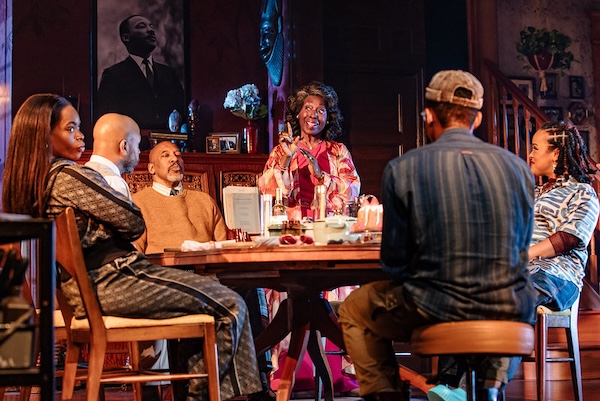
The cast of the Huntington Theatre Company production of Purpose. Photo: Marc J. Franklin
Politically, aside from its positive treatment of gender fluidity, Purpose largely avoids the contemporary efforts to roll back the civil rights for which Solomon and Claudine endured so much and fought so hard. It offers scant acknowledgment of the country’s ongoing authoritarian turn—despite the play’s 2024 premiere, years after the Trump administration’s 2017 travel-ban order barred entry to nationals of several predominantly Muslim countries and suspended refugee admissions. There may, however, be an oblique allusion to an American appetite for autocracy in Solomon’s celebration of bees: his admiration for their regimentation and acceptance of preassigned duty. Yet this symbolic detour is the script’s least effective device, culminating in Solomon’s heavy-handed exposition of the winged insects’ virtues.
When it comes to the nature of purpose, which can help individuals break free of overbearing family strictures and assert their independence, the script is evasive. For Nazareth, liberation is rooted in an aesthetically charged contemplation of the natural world: “The feeling of this mist that comes off the water at night … I imagined the earth. All that life teeming with its private needs … when you think about that, all that … power and mystery and design … it creates a feeling in me.” Yet this staunch nature photographer never acknowledges that the transcendent “power and mystery and design” he needs to feed his art and peace of mind is vanishing around the globe—and that fewer and fewer people will have the chance to experience it firsthand.
Ironically, for many who share Nazareth’s intuitive response to the natural world, aesthetic appreciation now compels a political imperative: collective action to protect what remains of the earth’s wild places from climate catastrophe. How we perceive nature often shapes how—and whether—we defend it. In that light, Jacobs-Jenkins’s treatment of nature as a private wellspring of “purpose”—rather than an invitation to action as urgent as the civil-rights struggles that shaped the Jasper family’s history—feels pat, even somewhat anachronistic. Given the deteriorating state of affairs, artists who celebrate nature’s traditional beauties, along with its spiritual and psychological consolations, must also confront its increasing fragility. They might take a cue from Henry David Thoreau: “In Wildness is the preservation of the World.”
Bill Marx is the editor-in-chief of The Arts Fuse. For over four decades, he has written about arts and culture for print, broadcast, and online. He has regularly reviewed theater for National Public Radio Station WBUR and The Boston Globe. He created and edited WBUR Online Arts, a cultural webzine that in 2004 won an Online Journalism Award for Specialty Journalism. In 2007 he created The Arts Fuse, an online magazine dedicated to covering arts and culture in Boston and throughout New England.
Tagged: "Purpose", Branden Jacobs-Jenkins, Ezra Knight, Huntington-Theatre-Company, Josiah Davis, Kalyne Ashley Coleman, MarHadoo Effeh, Omari K. Chancellor, Phyllis Yvonne Stickney