Book Review: “Traveling in the Direction of the Shadow” — The Fine Art of Meandering
By Ellen Elias-Bursać
Iana Boukova’s novel finds enchantment in digression, folklore, and the sensuous music of language.
Traveling in the Direction of the Shadow by Iana Boukova. Translated from the Bulgarian by Ekaterina Petrova. New York Review Books, 296 pages, $19.95.
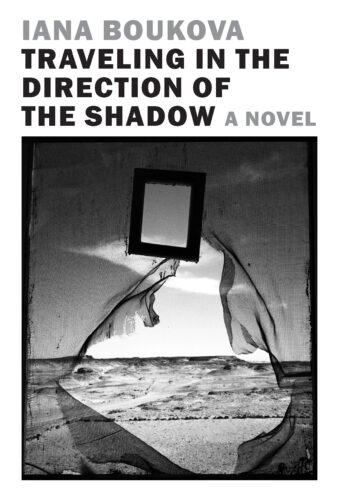 Iana Boukova explores the vicissitudes of storytelling in her novel Traveling in the Direction of the Shadow. Throughout the book, she challenges us to abandon any expectation of a neatly devised, easy-to-read plot. Instead, she encourages us to submit to the meanders, eddies, digressions, and asides in this collection of eight interlinked stories. Her translator from Bulgarian, Ekaterina Petrova, has adeptly harnessed the language of fairy tales and sagas, serving the needs of Boukova’s chant-like narrative, which evokes, in Part One, a long-past imaginary Balkan world. While the novel opens with a date—1827—the stories feel timeless, ancient, and otherworldly, even as they unpredictably twist and turn from encounter to encounter. Part Two gives us a Dutchman living in an urban setting, perhaps in the late 19th century, who is drawn to the allure of travel, if not its realities.
The stories possess a vivid physicality. Their characters grapple with life through their hands, feet, shoulders, lips, and eyelashes. Though most of their lives unfold in what we now think of as Bulgaria, travel—as the novel’s title suggests—shapes them all. Water, meanwhile—river and sea alike—laps at the narrative, sloshes through it, and finally drenches it.
The evocative language saturates the senses: as we read, we smell, taste, see, hear, and touch. Here’s an example:
He tasted the last remainders of the previous year’s wine in the barrels. Turbid and slightly bitter, it did not please him. He found the grass snake’s hole under the dining room door, and kept an eye on it until one sunny day he saw the snake emerge and stretch along the length of the threshold, forcing the cook monk to step over it. Following the garlic trail of the invisible monk, he found out where the key to the bell tower was kept. Once, he climbed the narrow stairs and did what every boy dreams of doing but never gets the chance to do—he rang the church bell as hard as he could. He felt the copper clapper striking inside his body, unimpeded by the flesh, freely and without crushing his bones, he felt the sound filling his body from top to bottom and from side to side, then felt it spilling out of his body, unbearable in its fullness, and when it could no longer go on, he felt it dying down, vibrating all the way to the tips of his toes.
Petrova takes evident joy in not just rendering the meandering storylines, but infusing that imaginative drift into the eddy and resonance of the sentences themselves.
Each story explores the life of a distinctive character: Iovana, a mother of eight who dies of the plague; Ismail Çelik, a gambler and chess player enthralled by a magical kilim; Primian Angelov, a stuttering bandit captivated first by calligraphy and later by words such as oversquanderous, hedgehog, dogheaded, laughingstock, hovel, out, and who; and Ian Van Athen, a Dutchman raised on Latin, maps, reading, writing, and the study of insects.
There is much here to challenge the translator, such as this meditation on the word “mercy”:
…the cup of coffee, his elbows on the table, and his head between his hands, and in his head the word mercy. Mercy: the mercantile display of compassion—toward others, toward oneself, toward God. Like a benignant mercenary—for the sake of others, for the sake of oneself, for the sake of God. One person’s mercy toward another is always a love triangle, with one corner touching the sky. To immerse in others, to emerse out of yourself, to be amersed by God. Mercy, clemency, gramercy, merci…
Petrova lets Balkan folklore and traditions speak for themselves, preserving words such as rakia (hard liquor), haiduk (bandit), zaptiya (constable), popadia (the wife of an Eastern Orthodox priest), çorbaji (soup maker), and onbaşi (corporal) in her translations.
While Part One is steeped in the traditions of a Bulgarian village, Part Two unfolds in an unnamed urban setting, in a household populated by maids, guardians, and a tutor. From there, Ian Van Athen ventures out after a childhood devoted to study, accompanied by Outis, a Greek-Bulgarian-Turkish storyteller and translator.
The narrative’s circuitousness may occasionally slow your reading. But if you’re willing to let the language’s cadence carry you along, you may find yourself transported to another time and another world.
Ellen Elias-Bursać has been translating novels, stories, and nonfiction by Bosnian, Croatian, and Serbian writers for the last 30 years. Her translation of David Albahari’s novel Gotz and Meyer, 2004 (Britain) and 2005 (US), was awarded the National Translation Award by the American Literary Translators Association in 2006, and Sons, Daughters by Ivana Bodrožić in her translation was given the EBRD Prize for Literature in 2025. She has also translated writing by Damir Karakaš, Dubravka Ugrešić, and Karim Zaimović. She served on the board of the American Literary Translators Association for over 10 years.