Book Review: “The Hard Path to Unity” — A Liberal’s Case for Caution
By Bill Littlefield
In The Hard Path to Unity, former congressman Barney Frank offers a sharp account of Trump-era politics and liberal disarray—but his call for patience with progressive “dissidents” invites serious resistance.
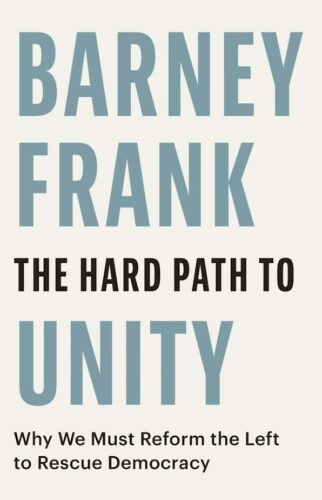
The Hard Path to Unity: Why We Must Reform the Left to Rescue Democracy by Barney Frank. Yale University Press, 144 pages, $28.
On page one of the preface to this short book, Barney Frank identifies what he considers the most compelling reasons for the success of Donald Trump and populists like him. Nobody on “the left” is likely to argue with the first: “anger over the increasing concentration of wealth.” Fatuous, eccentric, self-aggrandizing frauds such as Elon Musk have certainly angered and disgusted people across the political spectrum. And as we learn more about how Musk exploited DOGE to eliminate the mechanisms of government that might have slowed, through law, regulation, and oversight, his accumulation of billions of dollars, that anger is likely to increase.
Acceptance of Frank’s second reason will be less popular, especially among people associated with “the left,” including some of his former colleagues. Frank maintains that Democratic elected officials and others identifying as progressives should be understood as “dissidents,” distinguishable from “the mainstream left.” These so-called dissidents, in Frank’s analysis, are responsible “for making their most controversial positions into litmus tests,” alienating many people who might otherwise have voted for them and supported their programs.
Among the positions Frank identifies with what he calls the “dissident left” are a science-based response to the contention that the earth is getting warmer, in part because of fossil-fuel use, and the logical argument that more attention and money should be devoted to developing green energy sources; outrage over the increasing concentration of wealth, power, and control over our future in the hands of a small number of greed-addled, self-aggrandizing billionaires wealthy enough to buy legislators who are not “dissidents”; and the insistence that people are entitled to choose the pronouns by which they prefer to be identified.
Whether a reader regards these positions as “dissident,” or even radical, depends on that individual’s perspective. Full disclosure: to me, they seem tame, logical, obvious, and necessary. But Frank contends that “most American voters … do not support” some or all of these positions, or at least balk at the ways these challenges would be addressed if the “dissidents” were to prevail. Perhaps this means that some workers are frightened and alienated by the likelihood that they will lose their jobs if the country—and the world—becomes less dependent on oil, natural gas, and coal; that some people, uncomfortable with the acknowledgment of distinctions beyond “male” and “female,” have turned away from the party that does not feel completely bound by those distinctions; and that insisting on what might be termed “progressive” values by some—such as the right to travel from one country to another without being caged, for example—will continue to discourage enough voters to further empower demagogues, populists, and fascists.
A considerable portion of The Hard Path to Unity provides a useful guide to how this country reached the point at which Trump—an ignorant, vulgar con artist convicted of fraud, among other crimes—could be elected. Frank’s timeline and explanation of the economic and social conditions that led millions of people to embrace Trump are clear and convincing. He also explains how billionaires running various industries have corrupted the political process in this country, and how some of the most well-meaning legislators have, at times. produced laws and regulations that had unforeseeable and grotesque consequences.
It is hard to argue with the book’s historical analysis. Likewise, at least some of Frank’s specific proposals are solid and wise—for example, his contention that, in the 2026 elections, Democratic candidates should “include a proposal to raise taxes on annual incomes over $300,000 by the amount needed to fund a reduction in the age of Medicare eligibility to sixty.”
But when it comes to much of Frank’s strategy going forward, at least those who self-identify as “progressive” and do not see themselves as “dissident” or “militant” will have trouble. The debate over whether Democrats should tack left or cultivate support among centrist independents is not new. Frank maintains that “the left” has to convince the public at large that “the reason we do not enact disruptive public policies … is not that we forget about them, but that most of us—American voters as well as the representatives we elect—do not support them.”
Leaving aside whether Frank is right about the numbers, what about the obvious, inescapable argument that the Republican legislators now unapologetically making “public policy” could not be more disruptive? And that the corruption they have worked into the core of the political system we have taken for granted requires that vigorous action be taken by progressive opposition–immediately. What about the fear that the necessity of addressing climate change cannot wait for a time when even those who run, or are employed by, the oil, gas, and coal industries will climb aboard the sun-wind-water wagon, smile ruefully, and concede that the “dissidents” were right?
Frank’s point about pronouns may feel more defensible. Yet even there, his position can seem to echo the well-meaning white people who told Martin Luther King Jr. to be patient. It is also a little disappointing that the humor—all of it sharper than that of the average legislator—that often characterized Frank’s speeches before Congress and elsewhere is not much in evidence here.
There is no doubt that Barney Frank is right: “the broader fight for liberal governance” will require more coherence than Democratic legislators and voters have yet shown. But what form should that coherence take? Those as horrified as Frank by the madness Trump has wrought—and as alarmed by his assaults on human rights and voting rights, racial and economic inequality, the brutal, sometimes deadly treatment of immigrants, and a planet becoming increasingly uninhabitable—might reasonably hope that the opposition will coalesce around a more progressive and less patient agenda.
Bill Littlefield’s most recent novel is Mercy (Black Rose Writing).