Book Review: Novelist Tom McCarthy’s Labyrinth of Law, Language, and Delusion
By Bill Littlefield
The Rhyl Poster is a high-style legal conspiracy novel whose linguistic virtuosity can be both seductive and wearying.
The Rhyl Poster by Tom McCarthy. New York Review Books, 240 pages, $18.95.
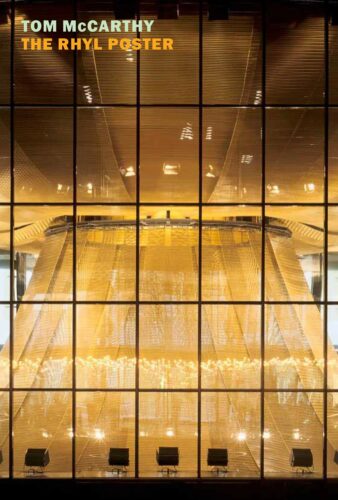 Benjamin Stanton is an orphan—“Who knows where he’s from?”—who develops into a man with a gift for making complex arguments comprehensible and, beyond that, for demonstrating through a cryptic form of writing/diagramming all his own that the arguments can not only be resolved but also that their resolutions can be made applicable in law. He is, therefore, a valuable employee at the Court of Justice of the European Union, a dazzling, futuristic edifice where his colleagues eagerly await each new demonstration of his brilliance.
But Stanton is also an addict. He takes a little blue pill—first once every couple of weeks, then every week, and eventually every day or more often. The pill provokes hallucinations that Stanton describes as “trickles” and that connect him to everything around him. Stanton receives the pills regularly from a man named Pirotti, who somehow knows that a wound Stanton suffered in Iraq still troubles him, and who has contrived to encounter the brilliant jurist so he can enlist his help in stealing files from the Court of Justice—files that are meant to be shredded but that will be passed on to a man named Mehrtens, whose concern seems to be “laying ground for what? Creation or destruction? Same process, right? Plan view, foundations, rubble, plan view…”
Part of the point of Tom McCarthy’s new novel seems to be complexity for its own sake. Ambiguity as ambience. Everywhere Stanton goes, he sees signs and indications of meanings he can’t quite figure out, even with the aid of the little blue pills that connect him with everything from colors and sounds to dreams of train rides and a message that will be plastered on a billboard if the workman with the brush and the paste ever finishes his cigarette break. What Stanton knows for certain is that, because of his “natural affinity for law’s halting progress, its incessant interruptions, recapitulations, looping catch-ups with its own past iterations,” he’s been sucked into a conspiracy perhaps designed to undermine or even destroy the process to which Stanton has long been devoted. Or maybe not. “Creation or destruction? Same process, right?”
McCarthy’s language is appropriate to the puzzling complexity of the novel’s various twists and turns. As Pirotti warns, “These are odd times. False rumour, misdirection, monsters and mirages everywhere.” In this novel there are few simple sentences. One noun will never do, and two are perhaps suspiciously inadequate. At one point Pirotti, who’s employed by an entity that may or may not have a physical presence, is described as embodying “an essential blind spot—a roaming one, located wherever he was, a peephole into a complex, secret realm; a peephole through which vision, the whole optic order, got diffracted and distorted, underwent anamorphosis.”
“Vision” won’t do. Call in “the whole optic order.” “Diffracted” is insufficient without “distorted”—and “anamorphosis.”
Sometimes Tom McCarthy’s adventures with language—and English isn’t the only one with which he dances—are splendidly entertaining. Often they are musical. Some readers will be delighted by those adventures. Some will become impatient.
Oddly enough, stripped of the aforementioned detours and cul-de-sacs, the central plot of The Rhyl Poster doesn’t feel especially complicated. In this respect, McCarthy’s novel differs from those of Thomas Pynchon, the writer he most seems to resemble here. Benjamin Stanton is a conspirator, though he never seems to be sure what the goal of the conspiracy in which he’s engaged might be. At some point Stanton decides to betray Pirotti and Mehrtens as well as his employer to create a document of his own that may become a “fountain from which new states of comprehension would, in time, leap forth, establishing the order that the age demanded,” though almost simultaneously he realizes that “this world really didn’t need him at its center to revolve.” Stanton leaves his plan for a more orderly universe with a couple of children playing a complicated, often violent video game, suggesting to them that they’ll understand one day. Then, apparently the victim of the equivalent of a “hot shot” via a new manifestation of the little blue pill, Stanton collapses, simultaneously imagining that the new beginning embodied in the truth he has to share with those who remain will appear on the billboard next to the train station in Rhyl—unless Rhyl is a place that exists only in his mind.
At one point late in the novel, Stanton, wearing headphones, is described as listening to the various translations of the arguments in a case at the European Court. The narrator says of Stanton that “he liked to…slide through the spectrum, switch between not only languages but also words, phrases whose content he understood and these same words’ and phrases’ transposition into a musical register of rhythms, patterns, cadences—a kind of aural shorthand that…sometimes forged connections sense alone couldn’t have made.”
Okay, Mr. McCarthy. I see you.
Bill Littlefield’s most recent books are Mercy (Black Rose Writing) and Who Taught That Mouse To Write? (Writing Mouse Press