Jazz Concert Review: Tuba Skinny Brings a Bit of Royal Street to Rockport
By Jon Garelick
An evening of obscure blues, early jazz, and New Orleans swing eventually overcame an absent vocalist, a substitute washboard player, and a concert-hall setting.
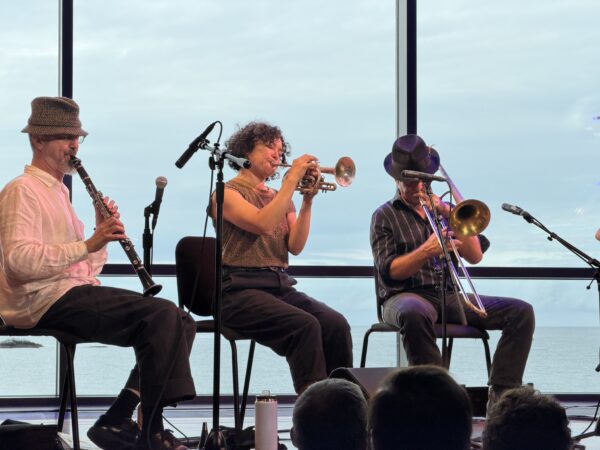
Tuba Skinny performing at Rockport Music’s Shalin Liu Performance Center. Photo: Jeff Turton
For a few moments at the beginning of Tuba Skinny’s Tuesday (Sept. 1) late set in Rockport, I was uncharacteristically downcast. This is my favorite working band, and I had looked forward to this show all summer. One of the band’s two superb vocalists, Erika Lewis, was not in the lineup. Usually I’m OK with that — Lewis several years ago decamped from Tuba Skinny’s hometown of New Orleans and now appears only occasionally with the band. But this annual Northeast summer tour is usually one of those occasions (as is the high-profile, good-money New Orleans Jazz & Heritage Festival).
Aside from her beautiful sweet-and-sour blues singing, Lewis also fills out the bottom end by thumping a bass drum she sits atop throughout the set.
OK, no Erika. I could deal. I’m always happy to hear guitarist Gregory Sherman’s vocal numbers. But it also turned out that Robin Rapuzzi, the band’s washboard player (and one of its founding members) was off the tour in favor of a sub. As a co-emcee (along with leader and cornet player Shaye Cohn), Rapuzzi is a no-bullshit charmer, and his washboard playing can change any preconceptions you might have had about this jug band staple. Rapuzzi plays it at the level of a top-flight percussionist, with fast flying hands and beat-splintering syncopations. He’s explosive.
The set opened with the band’s usual aplomb and keen song choices: Clarence Williams’s buoyant “Them Things Got Me” (c. 1929) and then Bo Carter’s “Nobody’s Business” (c. 1931-34), the latter sung by Sherman with his typical lived-in idiomatic slouch. Then came Duke Ellington’s “Take It Easy” (1928), beautifully played, illuminating all of Ellington’s reflective surfaces and taken airborne by Cohn’s articulate use of a straight mute. (She had said before playing it that Ellington’s trumpet man of the era, Bubber Miley, was a personal hero.)
The scholarly crate-digger knowledge shows up all over Tuba Skinny’s sets, in bandstand annotations along with song choices — Sherman introduced “Nobody’s Business” (not to be confused with the more famous Billie Holiday song) by saying that Carter was a cousin of Charley Patton and “a sometime member of the Mississippi Sheiks.” You could look it up.
By the time the band got to “Some Sweet Day” (1938), by Frankie “Halfpint” Jaxon, things began to gel, at least for me. Credit Sherman’s relaxed lean into the slow melody, or the easy-going, dreamy section for sousaphone, guitar, banjo, and washboard. I was being drawn back under Tuba Skinny’s spell. By the time the band started playing their originals (“Nigel’s Dream” by Cohn and the deathless “Chalmette Sunsets” by trombonist Barnabus Jones), I was gone. Louis Armstrong’s “Perdido Street Blues” (introduced with Cohn urging the crowd to check out the Hot 5 recordings) gave clarinetist Craig Flory a chance to fly on the Johnny Dodds part, with a heady glissando over nifty stop times, and a jubilant out-chorus.
There were other pieces that encouraged crate digging of my own: “Echo in the Dark” (1937) by the St. Louis Crackjacks; “Still Got California on My Mind” by Tampa Red (c. 1934-36, another astute Sherman vocal); Jabbo Smith’s “Ready Hokum” (super-fast with stop times for washboard); New Orleans R&B hero Smiley Lewis’s “Jailbird”; “Baby, How Can It Be” by the aforementioned Mississippi Sheiks; and Flory’s super-fast “Proximity Effect.”
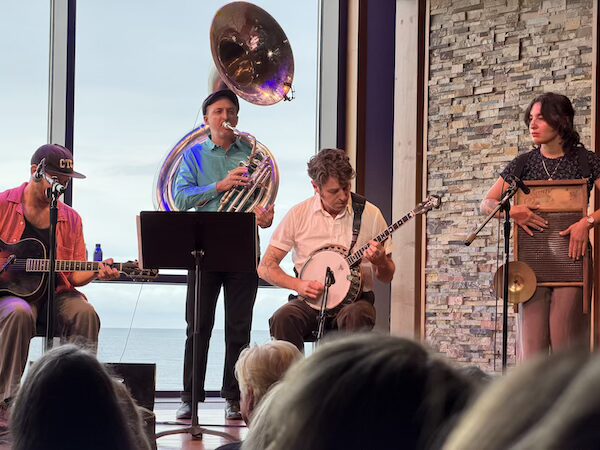
Tuba Skinny performing at Rockport Music’s Shalin Liu Performance Center. Photo: Jeff Turton
Cohn encouraged people to dance for Jelly Roll Morton’s joyous “Kansas City Stomp” (1923), but allowed that the raked seating floor could make it tricky. No one took her up on the challenge.
Maybe that was another reason it took me a while to warm up to the set. This is a band that was born busking on Royal Street and still plays beer joints and clubs for swing dancers. Even their sets at the August JazzFest take place in a big, open, sweaty tent.
This was the band’s fifth time playing at Rockport Music’s home venue, the Shalin Liu Performance Center. There had been a 5 p.m. show as well. Two shows means there’s a demand. And the Shalin Liu performance space is positively gorgeous, with angled wood paneling and a giant picture window behind the bandstand that overlooks Rockport Harbor. With 330 seats (including the balcony), it’s a surprisingly intimate small theater. And the sound is impeccable. It’s weird to think of a beautiful venue as a handicap. Maybe I needed time to adjust to its understated opulence.
But I got over it. Dizzy Incirlioglu, subbing for Rapuzzi, fired off adept rubboard breaks that got the crowd roaring on cue, and Sherman’s vocals never tire. Meanwhile, tenor banjo player Max Bien Kahn ripped propulsive chording and single-note phrases, sousaphone player Todd Burdick complemented his bass notes with upper register melodic derring-do, and Cohn’s cornet playing remains a thing of wonder: full-toned, beautiful lines. The critic Whitney Balliett once wrote that a lot of what goes into reviewing a live jazz show depends on “mood, digestion, and the fit of one’s shoes.” By the end of Tuba Skinny’s set I was in more than a good mood — I was elated.
Jon Garelick was an arts editor at The Boston Phoenix and is a retired staff member of the Boston Globe Opinion pages. He can be reached at [email protected].
Tagged: Barnabus Jones, Craig Flory, Dizzy Incirlioglu, Gregory Sherman, Max Biehn-Kahn, Todd Burdick