Film Review: “Virginia Woolf’s Night and Day” — Sexism and the Stars
By Peg Aloi
This lush, beautifully acted adaptation follows a young woman’s struggle to pursue astronomy—and defy the sexist conventions of Edwardian England.
Virginia Woolf’s Night and Day, directed by Tina Gharavi. Screening at AMC Liberty Tree Mall 20, Danvers, and Regal Independence Mall & RPX, Kingston, RI
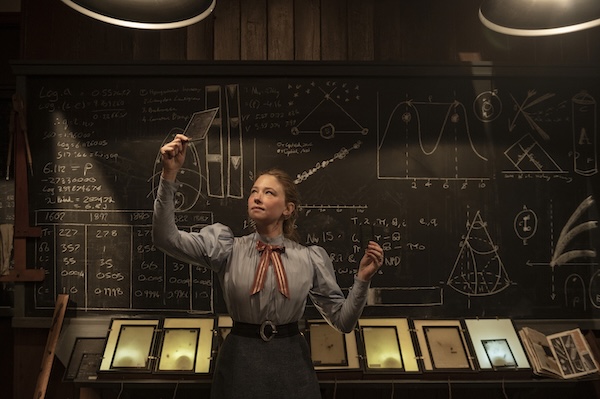
Haley Bennett in Virginia Woolf’s Night and Day. Photo: Vue Lumière/WestEnd Films
Adapting Virginia Woolf to the silver screen is no mean feat. Sally Potter’s iconic, genre-transcending Orlando (1992) starring Tilda Swinton surely stands out; Mrs. Dalloway (1997) directed by Marleen Gorris (Antonia’s Line) felt like a rigid costume drama to me. Stephen Daldry’s The Hours (adapted from David Hare’s stage play) looks at Woolf through the lives of several more contemporary characters who struggle with artistic expression and social norms: themes that Woolf’s famed essay “A Room of One’s Own” set forth in stark and personal terms.
Set in 1900, Virginia Woolf’s Night and Day is a lush and thoughtful exploration of a young woman’s struggle to pursue her dreams of being an astronomer in a world that doesn’t want women anywhere near a telescope. First-time screenwriter Justine Waddell appears to take some liberties with Woolf’s novel, highlighting one main character instead of the four who were originally featured. This appears to be a solid cinematic choice, however: Katherine “Kit” Hilbery (Haley Bennet, so excellent in 2020’s Swallow and 2022’s Cyrano) is a complex and sympathetic protagonist. The enchanting opening scene finds 28-year-old Kit swimming outdoors at night, looking up at the stars. When she sneaks back indoors, into her parents’ grand country manor, she drops her small spyglass. She has to lean perilously over her their bedroom window in order to retrieve it. She overhears her strict father (Timothy Spall) refer to her as a “spinster,” followed by her mother (Jennifer Saunders)’s gentle protestation.
Despite her upper class existence, Kit has no ambition to marry or to live a life of leisure. Instead, she has been working on a scholarly thesis about stars and the size of the known universe. Mapping the unknowable reaches of the cosmos is a fitting metaphor as Kit yearns to live a life beyond society’s genteel expectations. Social mores are slowly changing, and women’s suffrage efforts are on the rise. Regardless, Kit’s desire to study at Cambridge is thwarted by the university’s refusal to admit women. The men in Kit’s life reflect the patriarchal, aristocratic norms of the time: ironically, in just over a decade, the First World War would create an urgent need for women to perform work traditionally done by men. Kit’s maternal grandfather was an esteemed poet and her mother has been working on a biography about him for over a decade. Kit’s father disapproves of Kit’s studies and, in a fit of anger, willfully sabotages them. Her parents convince Kit’s childhood friend William (Jack Whitehall in a delightful performance) to propose marriage. She refuses, though she assures him of her friendship.
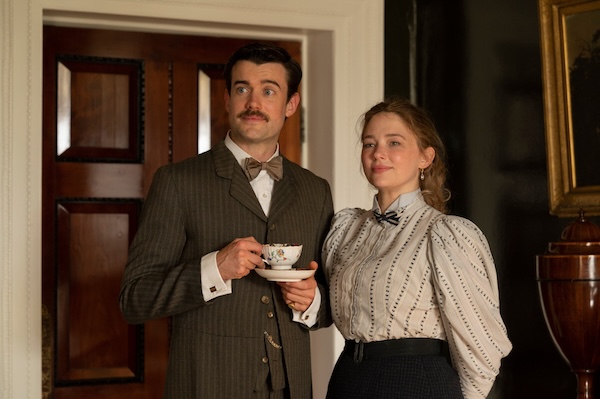
Haley Bennett and Jack Whitehall in Virginia Woolf’s Night and Day. Photo: Vue Lumière/WestEnd Films
At a history lecture, Kit meets an intriguing man, Ralph (Elyas M’Barek), who seems smitten with her intellect. Sparks crackle between them, but as she leaves the hall with William, she goads him to propose again so she can accept. Kit’s cousin Cyril (Misia Butler), himself a social rebel, gently disapproves of her decision to marry and encourages her to follow her dreams. Meanwhile, Kit vows to find ways to continue her work, and Cyril introduces her to Mary Dabret (Lily Allen), a firebrand working at a printing press with a number of other women, secretly creating pamphlets promoting women’s rights and suffrage.
Donning men’s clothing, Kit accompanies Cyril to a meeting of the men-only astronomy club, where the vote to admit women is overwhelmingly defeated, despite Cyril’s passionate speech urging the men to look toward the future. Determined to find a way forward, Kit applies to study at Cambridge. She refers to herself on paper as “Mr. Kit Hilbery,” not expecting a response. But Cyril’s recommendation prompts Cambridge to request an interview. Again and again, Kit is thwarted by the stupid sexist bigotry that rules the world, and when tragedy strikes, her unstoppable brilliance is subdued. And though it feels a bit conventional for a story by Virginia Woolf, there is a sense that the indomitable Kit will persevere and seize her future, even as the specter of war hovers in the distance.
Overall, this is a very solidly produced effort. I loved the unexpectedly intimate cinematography by Sebastian Edschmid (Black Death); the production design by David Hindle (The King’s Speech) is exquisite. Though Simon Goff’s orchestral score is very good, the choice to add contemporary songs to the soundtrack didn’t work for me — it felt jarringly anachronistic. This kind of choice can be thrilling when it succeeds, but it felt forced in this instance. Nevertheless, this beautifully acted film features a stellar cast and is confidently guided by Tina Gharavi, who has an intriguing, eclectic bio: her Iranian film I Am Nasrine (2012) was nominated for a BAFTA; her striking Netflix docuseries, Queen Cleopatra, has garnered critical acclaim. She’s currently working on a Swedish lesbian horror film called Häxan (whoa, bring it on!) and a new French-Icelandic TV series. I look forward to even stronger creative accomplishments from this promising filmmaker.
Peg Aloi is a former film critic for the Boston Phoenix and member of the Boston Society of Film Critics, the Critics Choice Awards, and the Alliance for Women Film Journalists. She taught film studies in Boston for over a decade. She has written on film, TV, and culture for web publications like Time, Vice, Polygon, Bustle, Dread Central, Mic, Orlando Weekly, Refinery29, and Bloody Disgusting. Her blog “The Witching Hour” can be found on substack.