Film Reviews — Dispatch from the Provincetown International Film Festival 2026
By Tim Jackson
At this year’s festival, films by Greg Araki and others explore erotic power, artistic identity, and spiritual unease—alongside a quietly inspiring portrait of painter Anne Packard.
The Provincetown International Film Festival is one of the friendliest in New England, encouraging a looseness and camaraderie that taps into the town’s status as an artist and LGBTQ mecca. Hunky Jesus, Maddie’s Secret, and the marvelous Mary Oliver: Saved by the Beauty of the World (for the PBS series American Masters) are worth seeking out. To my surprise, all the films I comment on below can be seen in theaters. One, Power Ballad, is already in release. The fourth film, Ann Packard: An Artist’s Resolve, is making the rounds of other New England Festivals.
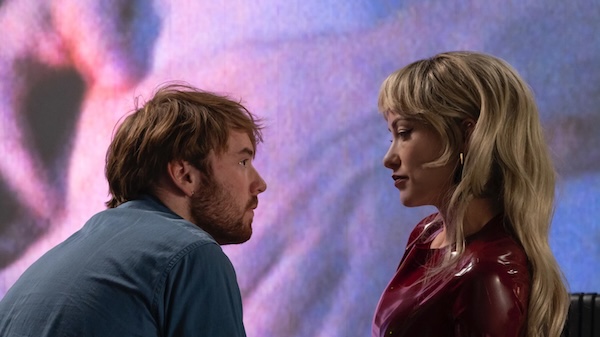
Cooper Hoffman and Olivia Wilde in I Want Your Sex. Photo: Lacey Terrell
The first two films I saw at the Provincetown Film Festival — I Want Your Sex (opening July 31) and Power Ballad — take compelling premises and push them to comic extremes. The over-the-top sensibility of Greg Araki’s I Want Your Sex is to be expected from a director who has been tweaking the system for decades with gay comedies, marginalized characters, and explorations of liberation. His films can be popular, as in the black comedy The Doom Generation (1997), or push boundaries, as in Mysterious Skin (2004). Some have achieved cult status, such as Nowhere (1997); others blend genres in unexpected ways, like the overlooked White Bird in a Blizzard (2014). Across his 15 features, Araki has consistently taken risks, securing a solid reputation as a pioneer of queer and transgressive cinema. He remains committed to pushing boundaries, embracing excess, and exploring the space where fantasy, desire, and satire collide. His latest effort is no exception. Now that sexual mores have loosened and polymorphous desire is practically mainstream, I Want Your Sex may be his most commercially accessible work.
Cooper Hoffman (now well beyond his “nepo” status) plays Eliot, a schlubby 21-year-old in a passionless relationship. He applies for a job as an assistant to a gallery owner and artist named Erika, played by Olivia Wilde. The first assignment for all of her interns is to complete an artwork: a vagina made from their freshly chewed gum pressed onto canvas. This parody of feminist conceptual art is only the beginning of Erika’s sexual gamesmanship. Adorned in various slinky, peekaboo fashions, she alternately tempts and humiliates her new hire as she grooms him for a special role — her sexual submissive. Back at his apartment, his partner Minerva, a student, has little time or desire for sexual antics. This new arrangement at work appears to light up both Eliot’s life and his loins.
The setup is a nifty reversal of the usual Fifty Shades-style premise of willing female submission. And Araki also offers amusing nods to similar films. I Want Your Sex opens with Eliot discovering Erika’s nude body, presumably dead, floating in a swimming pool. The shot from below echoes the famous opening scene of Sunset Boulevard, in which, via flashback narration, William Holden’s character begins to describe how he became subservient to Gloria Swanson’s Norma Desmond. Here, too, the narrative unfolds in flashback: Eliot is questioned about the incident in the pool by two detectives. Later, a title card reading “9½ Weeks Later” slyly references the 1986 Mickey Rourke-Kim Basinger film of erotic obsession (and vegetables).
The ensemble is excellent. Wilde is icy, seductive, and electric. Araki has described Apple, Eliot’s best friend (played by Chase Sui Wonders), as “an absolute sex freak,” but the performer infuses the character with a vulnerability that grounds the film whenever it begins to veer off the rails. Singer Charli XCX, as Minerva, is delightful as Eliot’s sexually bored girlfriend. Eliot’s woeful tale is recounted to two detectives, played by Margaret Cho and Johnny Knoxville. The talented ensemble helps turn the film’s unlikely sexual antics into a dry, delightfully offbeat erotic comedy.
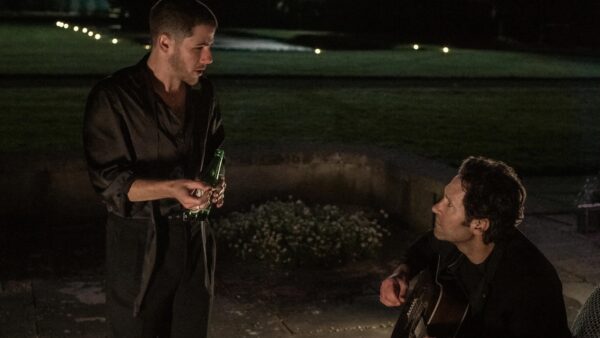
Nick Jonas (left) and Paul Rudd in Power Ballad. Photo: courtesy of Dublin International Film Festival
In Power Ballad, Paul Rudd plays Rick Power, a former rock star now fronting a Dublin wedding band. Director John Carney, whose previous music-centered films include Once and Sing Street, has displays a keen feel for the humor and melancholy in the predicament of a once-famous musician who has been reduced to covering other people’s hits at weddings. Except for the fact that the band is almost too good, the arguments, attitude, and bunk-room accommodations ring with authenticity.
One night, former boy-band celebrity Danny Wilson, played by real-life pop star Nick Jonas, sits in with the group, much to the delight of a wedding crowd. Afterward, Rick stumbles into Danny’s considerably swankier accommodations: the two spend the night drinking, smoking pot, swapping songs, and writing riffs. These scenes feel genuinely lived in.
I wish the film had remained that realistic, but credibility eventually gives way to wish-fulfillment comedy. Back in Los Angeles, Danny can’t seem to write a hit song. His manager warns him that he risks becoming known as the former boy-band star who sat in with an Irish wedding band on TikTok. Then comes the slick premise: Danny appropriates a song Rick wrote during that drunken night, and it becomes a global smash hit. When Rick hears the song blaring over the speakers at a local mall, he explodes with frustrated anger. He has no proof he wrote the song — and no one believes his claim that he did. Rick’s obsession culminates in a fight when he refuses to perform the song at a wedding. The band kicks him out, and, with his wife and daughter tired of hearing about “his song,” he packs his bags and leaves.
Rudd remains a relaxed, and appealing, screen presence, while Jonas succeeds at playing a variation on himself. Power Ballad is an entertaining night at the movies: it appears headed toward a predictable conclusion, but ends up taking several rewarding turns.
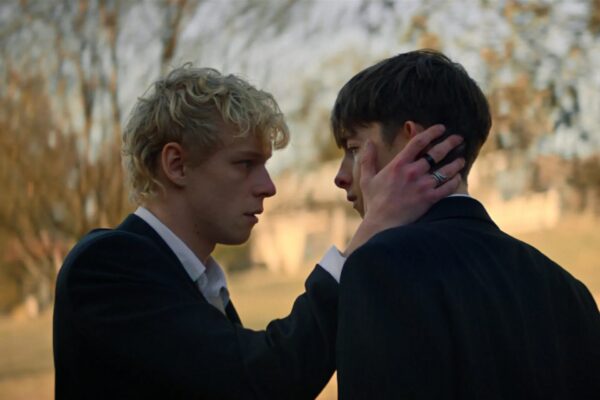
A scene from Leviticus. Photo: Neon
“I am the Lord your God; consecrate yourselves and be holy, because I am holy. Do not make yourselves unclean by any creature that moves along the ground.” —Leviticus 11:44
According to the Book of Leviticus, there is a prescribed way to live in God’s holy presence. One path is to confess one’s sins and offer an animal sacrifice, acknowledging the evil those sins have brought into the world. The death of the animal serves as atonement and demonstrates God’s forgiveness and grace. The Australian horror film Leviticus (opening at Coolidge Corner Theatre on June 19) places this ritual within the realm of psychological and supernatural terror. Here, homosexuality is treated as the “sin,” with sacrifice taking the form of oneself — or one’s demonic double.
Naim (Joe Bird) is wrestling with Ryan (Stacy Clausen), a classmate from church, when their roughhousing unexpectedly turns into an erotic embrace that is witnessed. In their rigid fundamentalist community, such desires are condemned. Complicating matters further, Ryan is also secretly involved with the pastor’s son, making the tussle part of a volatile mix of jealousy, shame, and guilt. The pastor brings the boys to a deliverance healer, and what follows is an occult ceremony intended to purge their desires. Instead, those desires take on a monstrous form. The object of one’s longing begins to reappear as a shapeshifting double — an evil entity that blurs the line between demon and human. Determining which it is becomes a bloody exercise in horror. The boys attempt to separate themselves from these manifestations, but their yearning proves impossible to exorcise — the situation spirals out of control. Mia Wasikowska, best known for playing Alice in Tim Burton’s Alice in Wonderland, plays Naim’s mother. The character cloaks her disapproval of her son’s sexuality behind a gentle smile, making her rejection all the more unsettling and deepening the surrounding atmosphere of guilt.
There is value in using the horror genre to explore the conflicting emotions, internalized shame, and social stigma surrounding same-sex love, particularly within a religious context. Still, the frequent extended, static close-ups of faces struck me as tedious rather than immersive. The film also relies on familiar jump scares and “gotcha” moments.
Like the recent hits Backrooms and Obsession, Leviticus harnesses the enduring popularity of horror to engage contemporary Gen Z anxieties and concerns. Its greatest strength lies in its exploration of identity, desire, and belonging.
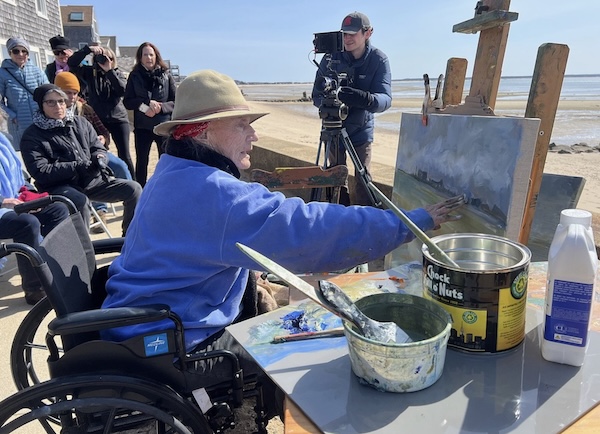
A scene from Anne Packard: An Artist’s Resolve. Photo: Provincetown International Film Festival
Anne Packard: An Artist’s Resolve, screening July 26 at the Woods Hole Film Festival, is much more than a portrait of a local artist. At 92, Packard — who launched her own gallery after achieving success later in life — embodies a spirit of resilience forged through years of struggle and loss.
Impressionist painter and director Arthur Egeli engages Packard in conversations that move among personal stories, meditations on life, and reflections on her luminous Provincetown landscapes. Egeli shoots with an artist’s sensibility, speaking not only with Packard but also with her friends, neighbors, and grown children. The impending closure of Packard’s gallery on Commercial Street — a sacred space for her work for many years — hovers over the film, leading to a surprising turn near the end.
Packard is a compelling figure, direct and unsentimental when describing a life marked by hardship. Today, she gets around in a wheelchair, having lost part of her leg to circulation problems. She had a stair lift installed so she could reach her second-floor studio; when it fails, we watch her descend on her butt, one step at a time. One of her sons disappeared while hiking in the American West with his girlfriend, a tragedy that left an indelible mark on her character and strengthened her stoicism. She says she has been unable to cry since the loss. In response, she used his uncashed traveler’s checks to buy a boat for her remaining son, an avid fisherman, helping to launch his career.
Abandoned by her husband and largely unrecognized as an artist until later in life, Packard persevered while raising three daughters. A 1981 photograph by Provincetown resident Joel Meyerowitz, The Packard Family, pictures a younger Anne with her daughters — one of them bare-breasted — in an image evocative of the town’s freer, bohemian life.
Packard once rented a house to Roy Cohn, who attempted to pressure her into selling the property; he died before he could pursue the matter further. Another neighbor, painter Robert Motherwell, began buying her paintings, which she displayed on her fence. He told her he could make her famous but later refused when she asked him to write a few lines about her work. “I realized I had crossed a line,” Packard recalls. “There is an invisible line with famous people. They decide what the rules are, and you don’t ask.” Motherwell never spoke to her again.
The film is filled with similarly memorable anecdotes. Given the many artists who have lived and continue to reside in the seaside colony, Provincetown itself becomes a character in the documentary. The gentle score by Bulgarian composer Mario Grigorov never tips into sentimentality. I walked away from the screening inspired by a life devoted not to wealth or recognition, but to the quieter, sustaining rewards of living authentically and making art on one’s own terms.
Tim Jackson was an assistant professor of Digital Film and Video for 20 years. His music career in Boston began in the 1970s and includes some 20 groups, recordings, national and international tours, and contributions to film soundtracks. He studied theater and English as an undergraduate, and has also worked helter-skelter as an actor and member of SAG and AFTRA since the 1980s. He has directed four feature documentaries: Chaos and Order: Making American Theater, which is about the American Repertory Theater; Radical Jesters, which profiles the practices of 11 interventionist artists and agit-prop performance groups; When Things Go Wrong: The Robin Lane Story, and Marblehead Morning: Daring & Stahl: 50 Years in Harmony. He has made two short films as well: Joan Walsh Anglund: Life in Story and Poem and The American Gurner. He is a member of the Boston Society of Film Critics. You can read more of his work on his substack.
Tagged: "Ann Packard: An Artist's Resolve", "I Want Your Sex", "Leviticus", "Power Ballad", Arthur Egeli, Cooper Hoffman, Nick Jonas, Olivia Wilde, Paul Rudd