Book Review: “Summer of Freedom” — History Lit by Flashbulb
By Thomas Connolly
Oliver Hilmes’s Summer of Freedom offers vivid snapshots of 1945 — but little sense of why the world changed.
Summer of Freedom: How 1945 Changed the World by Oliver Hilmes (translated by Jefferson Chase). Other Press, 272 pages, $29
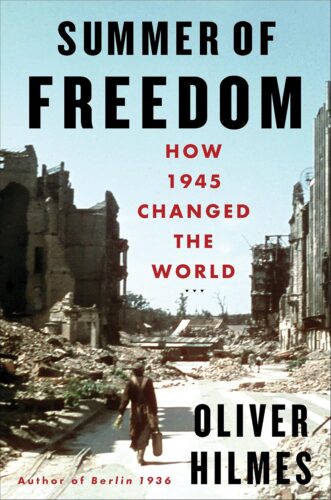
If it weren’t for the title’s overreach, this would be a fine little book to spend a few hours with. Unfortunately, Oliver Hilmes does nothing to explore how the defeat of Nazi Germany, the founding of the United Nations, or America’s dropping of atomic bombs changed the world. Instead, he offers telling snapshots of the people who lived through these events. A book like this is rather like a special issue of the old LIFE magazine — without the photos.
We glimpse Thomas Mann enjoying a “hearty breakfast”; Alma Mahler-Werfel, on the other hand, prefers liquid lunches. Harry Truman moves into a rickety White House and then takes up residence in a sparsely furnished Schloss during the Potsdam Conference. Strangely left unmoored by the Allies’ triumph, Churchill fails to consult his notes before the conference and comes off as befuddled. He’s replaced by the drab Clement Attlee after Labour wins the British election. Stalin insists that the Soviet Union celebrate V-E Day later than the rest of the world, and then has to deal with the terrible weather that mars his personal victory celebration (even back then, potentates couldn’t stop the rain).
Hilmes also goes into how selected victims of the war lived their days and nights, but his approach to these portraits of the high and low is fitful, a succession of fragmented glimpses. Some figures are given recurring narratives; others are mentioned only once. The book’s structure is strictly chronological, emphasizing rote order over a unifying argument. Microhistorical successes such as Frederic Morton’s matchless A Nervous Splendor are more than an assemblage of looks at the celebrated and the obscure. These books advance a guiding thesis that infuses coherence into their collection of vignettes. By contrast, Hilmes provides little sustained commentary or interpretive insight that connects events in a meaningful way. Confining the narrative to a timeline allows the writer to sidestep probing just how the world changed.
That said, Summer of Freedom is a brisk read and hard to put down. At his best, Hilmes puts his readers in a jeep and drives them through Berlin’s rubble to wave at the Trümmerfrauen as they work to clean up the city, one brick at a time. He quotes the marriage statistics for 1945 and notes that Eva Hitler (“née Braun,” as he takes pains to inform us twice) was one of the brides in April, when the marriage rate was low; soon after, however, the rate increased. In that sense, he successfully taps into how the catastrophe of war can make for a gripping story. And you might learn something. But his account only asks “what” and “who” — it shies away from “why.” Hilmes seems to assume that he has done his job by just presenting events and factoids drawn from April through August 1945.
Hilmes shows us the sets, not the actual political/personal dramas taking place on them. The furnishings of the Potsdam palace are described, but there’s barely any discussion of how the Conference abandoned the principles of the Atlantic Charter, which signaled the end of idealism and the ascendance of nationalist realpolitik. And there are disturbing lacunae along the way. He records German reactions to the raping and pillaging by the Russians, and how they blamed the British and Americans for committing the same horrible crimes. He also reports German remarks that the Russians had been enraged by what the Germans had done to their country, so, in their case, the violence against civilians is understandable. This bit of oblique commentary is superficial and disturbing. Hilmes shares some gruesome details of what the atomic bomb did to various residents of Hiroshima, and he trots out Robert Oppenheimer’s much-used quotation from the Bhagavad-Gita. But he includes no serious consideration of the moral, ethical, or even tactical questions raised by America’s decision to drop the bomb.
Given that there are enough World War II memoirs and eyewitness accounts to fill libraries, this entertaining-enough volume merits no more than cursory attention. It is history illuminated by flashbulb.
Tom Connolly is Professor Emeritus of Humanities and Social Sciences at Prince Mohammad Bin Fahd University. He recently edited a historical study (in English) of the 19th- and 20th-century Jewish community of Döbling for the Österreichischen Akademie der Wissenschaften, Institut für Kulturwissenschaften. His book Goodbye, Good Ol’ USA: What America Lost in World War II: The Movies, The Home Front and Postwar Culture is forthcoming from Houghton Mifflin/PMU Press.
Tagged: "Summer of Freedom: How 1945 Changed the World", Oliver Hilmes