Television Review: “Lord of the Flies” — A Savage Island, Revisited
By Sarah Osman
A remarkable young cast anchors Netflix’s Lord of the Flies, a haunting adaptation that resonates sharply with today’s anxieties about masculinity and violence.
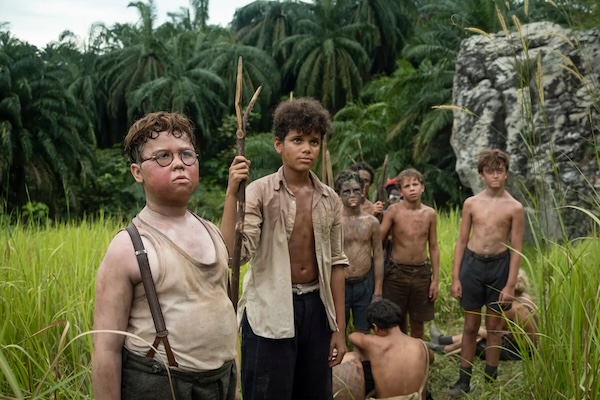
David McKenna as Piggy, left, and Winston Sawyers as Ralph, center, in Jack Thorne’s Lord of The Flies. Photo: J Redza/Eleven/Sony Pictures Television
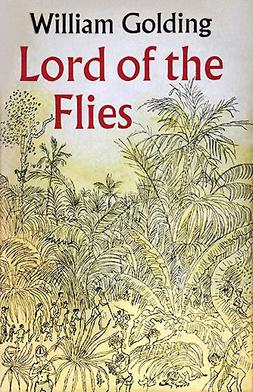
It’s been years since I’ve read William Golding’s haunting novel, Lord of the Flies. But unlike some of the other assigned “classics” in high school, it has stayed with me. I still get sad thinking about poor Piggy. And, despite being published in the Cold War era of the 1950s, the novel’s reflections on war, toxic masculinity, and society’s degradation into chaos feel more apt today than ever before.
Perhaps it’s those uncomfortably resonant themes that inspired British writer Jack Thorne to adapt Lord of the Flies for television. Directed by Marc Munden, the four-part Netflix series closely follows the novel’s trajectory, with a few flashbacks thrown in. Each episode focuses on one of the four main characters — Piggy, Jack, Simon, and Ralph — delving into their backstories and probing what makes them tick.
What drew me into this new adaptation was the young actors. For most of them, this is their first acting role, and the caliber of their performances is astonishing. David McKenna is especially impressive as nerdy Piggy, the one boy who tries to assemble some sort of order amid the adolescent urge for disorder. McKenna telling bedtime stories to the “young’uns” (as the younger boys are called) is especially moving. In the novel, Piggy can be a little annoying, but McKenna softens the character, delivering a performance of heartbreaking sympathy. Lox Pratt is suitably menacing as Jack, the antagonist who wreaks havoc and refuses to adhere to any sense of reason. Still, Pratt manages to make Jack somewhat sympathetic, especially in a scene where he cries after being told off by Ralph. It’s a harsh reminder that these are indeed lost children who desperately need help.
 One of the interesting additions to the series is the use of flashbacks for the four main characters. These are artfully done and integrated naturally into the narrative — they do not feel shoehorned in. In the original novel, we don’t know a lot about the boys, but we presume they come from wealthy, “civilized” backgrounds. Here, we learn about their families and their time spent at school, which helps to flesh out who they are and why they behave as they do.
One aspect of the adaptation that gave me pause was some of the filmmaker’s choices. The visuals are absolutely stunning. I checked where the series was shot (Malaysia) because I plan to visit someday. Lingering shots of the island’s beauty serve as a forceful contrast to the senseless brutality the boys subject each other to.
Still, some odd choices crop up from time to time. In the first episode, a fish-eye lens is used to suggest Piggy’s disorientation when he wakes up on the island. In this case, the fish-eye lens makes narrative sense. But it reappears at random, and this eventually becomes downright distracting. Also, as the narrative progresses, the look of the island morphs from vibrant green flora to a background of scarlet and gray trees. We know the boys are descending into madness by their actions; there’s no need to underline that shift through increasingly conspicuous cinematography. This comes off as ham-fisted in a powerful series that has no need for such gimmicks.
This adaptation of Lord of the Flies feels as if it were written in conversation with last year’s British drama, Adolescence. Both series examine similar terrain, speaking to the dangers engendered by toxic masculinity and how that toxin infiltrates the minds of young boys. (It’s alarming to see how their diagnoses align.) Netflix’s Lord of the Flies offers a graceful testament to the disturbing resonance of Golding’s tragic fable.
Sarah Mina Osman is based in Los Angeles. In addition to The Arts Fuse, her writing can be found in The Huffington Post, Success Magazine, Matador Network, HelloGiggles, Business Insider, and WatchMojo. She has an MFA in Creative Writing from the University of North Carolina Wilmington and is working on her first novel. She has a deep appreciation for sloths and tacos. You can keep up with her on Instagram @SarahMinaOsman and at Bluesky @sarahminaosman.bsky.social.
Tagged: "Lord of the Flies", David McKenna, Ike Talbut, Jack Thorne, Lox Pratt, William Golding