Visual Arts Review: Tracey Emin, Organized
By Margherita Artoni
Today, Tracey Emin occupies a singular place in contemporary art, where autobiography, confession, and institutional framing converge within a shared system of visibility.
Tracey Emin: A Second Life. Texts by Tate Modern and contributors. Tate Publishing, 2026.
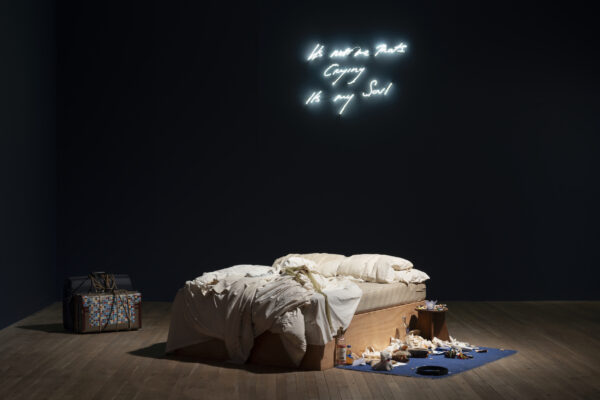
Tracey Emin, A Second Life, Tate Modern installation view with My Bed, 1998 and It’s Not Me That’s Crying Its My Soul, 2001. Photo © Tate (Jai Monaghan)
The Tate Modern retrospective Tracey Emin: A Second Life and the Tate Publishing catalogue that accompanies it, does not simply revisit a career. The exhibit and book reorganizes it into a clear and carefully shaped story of exposure. What once appeared as rupture — confession, bodily excess, autobiographical volatility — is here reconfigured as continuity. Instability is not resolved but structured. Life is translated into a readable form, where subjectivity is continuously produced through its own exhibition.
Yet this readability should not be mistaken for transparency. The confession at work here does not reveal a pre-existing subject; it helps construct one in real time. Subjectivity is not simply expressed through exposure, but it is shaped in advance by how it will be seen and understood. In this sense, what appears as autobiographical disclosure is already a managed condition of legibility.
A triadic structure — autobiography, confession, bodily inscription — underpins this system. Confession no longer functions as revelation but as a way of generating identity: subjectivity emerges in the act of speaking and is stabilized through display. The exhibition follows a recognizable sequence — trauma, crisis, illness, recovery, and the declaration of a “second life” — but this sequence should not be taken as straightforward truth. It is a curatorial framework that organizes experience into a compelling narrative. Fragmentation is not preserved, but shaped into biography.
This logic finds its most cited material anchor in My Bed, where domestic residue — sheets, clothing, bodily traces, everyday objects — appears as a sedimentation of lived experience. But what is at stake here is not simply the transformation of the everyday into an archive. Something in My Bed resists full conversion into meaning. Beneath the archival surface, there persists a material remainder that does not settle into story or symbol. It is precisely this excess — not easily readable as confession — that complicates the work’s apparent transparency. The bed does not only record life; it disrupts any neat attempt to turn that life into narrative.
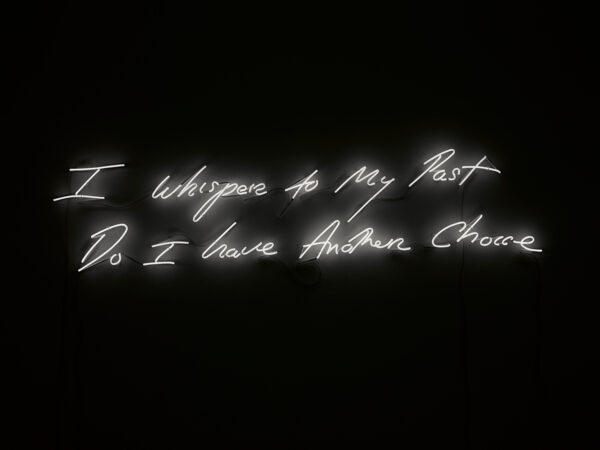
Tracey Emin, I Whisper to My Past Do I Have Another Choice, 2010 © Tracey Emin. All rights reserved, DACS 2026
From a semiotic perspective, the distinction between index and symbol begins to collapse. In plainer terms, what looks like a direct trace of life has also been shaped into something meant to be read and interpreted. The object no longer simply points to life; it circulates as evidence within an exhibition. This shift extends into language and image. In I Whisper to My Past Do I Have Another Choice, a neon work, emotional address becomes a temporal structure: language and image converge in a circuit where feeling is produced through looking back. The past is no longer memory but an active presence. Subjectivity emerges as something addressed and re-addressed, rather than something stable and internal.
In I Never Asked to Fall in Love – You Made Me Feel Like This, emotion is framed as cause and effect. The statement presents feeling as the direct result of another’s action. Language here does not simply describe emotion; it organizes it. The “I” shifts within this structure, suggesting that identity itself is shaped through expression. Confession becomes a material form rather than just personal revelation.
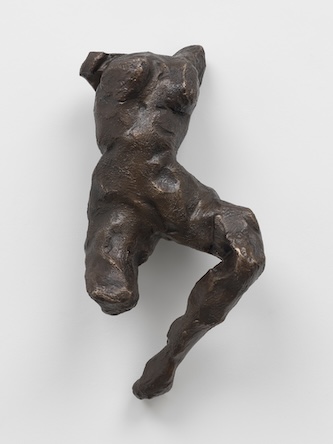
Tracey Emin, Ascension, 2024 © Tracey Emin. All rights reserved, DACS 2026
The feminine imaginary runs throughout the exhibition, but it is not presented as a fixed identity — it is repeatedly constructed. The body appears as a surface continuously rewritten by biography, emotion, and cultural expectations. Autobiography and representation begin to blur, making lived experience and its artistic framing hard to separate. Femininity thus operates less as a matter of identity than as a way of making certain experiences — pain, desire, vulnerability — visible and legible to others.
This logic connects Emin’s work to a broader artistic field. Bruce Nauman exposed how language can shape and control the body. Cindy Sherman dismantled identity through staged images. Marina Abramović pushed physical endurance to reveal the limits of performance and institutional framing. In each case, subjectivity is unsettled. In Emin’s work, however, that instability is no longer outside the system — it is built into it. What once felt like rupture now circulates as part of the artwork’s appeal.
The catalogue makes this shift especially clear. Fragmentation is no longer disruptive but organized. Traces of life, trauma, and material accumulation are arranged into continuity. What emerges is not an archive of rupture, but a carefully edited sequence. Intimacy survives, but only in structured form. Subjectivity becomes material for exhibition.
Foucault’s idea that confession produces the subject is still relevant but, in Emin’s case, the process has been taken further. The subject is not only generated through confession, but shaped in advance by the conditions of its display. Julia Kristeva’s notion of abjection is also shifted: what once disturbed or unsettled is now completely absorbed into an aesthetic surface. Emotion remains, but as controlled intensity.
Critic Hal Foster’s writing on the archive helps clarify this dynamic. Contemporary institutions do not eliminate fragmentation; they organize it. The catalogue follows this logic, arranging images, objects, and texts into a readable sequence. Giorgio Agamben’s idea of “bare life” — life exposed — still applies, but here exposure does not serve as a limit; it is the very structure of the exhibition. Writing itself becomes a way of organizing time and experience into something that can be seen and understood at a glance.
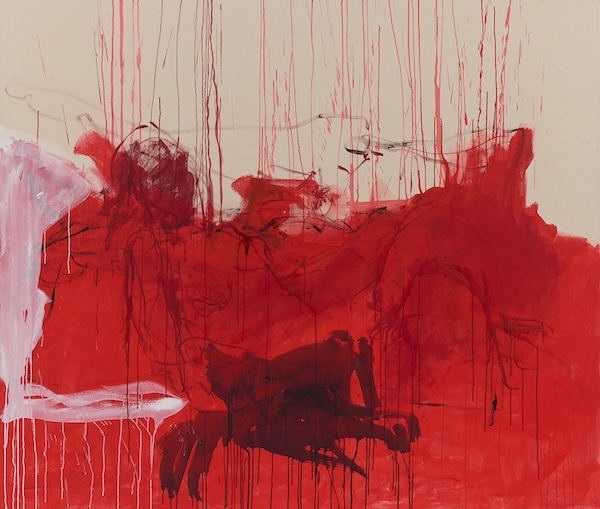
Tracey Emin, I Never Asked to Fall in Love – You Made Me Feel Like This, 2018 © Tracey Emin. All rights reserved, DACS 2026
The result is procedural rather than expressive. Trauma is sequenced, affect is formatted, instability becomes biography. Administrative logic replaces transformation. Where Abramović once staged endurance as friction against institutional framing, here that friction has already been absorbed.
And yet this apparent clarity may be misleading. What looks like total control may also reflect a critical desire for coherence — a wish to see everything as fully readable and contained. The exhibition may not settle into transparency but move between what can be understood and what resists explanation.
What the exhibition ultimately stages is not the end of confession but its transformation. Confession no longer simply reveals the self; it creates the conditions under which the self can appear as readable. The “second life” is not a resolution but a reformatting of experience into exhibition form.
Within this framework, subjectivity stabilizes only as a surface effect, continually activated by display. What remains is not raw experience but its circulation. Yet even here, something may exceed the system — a remainder that resists being fully absorbed into narrative or display.
Margherita Artoni is a contemporary art critic and curator working between Italy and the United States. She began her career collaborating with Flash Art and currently writes for Segno, Juliet, Artribune, Exibart, Inside Art, ArteIN, part of cult(ure), The Arts Fuse, and Whitehot Magazine.
She has directed galleries in Turin — including NEOCHROME and EDGE Art Space — and in New York at TEAM Gallery. Her curatorial work has included exhibition programs with international artists such as Rashid Johnson, Theaster Gates, Ali Banisadr, Angel Otero, Tim Rollins & K.O.S., Laura Owens, and Mika Tajima.