Visual Arts Review: Jules Olitski — Spray Gun Art from the Swinging ’60s
By Trevor Fairbrother
A focused museum show revisits the radiant ambition — and shifting fortunes — of a Color Field innovator.
Spray: Jules Olitski in the 1960s at the The Currier Museum of Art, 150 Ash Street, Manchester, NH, through August 9.
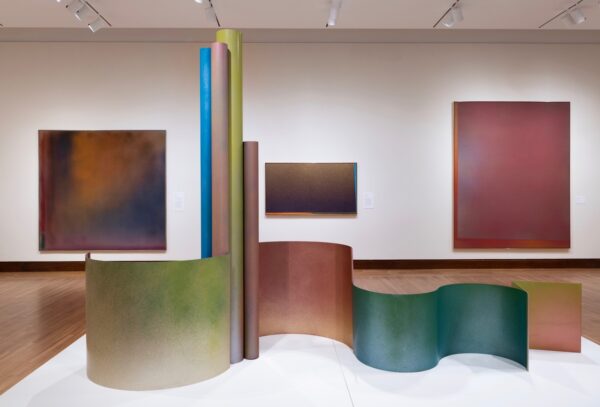
View of the Olitski exhibition at the Currier Museum. Photo: Morgan Karanasios. The painting at the left is titled Shoot, 1965, and is owned by the museum.
Jules Olitski (1922-2007) was brought to New York as an infant by his mother and grandmother, Jewish immigrants from Bolshevik Russia. He studied at the National Academy of Design in New York. His interest in contemporary avant-garde painting flourished during a two-year sojourn in Paris, funded by the G.I. Bill. The prominent critic and art consultant Clement Greenberg took an interest in Olitski’s work in the late 1950s, the period when he was tracking the shift away from the existential dramatics of Abstraction Expressionism towards the openness and clarity of Color Field painting. Greenberg had already promoted such artists as Helen Frankenthaler, Morris Louis, and Kenneth Noland, who poured thinned paint onto raw canvas. After his entrée into Greenberg’s circle, Olitski won acclaim with abstract paintings made with industrial spray guns.
The Currier Museum of Art created the exhibition Spray: Jules Olitski in the 1960s as a showcase for the brief but highly regarded chapter when the artist was enthralled by the aesthetic possibilities of sprayed color. The co-curators of the show and co-authors of the accompanying catalogue are Bruce McColl, the Currier’s director of Curatorial Affairs, and Alex Grimley, an art historian who is a regular reviewer for The Brooklyn Rail. In 1977 the Currier acquired a large and impressive spray painting made in 1965 titled Shoot: that was reason enough to initiate this project. Another factor was the museum’s interest in artists meaningfully connected to New England. Olitski lived in Vermont and taught at Bennington College (1963-67) and he summered on Lake Winnipesaukee in New Hampshire for decades. The Jules Olitski Art Foundation, located in Vermont, has loaned numerous works to the exhibition.
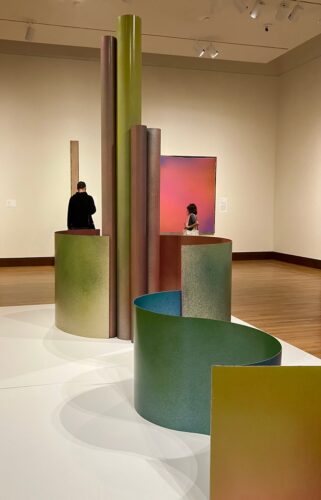
View of the Olitski exhibition at the Currier Museum. Photo by author.
The main room of the Currier’s exhibition provides a generous amount of wall space for 10 paintings. Seen from a distance, each picture acts as a luminous site where zones of colors seem to hover like clouds. One has to stand very near to a given picture to perceive the finesse with which Olitski layered the various colors. He worked on an unstretched canvas, laid on the studio floor, and made successive sprayings of paint to invoke his vision of atmospheric, disembodied zones of color. Close inspection is essential if one wants to understand the artist’s penchant for introducing painterly or linear elements that give subtle emphasis to some of the edges of his compositions: these moves included brushed applications of paint and the use of masking.
Olitski’s majestically expansive sculpture No. 7 (1968) stands at the center of the Currier’s airy and serene gallery. It is an arrangement of aluminum sheet metal forms — diagonals, curves and tall, thin cylinders – whose surfaces have been sprayed with lacquers of different hues. The color effects are as varied as the forms they cover: some suggest vaporous misty effects, while others are flat monochromatic zones. To walk around No. 7 and experience it as a succession of visual shifts and juxtapositions is a decided pleasure. The surrounding paintings are no less playful and adventurous, but the artist’s inventiveness is more accessible in a watchful journey around the sculpture. I imagine that Olitski would have been thrilled by the presentation of his works in this airy room. Both curators studied painting at college, and I’ll bet that this beautiful installation benefited from their instincts as artists.
McColl and Grimley have thoughtfully included works on paper, photographs of the artist, and archival ephemera from the 1960s to contextualize Olitski’s milieu and accomplishments. Happily, these items do not clutter up the main room: they occupy the two enclosed transitional spaces at the threshold to the main gallery. The seven pastels from 1963-64 offer a compelling comparison with the spray paintings. More intimate in scale, they palpably demonstrate the artist’s interest in evoking semitransparent veils and free-floating curtains of color. The photographs include studio shots and a captivating portrait that Ugo Mulas staged in Olitski’s living room in South Shaftsbury, Vermont. Mulas shows the artist in an armchair with his daughter Lauren at his feet; on the mantel there is a photograph of Olitski with his artist friends Anthony Caro and Kenneth Noland; a choice diamond-shaped abstract painting by Noland is centered over the fireplace. The canvas glimpsed at the right edge of Mulas’s photograph is Olitski’s Pizzazz (1963), which is the first painting viewers see in the exhibition Spray. The curators included it because it was an early experiment in spray techniques involving aerosol cans purchased from hardware stores.
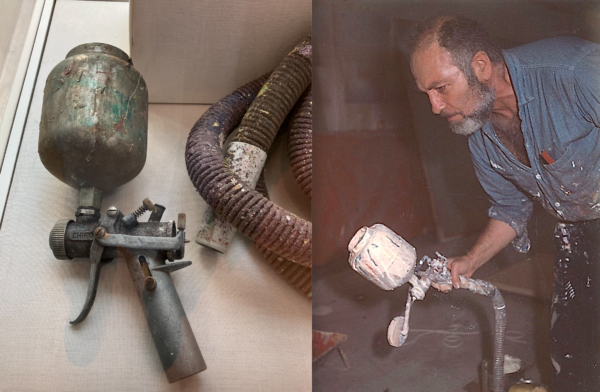
Left: spray gun used by Olitski. Right: Olitski in his studio in New York, 1972. Images paired by the author.
The biggest surprise in the show’s introductory section is a spray gun and portable blower that the artist used. It is both ironic and mindboggling to think of such stereotypically macho equipment serving in the creation of refined pictures with exquisitely textured surfaces, which sometimes recall the materiality of ceramic art. A nearby display case includes Olitski’s copy of the brochure for the Chiron Type 51 spraying equipment.
The exhibition Spray makes a conscientious effort to connect the historic work of Olitski to abstractions made by later generations. In an adjacent gallery the curators have hung midsized paintings by Heather Hutchison (b. 1964), Joseph Marioni (1943-2024), Jane Swavely (b. 1959), and John Zurier (b. 1956). This move demonstrates that many artists continue to practice abstraction as a means to communicate their emotions and responses to the natural world. In a spirit similar to that of Olitski, the four chosen painters invite the viewer to give slow, sustained attention to their devoted explorations of color. The catalogue for Spray illustrates and discusses two works by each of the artists.
Olitski was a restless figure, feverishly productive and always eager to take a gamble on something new. In the 1950s he experimented with thick accretions of acrylic resin admixed with spackle and dry pigment. The first works he made after entering Greenberg’s circle presented brightly colored bulbous shapes flatly and smoothly rendered with Magna acrylic. Then, in 1965, he turned to the refined and atmospheric spray paintings that are the focus of this exhibition. By the early 1970s Olitski had embarked on his next evolutionary shift, making austere, comparatively monochromatic abstractions in which the paint had a more tactile and assertive presence. He came full-circle in the late 1980s with his weirdly visceral “Mitt” series: canvases heavily laden with new types of acrylic paint and thick gels that he manipulated (or, in a sense, sculpted) with his mitten-covered hand. I think the exhibition Spray is so successful and rewarding because it focuses intently on just one body of work.
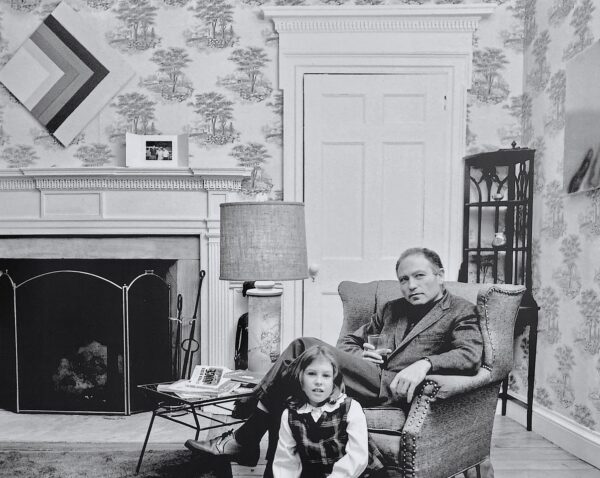
Detail of a photo portrait of Olitski and his daughter. Photo: Ugo Mulas.
The zenith of Olitski’s critical acclaim coincided with the years when his spray paintings were most exhibited. In the 1980s, Clement Greenberg and his cadre of “Color Field” painters encountered a widely based backlash. The cumulative effect of the critic’s grand and derisive sneers about Pop Art, Minimalism, Conceptualism, and New Realism came back to haunt him. In 1987, Artforum published an essay by Kay Larson titled “The Dictatorship of Clement Greenberg.” The author called for dissent from his a priori propositions and authoritarian prohibitions. For example, she stated that his notions about “color field” abstraction were now “nothing but caricature,” then added, “and Jules Olitski can barely raise a puff of dust at auction.” Much had happened since 1966, when Greenberg hailed Olitski as “one of the profoundest pictorial imaginations of this time.”
In a review of Spray published in The Boston Globe Murray Whyte pictured the artist’s career as a story about “the vagaries of critical acclaim, and the fickleness of fame.” He connected Olitski’s “stratospheric rise and just as sudden decline” to Greenberg’s sway as the high priest of abstraction. Whyte also suggested that a sea change may now be developing by quoting a line Roberta Smith wrote in The New York Times in 2021: “Olitski … made some of the most astounding abstract paintings of the 20th century.” In the same review Smith also observed that the artist “has been ripe for reconsideration for some years.” At the same time, however, she called for a reckoning with Olitski’s masculinist foibles, insisting that “the avuncular sexual innuendos and women’s names in most of [his] titles are by now wearying, the stale artifacts of a malign, oblivious era.” For what it’s worth, the book on the coffee table in Ugo Mulas’s domestic portrait of Olitski is Juice, a 1958 novel by Stephen Becker, first released as a Dell paperback in 1965; Juice was promoted as “a novel about the sinister power generated by money and influence”
If you are interested in the history of abstract painting, head to the Currier Museum. Olitiski’s big works are presented in a pitch-perfect gallery setting. His ballroom days are resurrected, right down to the narrow gold strip frames on all the paintings: a ritzy touch encouraged by Clement Greenberg.
Trevor Fairbrother is a writer and curator. In 1994, when he worked for the Museum of Fine Arts, Boston, he organized a quirky group exhibition drawn from the permanent collection and titled The Label Show: Contemporary Art and the Museum. One of the first works visitors saw was Olitski’s 1977 painting Natural Histories I, acquired as a gift from a museum trustee in 1980. The artist kindly agreed to write a short text to accompany his painting. This was his contribution:
Poussin said, “The goal of art is delight.” Even so, it takes two to tango. First comes the artist’s work (his or her vision). Then comes the viewer’s eye (his or her soul). When vision and soul embrace, the dance begins.”
For myself, when done with a work, I eye it somewhat dispassionately, asking, does it work? If it appears to, well and good; however, my real and great pleasure in making art lies solely in the making, for that is where I am unbound, given over to another reality, intense and concentrated, where power flows to where it is most needed.”