Film Review: François Ozon Reimagines Camus with Style — and Judicious Revisions
By Gerald Peary
A rigorously faithful Stranger that nonetheless reframes the novel’s moral center in worthy, modern ways.
The Stranger, directed by François Ozon. Screening at Coolidge Corner Theatre

A scene from François Ozon’s The Stranger. Photo: Music Box Films
OK, God doesn’t exist, life is meaningless. So what are you going to do about it? For Jean-Paul Sartre, there’s a mandate to create your own meaning, your “essence,” ideally by something valiant like fighting in the French underground. Although it’s philosophically absurd, use your time on earth to create a proper planet. And then there’s Albert Camus, a political activist and a Frenchman defending the rights of Arabs while living in Algeria. Why in the world would he write a book as peculiar as The Stranger (1942), with his creation, Meursault, the most apolitical and seemingly unheroic of protagonists? Meursault is insistent that existence is meaningless; but his way to deal with it is with passivity and inactivity, floating through his rote days and never taking a stand about anything. An existentialist slacker.
The novel of The Stranger is broken by Camus into two parts, approximately 60 pages each, and it’s the Meursault of Part One who is the thinnest excuse for a human being. Living in Algiers on the edge of World War II, he’s an unambitious office worker involved sexually with a young woman, Marie. Although he doesn’t love her, he agrees to marry her because — who cares? — he lazily agrees to everything proposed to him. Meursault makes no objection when one of his neighbors, Salamano, beats his dog, and also no objection when another neighbor, Raymond, a pimp, slaps around his Arab girlfriend. He just shrugs about any and all types of human behavior, even if heinous. A typical day off work for Meursault is standing on the balcony of his apartment and observing people walk by below. He’s fine with doing nothing. And guiltless about feeling nothing. “Mother died today. Or was it yesterday?” are the famous opening words of The Stranger. He is unmoved by his mother’s death, and sheds no tears at her funeral.
And where does all this passivity lead? Dazed by the sun on a hot beach day, Meursault stumbles about on the sand and — without quite meaning to — shoots dead a young Arab man who is vaguely threatening him with a knife. End of Part One.
Part Two of The Stranger unveils Camus’s plan for his erstwhile off-putting protagonist. Meursault is imprisoned and then put on trial. Confined to a cell, this phlegmatic figure develops some backbone. Some cojones. He won’t cooperate with those at his trial who are trying to soft-pedal his crime. Without hesitation, he admits to the killing. Even with the guillotine in front of him, he refuses to bend down to a priest pleading with him to ask for the forgiveness of God. Proclaiming his atheism, Meursault boots the priest out of his cell; he finds a perverse solace in the absurdity of the universe. But he has also “changed.” In his prison cell, he gets a thirst to be free. Though life is meaningless, better to be pardoned and live than to be guillotined. Though he professes not to believe in love, he tells the priest he is thinking about Marie, not God. He affirms in court that Raymond is his friend. He understands for the first time why his aged mother wanted in her last days to have a boyfriend.
The author of The Stranger called Meursault… “a hero”! As Camus explained, “The hero of my book is condemned because he does not play the game.… he refuses to lie.… He says what he is, he refuses to hide his feelings, and immediately society feels threatened.… One would not be much mistaken to read The Stranger as the story of a man who, without any heroics, agrees to die for the truth.”

A scene from François Ozon’s The Stranger. Photo: Music Box Films
In getting permission from the demanding Camus estate to film The Stranger, the French director François Ozon surely pledged to adhere closely to the novel. In his screen adaptation, he stays remarkably close, even in the smallest details. In the film Meursault eats in a restaurant given the identical name of that in the book, and Raymond offers him the same treat as in Camus, blood sausage and wine. Meursault quotes a Czechoslovakia-set story found in a newspaper clipping and it’s what’s in the novel, word for word. Lots of the screenplay follows dialogue in the book, and almost every scene in the book is repeated in the movie. How does this work out? For the most part, admirably. Ozon is, as always, an excellent filmmaker. He’s put together a sterling cast to bring Camus to life, and the Moroccan city of Tangier works beautifully as a substitute for Algiers. Camus’s story, told in the hardboiled way of American writers like James M. Cain, makes for a sleek, propulsive screen narrative. Ozon goes with it, and rarely mucks it up.
Where in this faithful adaptation do we see the Ozon touch? The filmmaker is a cineaste. He directs his lead actor to show almost no facial expression, in the way of the frozen performers in the works of France’s Robert Bresson. He lights and films Meursault lying in his jail cell in an exact replica of Burt Lancaster prone on his bed in The Killers (1946), both men fatalistically awaiting their deaths. Meursault in the book notes that he and his girlfriend attend a film starring the popular French comedian Fernandel. For his movie, Ozon concocts an extended scene at the bijou with Fernandel on-screen, and the comic mutters a prophetic line which is not in Camus: “All condemned men have their heads cut off.”
Ozon’s personal touch is also there in an unspoken queerness that spills at moments into his film. That begins with his tasty casting of Meursault: the sumptuously handsome French actor Benjamin Voisin, with his brooding mouth and perfect bone structure, photographed in a sensual, intimate way. But where queerness explodes on screen is the climactic scene of the killing. The Arab victim is nestling on the beach sand in a sexy, close-to-cruising pose. Ozon’s camera explores his male body in a gay-porn fetishist way by landing the lens on his hairy armpit. The Arab is fetishized, then he’s murdered. Pure Pasolini.
 In recent PC times, Camus’s novel has been attacked as antifeminist and procolonialist, perhaps a mite unfairly. Yes, the women in the book are treated in a callous way, but that’s by the sexist characters, Meursault and Raymond, with no evidence that the author is approving what they are saying or doing. I suppose Meursault is a colonialist just by being a white Frenchman living in Algeria in the 1930s. But he doesn’t exploit the local population, and he never says anything racist beyond calling the person he murders “the Arab.” It’s Raymond who talks of “dirty Arabs,” never Meursault. Nor does Meursault whine that it’s unjust for a white man to be put on trial for killing an Arab. Nor does he complain about being put among Arab prisoners. Still, there’s no denying that Arabs are the Other in The Stranger.
François Ozon makes his biggest break from Camus by, in a sound and judicious way, trying to rectify the political objections made against the novel. In the book, Marie is a lightweight, not especially brainy, and envisioned by the author much the way Meursault sees her, as a luscious bedmate. You, the reader, understand why Meursault isn’t in love with her, why a marriage seems ridiculous. For his movie, Ozon cast actress Rebecca Marder as Marie because of her sensitivity, intelligence, and refined beauty. It’s a total switch. You, the film watcher, can’t quite understand why Marie desires to be with the dour taciturn Meursault, except as a pinup bed partner. Why does she want to marry him?
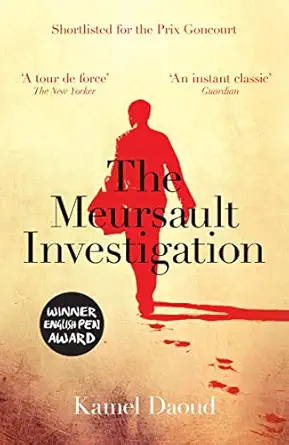
Even more eventful is how Ozon deals with the charge that Camus, though an acclaimed leftist, displayed a colonialist mentality in The Stranger. In 2013 an Algerian writer, Kamel Daoud, published a corrective novel, The Meursault Investigation, retelling the story from the Arab point of view. He gives the murdered man, “the Arab,” an actual name, Moussa. He also endows the murdered man’s sister with a name, Djemila. She is the unnamed woman in Camus who is beaten up by Raymond.
I will end with a spoiler note: Ozon makes reparation by highlighting Djemila in several important moments, including a scene invented for the movie in which Marie tries to speak with her at court. And is defiantly rebuffed! Djemila with agency! And an addendum to the movie. Stretching beyond Camus’s all-Meursault conclusion, Ozon offers a poignant elegy to the murdered Arab man called, as in Daoud’s novel, Moussa. As Ozon has explained in an interview, Daoud “allowed us to understand how shocking Camus’ book was for Algerians…the violent experience felt by an Arab of not existing in Camus’ book.” In a worthy way, Ozon pulls The Stranger into the 21st century.
Gerald Peary is a professor emeritus at Suffolk University, Boston; ex-curator of the Boston University Cinematheque. A critic for the late Boston Phoenix, he is the author of nine books on cinema; writer-director of the documentaries For the Love of Movies: The Story of American Film Criticism and Archie’s Betty; and a featured actor in the 2013 independent narrative Computer Chess. His last documentary, The Rabbi Goes West, co-directed by Amy Geller, played at film festivals around the world, and is available for free on YouTube. His 2024 book Mavericks: Interviews with the World’s Iconoclast Filmmakers, was published by the University Press of Kentucky. His newest book, A Reluctant Film Critic, a combined memoir and career interview, can be purchased here. With Geller, he is the co-creator and co-host of a seven-episode podcast, The Rabbis Go South, available wherever you listen to podcasts.
Tagged: "The Stranger", Albert Camus, Benjamin Voisin, Denis Lavant, Pierre Lottin