Film Retrospective: Conmen and Catastrophe — The Works of Béla Tarr and László Krasznahorkai
By Peter Keough
A retrospective of four films by those two Hungarian artists unfolds as a monochromatic monolith of mud, misery, human folly, and inexorable corruption.
TARR/KRASZNAHORKAI. At the Harvard Film Archive April 11-25.

Director Béla Tarr. Photo: Brigitte Lacombe
In the world of the late filmmaker Béla Tarr and his frequent collaborator, Nobel Prize-winning author László Krasznahorkai, fools seek salvation from degenerate grifters. That’s the way it is in our world today, too, of course, so it is serendipitous for the HFA to screen a retrospective of four of the films those two made together, a monochromatic monolith of mud, misery, human folly, and inexorable corruption.
Krasznahorkai, from the school of slow literature that is the counterpart of slow cinema, a supreme observer of civilization’s breakdown, a master of the unleashed sentence and a minute chronicler of misery like Thomas Bernhard and Samuel Beckett, proved an ideal fit for Tarr. The filmmaker’s extremely long takes matched well the writer’s pages-long, single sentence paragraphs.
Not all of their films would feature a treacherous false redeemer, however. Worse luck for the characters. Like the seedy, solipsistic protagonist Karrer (played by Tarr regular Miklós B. Székely, who resembles a more dissolute Bruno Ganz) in Damnation (Kárhozat; 1988; screening April 24 at 7 p.m.), the pair’s first partnership (co-directed, as always, by Tarr’s partner Ágnes Hranitsky). It is the film noir from hell.
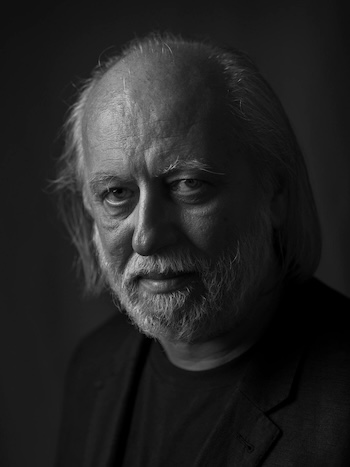
Author László Krasznahorkai. Photo: Miklós Déri
A drunken, philosophical low life stewing in the kind of rainy, flyspecked town that served as Tarr’s archetype of human society, Karrer suffers a masochistic infatuation with a torch singer in the aptly named “Titanik” club (shades of Blue Velvet). Her rendition of an eerie, minimalist, unrequited love song by perennial Tarr cohort Mihály Vig sets the mood. With the connivance of the bartender, Karrer plots to remove the singer’s lumpish husband from the triangle by setting him up in a smuggling caper. As with all schemes involving nefarious barkeeps, it does not go quite as planned.
Though at times it drifts into near self-parody, Damnation establishes the stylistic and thematic paradigm that all Tarr and Krasznahorkai’s subsequent films would follow. That includes motifs like the sibyl-like bible thumper, here represented by a middle aged cloakroom attendant who shows up to declaim the vanity of all things whenever anyone starts feeling a bit optimistic. At one point, she drops by a brooding Karrer, states the dreaded words, “Do you know the Old Testament, young man?” and proceeds to wearily recite the entirety of Ezekiel Chapter 7 (“Their silver and gold cannot save them from the day of the Lord’s wrath,” etc.). Harrer listens, says nothing, and shuffles off to pursue his plot, eventually meeting the fate of the title.
In their second pairing, the seven-and-a-half hour long adaptation of Krasznahorkai’s novel Satantango (1994; screens April 25 at 2 p.m.), the melding of the two artists’ aesthetics is complete. With Kieslowskian aplomb, Tarr adopted the writer’s knack for multiple points of view, his cyclical chronology, and his interlinking of individual narratives. Among these, that of the conman dominates the whole – Irimiás (played with sinister charisma by Mihály Vig), whose name comes from the prophet Jeremiah and whose avowed zeal for social justice does not conceal his sadistic nihilism, his lust for apocalyptic catastrophe.
As a counterpoint to Irimiás, there is the doctor, one of Tarr’s recurring types of the debased intellectual rendered impotent through crackpot obsessions. Perpetually drunk, immobile in his cluttered, filthy quarters, the doctor spies on everyone in the neighborhood, writing down a daily log of their activities in school composition notebooks (a hobby which, in the end and in circular fashion, takes us back to the beginning of the story). He is stirred to leave his lodgings only when he runs out of booze. As he staggers through the rain and mud and growing darkness to the bar, he bumps into and rebukes Estike (an uncanny Erika Bók), a child who begs for his help and the only other character in the film who might be considered innocent.
An outcast and trauma victim, Estike is a kind of Dostoevskian idiot savant. Her father hung himself, her mother abuses her, her two sisters are whores, and her brother cheats her out of her pittance by having her bury it to grow a “money tree” – a foreshadowing of events to come. In response to her mistreatment, she torments and poisons her cat (Tarr insisted that no animals were harmed in the making of the movie).
This seemingly endless sequence serves as the tragic heart of the film and perhaps all of Tarr’s films. It recalls the heartbreak of René Clement’s Forbidden Games (1952). Nearly unwatchable, the episode is ultimately transcendent in its pathos, a stark contrast with the dance of the film’s title, a long, drunken fandango of debauched, automaton-like bodies twisting to a melancholy refrain played on an accordion. Estike, inconsolable and carrying her dead cat, witnesses this sad orgy and flees. She then takes the poison herself. “‘Yes,’ she said softly to herself,” the voiceover narrator relates, “‘the angels see this and understand it.’ She felt at peace inside, and around her, the trees, the road, the rain, and even the night all radiated tranquility.”
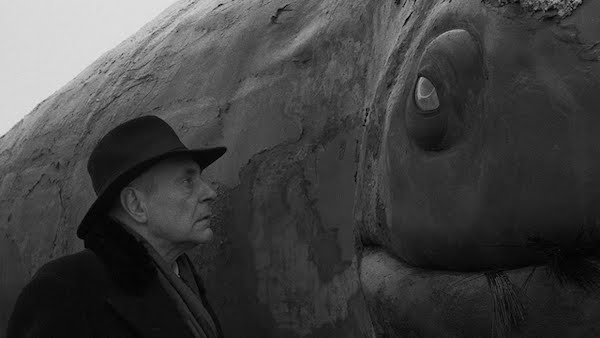
Peter Fitz as György Eszter in a scene from Werckmeister Harmonies. Photo: Curzon Film
This tranquility is felt by János (Lars Rudolph, who, with his huge, otherworldly, deep-set eyes, looks like a cross between Klaus Kinski and Jim Carrey), hero of Werckmeister Harmonies (Werckmeister harmóniák; 2000; screening April 19 at 3 p.m.), an adaptation of Krasznahorkai’s 1989 novel The Melancholy of Resistance. As the film begins, János orchestrates a dance much different from the Satantango, enlisting the raffish patrons of a grubby tavern into recreating the cosmic choreography of the sun, moon, and earth. “All I ask is that you step with me into the boundlessness where constancy, quietude and peace, and infinite emptiness reign,” he asks them, and bemused and even awestruck, the customers ineptly but gamely comply.
But disrupting this attempt at peace and order are rumors of revolt and abominations. A circus is coming to town and in its wake arrive angry mobs made up of the despised and disenfranchised. One of its advertised attractions is a taxidermied whale, which János is smitten with as he examines it in a bizarrely eloquent sequence. As he later tells his friend György Eszter (Peter Fitz), “The giant whale is as long as twenty meters and you can look into its head and it really stinks. And all a man can do is look on it and see how great is the Lord’s creative impulse and power and his omnipotence is reflected in that animal.” Later, when the mob threatens violence, he visits the creature again and comments, “See how much trouble you’ve caused even though you haven’t been able to harm anyone for a long time?”
The culprit, however, is not the long-dead leviathan. It is the man behind the curtain, dubbed the Prince, whom János spies on as he is arguing with the circus owner. The Prince, seen only in shadow and looking like a marionette, speaks only in Slovak — his thuggish “factotum” supplies the translations. The owner, whose only interest is in making money, refuses to let the Prince appear before the crowd and incite a riot and ruin his good name. But the Prince gleefully denounces his would-be handler, and vows to bring about the downfall of society. “I alone see the whole,” he proclaims. “And the whole is nothing.”
Compared to Satantango, this adaptation ruthlessly condenses the original text. Instead of the former’s multiplicity and chronological fluidity, the film focuses on one point of view and one narrative line – that of János. This strategy diminishes the role of Eszter, an entry in Tarr and Krasznahorkai’s series of ineffectual pointy-headed cranks. To be fair, Eszter does contribute the title of the film, which reflects his obsession with the tuning system devised by the Baroque-era musicologist Andreas Werckmeister. That groundbreaking artifice tempers intervals between notes, a kind of fudging of the facts that Eszter condemns as illusory; he strives in his solitary labors to restore tonality to its original and more realistic chaos. Thus, though a devoted friend of János, Eszter may be said to be the passive, intellectual advocate of the anarchy that the Prince professes.
Another character who receives short shrift is Eszter’s estranged wife, Tünde, played by the sublime—though here underused—Hannah Schygulla. She represents the kind of scheming politicos and bureaucrats who often surface in the pair’s films. Even more than the Prince, whose antics she exploits, Tünde embodies the entrenched powers that ultimately manipulate terror and misery for their own aggrandizement.
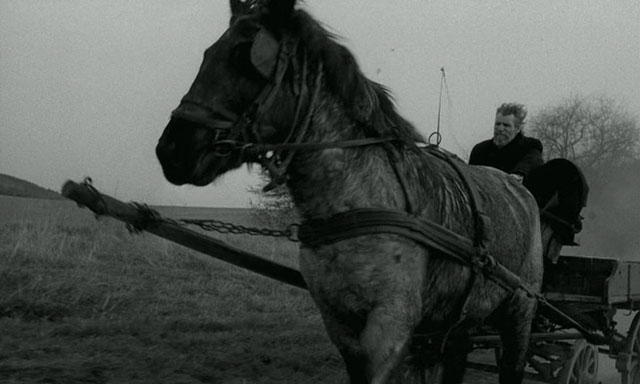
János Derzsi in scene from The Turin Horse — Tarr’s final film dealt with an animal who goes on strike. Photo: Curzon Film
There are no con artists in Tarr’s last film The Turin Horse (A torinói ló, 2011; screening April 17, 7 p.m.). And no benighted geniuses, though the ghost of Friedrich Nietzsche makes an appearance in the voiceover prologue. It relates how, while living in Turin, Italy, the philosopher came across a horse being brutally beaten by its driver. Nietzsche embraced the horse, went insane, and remained so for the rest of his life.
But other elements of Tarr’s cinema make their final appearance here in indelible form. Many appear in the opening scene alone: a barren landscape, battered by wind instead of rain, a world of desolate squalor, of repetitive, unending, futile toil. In it, the title steed—somehow relocated to the Hungarian plain—pulls a cart, driven by a bearded, broken old man, for four and a half minutes in a single take.
Glacial even by Tarr’s standards, the film comprises only thirty shots over its 146-minute length. It records, with almost no dialogue, a Biblical six days in the lives of the horse, the cart driver Ohlsdorfer (János Derzsi), and his daughter, played by an older but no wiser Erika Bók, who perhaps is atoning for her treatment of the cat; at one point she has to pull the cart for the ailing horse. In a ruined farm in the middle of wind-blown nowhere, she boils potatoes, does laundry, draws water, and cleans the stable while Ohlsdorfer eats potatoes, grumbles in his long johns, and, when the horse can no longer draw a cart, lies in bed. Then things get worse. Mihály Vig’s dirge-like soundtrack underscores the eloquent futility, which makes Bresson’s Balthazar seem Disney-like.
Though the bleakest of Tarr’s films, it has a happy ending, of sorts. Asked in an interview about how they cast the horse, Tarr says, “We found her in a market in a small village in the Hungarian lowland…She was a very sad horse. But I have to tell you, all horses are sad who are around people. The owner wanted to make her work, and she refused. And it happened like with Nietzsche – I stopped him immediately. I was screaming at him, and then he sold us this horse, and she’s our horse now. Now she’s OK.”
Peter Keough writes about film and other topics and has contributed to numerous publications. He was the film editor of the Boston Phoenix from 1989 to its demise in 2013 and has edited three books on film, including Kathryn Bigelow: Interviews (University Press of Mississippi, 2013) and For Kids of All Ages: The National Society of Film Critics on Children’s Movies (Rowman & Littlefield, 2019).
Tagged: Agnes Hranitsky, Béla Tarr, Erika Bók, Harvard Film Archive, László Krasznahorkai