Book Review: “Colossus” — Swimming With the Snakes
By Bill Littlefield
Ross Barkan is a good enough of a writer to have avoided the trap of making this novel just an anti-Trump protest.
Colossus by Ross Barkan. Arcade Publishing, 277 pages, $29.99.
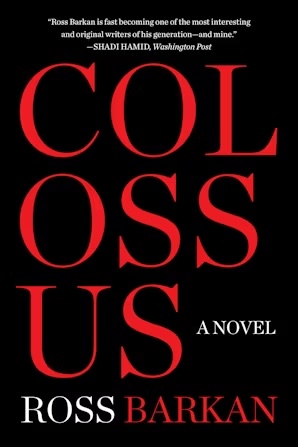 Journalist Ross Barkan’s new novel may remind some readers of the fiction of Don DeLillo, but he has in mind another influence. In an essay, Barkan identified his “North Star” for this book to be “Richard Ford’s Frank Bascombe novels, especially The Sportswriter.” Barkan goes on to characterize Colossus‘s narrator, Teddy Starr, as “dark Bascombe.” I think that is misleading. To me, Ford’s Bascombe comes off as a pleasant, somewhat quirky fellow with an attractive tendency toward self-deprecation. Starr is, as Barkan acknowledges, “despicable.”
But that heinousness is not obvious at the beginning of Colossus. Sure, Starr exudes lots of sleaze. He’s a pastor/slumlord and happy in both roles. His congregation is made up of comfortable, Midwestern conservatives whom Teddy sees no profit in discomforting. He fantasizes about telling one of his parishioners to “buy, buy,” because “God will love you, regardless, yes, but He looks well on those who attempt to prosper.” If you’re rich, that means Jesus has blessed you — just as he has blessed Teddy himself, whose bounty includes not only a loving wife, three children, and a big house, but a flourishing real estate business and a rundown trailer park full of mostly meek and dependable tenants. Teddy has what his wife defines as “a floating sensibility,” and she doesn’t know the half of it. She’s not referring to Teddy’s adulterous behavior when she makes that observation but, if she had been, she’d have been on target. Like the hero in the old John Gorka song, “Vinnie Charles is Free,” “the women pass under him as if he could fly.”
All this might seem to add up to no more than another novel about a roguish anti-hero, if it weren’t for Barkan’s inclination to infuse Teddy Starr with some of the more predatory and “despicable” characteristics of various contemporary politicians. Like Donald Trump, Teddy Starr is an egomaniacal projection of his own imagination — a hoax that people have embraced. But the current politician Teddy most closely resembles is J.D. Vance, a man who has changed his name several times and bent the details of his biography to fit his worldly ambitions.
At a critical moment in the story, Teddy imitates the kind of rhetoric that might be mistaken for one of Trump’s late night tweets or something oozing out of a warmongering speech by Pete Hegseth. “Today in this country we have a great evil,” Teddy says. “We have people, powerful people, who swim with the snakes. You are with God, or you are against God. America is a godly country. We are a godly people. But look around you today. Whether it’s the glorification of the slaughtering of the unborn…whether it’s an entire political party aligned against US, that wants to take God out of American life and have us worship false idols, it’s more important than ever that we are united, that we stand firm in our faith.” Before he utters these stirring—if baldly hypocritical—sentiments, Teddy has been revealed as a fraud. That revelation has no bearing on the oily intensity of his speech-making — except to supercharge it.
The risk of entrusting the narration of a contemporary novel to a character who so closely resembles contemptible figures in the headlines is that readers will dismiss Colossus as only being a political statement. Barkan is good enough of a writer to have avoided that trap. After a deceptively leisurely beginning, his novel gains dramatic momentum and builds up some genuine tension. Warning: its conclusion will dismay those who hope that the fall of this stand-in for Trump, Vance, Hegseth et al., will be swift and thorough.
Bill Littlefield’s most recent novel is Mercy (Black Rose Writing)