
Book Review: “Coyote” Bio Focuses on Sam Shepard’s Turbulent Life but Skims Lasting Impact of His Work
By Robert Israel
The biographer puts far too much emphasis on Sam Shepard’s louche life, neglecting to provide much analysis about the value of his stage work, particularly on whether it will endure.
Coyote: The Dramatic Lives of Sam Shepard, by Robert M. Dowling, Scribner, N.Y.
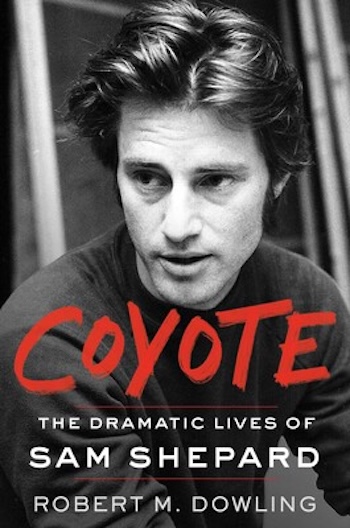
Coyote, Robert M. Dowling’s biography of Sam Shepard (1943-2017), is the fifth study on the acclaimed American playwright, musician, and actor (the first appeared in 1985, the last in 2017). Dowling, a professor at Central Connecticut State University, probes the connection between the playwright’s beguiling dramatic works and how they align to Shepard’s turbulent personal life. But Shepard doesn’t make establishing those links easy. He was like Wile E. Coyote, up to no good, hell bent on setting off explosives. The fact that Dowling gets as far as he does in his attempt to pin down such a rakish devil is commendable. But his exploration of the artistic wages of sin doesn’t go nearly far enough. I was not won over. By focusing on what I call the Shepard Miracle – a creative artist who achieves success despite self-destructive behaviors — Dowling puts far too much emphasis on Shepard’s louche life, neglecting to provide much analysis about the value of Shepard’s work, particularly whether it will endure.
I witnessed the Shepard Miracle in person at a party after Seduced, his 80-minute surrealistic romp about billionaire recluse Henry Hackamore (nom de folie for aviator/tycoon Howard Hughes), was given its world premiere at Trinity Rep in Providence in the late ’70s. I was writing for the weekly New Paper while completing my university studies. Shepard was at the vent, inebriated. He rambled on about why he liked my hometown, having performed a few years before at the Providence Civic Center as a drummer in Bob Dylan’s Rolling Thunder Revue. He said his plays were being produced off-Broadway, that he was gigging with the stoner band Holy Modal Rounders, and was acting, sporadically, in films. I asked about his writing career. “I don’t have one,” he insisted. “I write whatever I want to. I’m working on a longer script. And…” Just then a woman wrapped her arms around him: she was drawn by his magnetic male charm. He ended the interview abruptly. “[Trinity Rep’s] Adrian Hall is gonna produce more of my stuff. Interview him,” Shepard said.
Early Coyote chapters inform us that Shepard, raised by an alcoholic father and doting mother, wanted to be a veterinarian. Instead, he became an equestrian who later bought and sold Thoroughbreds (and he earned hefty profits). Like his playwriting contemporary, August Wilson (1945-2005), he vigorously pursued extra-marital affairs. While married to O-Lan, the mother of his first child, he’d dash out, telling her wanted to pick up a quart of milk or whatever. In reality, he was on the hunt for booze and hookup sex, only returning home the next day. But these and other titillating tidbits from Dowling offer no insight into the writer’s creative processes or output.
Nor do we gain understanding of Shepard’s artistry by reading about his alcohol-fueled “benders,” some lasting 10 days, others lasting months or longer. Dowling devotes pages upon pages detailing Shepard’s appetites: he took LSD, Benzedrine, crystal methedrine, gobbling up, as he put it, “almost any pill that kept us up and doing without sleep for days at a time.” In his early twenties, living la vie Boheme in a squalid downtown NYC apartment with rocker Patti Smith, Shepard flirted with heroin. “If I wasn’t so fucked up,” Shepard said about his addictions, “I probably couldn’t have written all those great plays.”
Except not all of his plays were “great,” with few ascending to the height of his sole 1979 Pulitzer prize-winning script Buried Child. (Trinity Rep produced it and then took it on the road with an ensemble cast to Syria, India, and Egypt, on a double bill with John Steinbeck’s Of Mice and Men, thanks to a State Department grant. This was a remarkable accomplishment then, and most certainly impossible today, but Dowling doesn’t mention it, not even in a footnote.) Failure or doubt was not something Shepard coped with easily. “Why should everything be evaluated in terms of success or failure?” the writer asked. “If I ever got wealthy enough to produce my own plays, I’d never have them reviewed.”
Dowling gives short shrift to Shepard’s embrace of the dramatic works of Samuel Beckett. We are given mentions, not a proper evaluation, of how the plays of the Nobel laureate inspired Shepard to create his version of American absurdism, populated by tersely drawn characters who are trapped in a homegrown existential malaise. Neither does Dowling probe Shepard’s kinship with the gifted theater artist, the late Joe Chaikin, a Beckett acolyte.
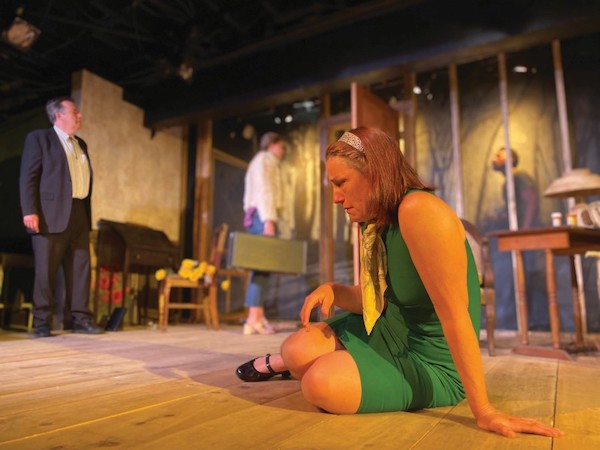
D’Arcy Dersham, on the floor, and, in the background from left, Robin Bloodworth, Allison Zanolli, and Jack Ashenbach perform in the Harbor Stage Company’s new production of Sam Shepard’s Buried Child. Photo: Joe Kenehan
Instead, we learn that Shepard, like aforementioned August Wilson, had a violent temper. When a freelance journalist took a photo of him strolling in Boston on Beacon Hill with actress Jessica Lange, his longtime paramour and mother of his other two children, Shepard exploded. “If you don’t get off this street, I’ll get a gun and blow your fucking brains all over the street,” Shepard snarled.
Shepard finally sought help for his alcoholism and experienced “a dry period that would last four years,” Dowling notes. But sobriety didn’t win out. He was arrested for DUI – in Illinois and New Mexico, and again a year before his death — telling a friend: “I must admit I like getting drunk. I like the feeling that comes over me. The numbness. The moving into a different state.” Dowling does only a passable job of examining how Shepard’s characters often exhibit a similar state of “numbness,” as in his plays The Tooth of Crime, A Lie of the Mind, and Fool for Love.
The book’s title is attributed to singer/songwriter Joni Mitchell’s nickname (and song) for Shepard after their cocaine-fueled romance while touring with Bob Dylan’s Rolling Thunder Revue. She said: “But for me, on coke, I found him attractive. He reminded me of the people…from the region that I come from [in Canada].”
Dowling offers compassionate insight into Shepard’s last years in Kentucky, the last stop in his restless life, where he succumbed to ALS (amyotrophic lateral sclerosis). Left untouched is an assessment of Shepard’s impact on other American contemporary playwrights, whose works, to my mind, help us to better understand our troubled American psyche. (For example: Some years ago I interviewed playwright Lanford Wilson, and he told me that Shepard and other writers, aware of the highly experimental nature of their craft, engaged one another in cross-pollinating sessions during the stony off-off-Broadway days. Dowling mentions this loose coterie of risk-takers, but not what came from their friendships or collaborations.) Tellingly, since Shepard’s death, regional theaters nationally, and on Broadway, have not mounted major revivals of his plays. And this neglect includes Boston’s Huntington Theatre Company, whose artistic director, Loretta Greco — she served as AD at San Francisco’s Magic Theatre and directed several of Shepard’s plays from 2013-2016 — has yet to include his work in upcoming seasons. So Coyote leaves a number of important questions unanswered: Is Shepard’s voice relevant for today’s audiences? Was the Shepard Miracle a sideshow?
Robert Israel, an Arts Fuse contributor since 2013, can be reached at [email protected].
2 Comments
Leave a Comment
Bob seems skeptical about the worth of Sam Shepard’s plays in the future. I am curious, with a sense that a handful will fare well. The fact that Shepard’s work is not being revived now does not set him apart — most of the dramatists of his generation are being ignored — a fact that Bob has mentioned regarding Guare, Wilson, etc. And we remain in a musical-crazed age, though that my change as economic reality sets in — most musicals on Broadway are not making a profit. Also, Shepard’s work was much more popular than his compatriots, aside from Mamet. I remember a time when it was a rare season that someone did not produce True West.
So let’s see what happens. Shepard’s critique of America as the land of self-destructive delusion, a continuation of O’Neill’s, may be of interest, as well as his wild absurdity (which includes a healthy disdain for the macho) and expansive use of language, which counters the current embrace of minimalism and YA comic book babble.
The author of this article needs to do some real research here. Sam was NEVER a drummer for Bob Dylan’s Rolling Thunder Revue (which toured New England in the Fall of 1975). He was hired to help with character studies for Bob’s Renaldo and Clara film. That’s an embarrassing reach and completely untrue.