
Book Review: Putting Words into Dreams — Poet May Swenson
By Michael Londra
Optimistic, a canny survivor, relentless, genderfluid—poet May Swenson described herself as “I am one of those to whom miracles happen.”
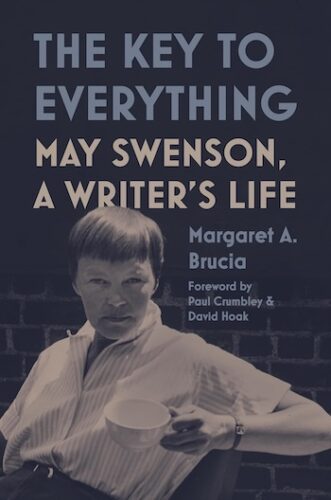
The Key to Everything: May Swenson, A Writer’s Life by Margaret A. Brucia. Princeton University Press, 288pp., $29.95
 Dig this moxie. The year is 1936. Poet May Swenson is stuck in a dead-end job hawking advertising for Utah, a regional magazine based in Salt Lake City. She can’t officially join the writing staff because she is a woman. This despite recently graduating with an English degree from Utah State Agricultural College (now Utah State University), where her father is a professor. Born into a devout Mormon family of Swedish immigrant converts, Swenson hails from the small town of Logan, eighty-one miles from Salt Lake. Around seventh grade, Swenson starts doubting her parents’ faith. She develops an “intense desire” for Helen, a classmate, contradicting church doctrine forbidding same-sex relationships. Skepticism soon turns into rebellion. Delighting in subverting the uptight bourgeois conventions of her religious elders as an undergrad, she revels in the clichés of disobedience—smoking like a chimney and swearing like a sailor. Swenson adds to these by living openly as a lesbian.
This is done, in fact, during a time when any detour from heteronormative sex is legally classified a felony. Now, with a few failed lesbian love affairs behind her—as well as several unhappy experiences dating men (including a botched attempt to lose her virginity with a blind man)—Swenson is frustrated. Inspired by “literary idol” Thomas Wolfe’s novels Look Homeward, Angel and Of Time and the River, she opts to follow the example of Eugene Gant, Wolfe’s fictional “alter ego” who “breaks away from his family in pursuit of glory as a writer.” Swenson likewise pierces the “bubble of Mormonism” restraining her. At 23, bidding adieu to parents and siblings, she lights out for Manhattan. But the Great Depression is underway. Swenson has no publishing contacts. Nor is she armed with the slightest prospect of paid employment. Defying common sense, this reckless dreamer from the sticks proclaims in her diary: “arrived N.Y. City Monday July 20…I am in the city of my birth—you may look for me now in these streets and hereafter.”
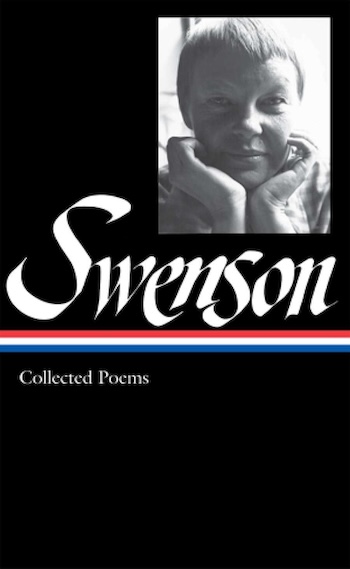
How this act of chutzpah became one of the twentieth century’s most unique careers in American poetry is the subject of Margaret A. Brucia’s The Key to Everything: May Swenson, A Writer’s Life. Neglected today, May Swenson (1913-1989) achieved a hard-won prominence during her lifetime as an original poet, playwright, and translator. Harold Bloom considered her a major author, “undervalued” after her death. Picking up the 2013 Library of America edition of Swenson’s Collected Poems, edited by Langdon Hammer, shows why. Completing ten collections of poetry, notably Another Animal, A Cage of Spines, Iconographs, and New & Selected Things Taking Place, Swenson was extensively anthologized. Her prolific legacy includes well over five hundred poems in a wide range of styles on a multitude of topics. Influenced by Emily Dickinson, Marianne Moore, e.e. cummings, and Elizabeth Bishop, Swenson also followed in the footsteps of European experimentalists like Guillaume Apollinaire, and seventeenth century English Metaphysical poet George Herbert.
Just as she claimed New York for herself without seeking approval or permission, Swenson followed her poetic muse unapologetically, immune to negative criticism. While some considered it gimmicky, for instance, Swenson pursued an aesthetic construction alternatively referred to as “shape” or “concrete” poetry. True to form, Swenson disdained these terms, and coined her own: “iconographs”—language placed typographically in a design mirroring the poem’s theme. “The Blue Bottle,” for example, contours language into a silhouette that resembles a glass container. Swenson, moreover, was a pioneer in a genre she christened “riddle poems.” Poems to Solve is perhaps the first volume of lyrical puzzles challenging readers with concealed meanings to sleuth out. Self-identifying as a lesbian, Swenson eloquently captured the joys and pains of queer desire. Whether stirred by nature, NASA’s Apollo missions to the moon, family life, baseball, animals, ancient myth, scientific discoveries, travel, or sensuality, Swenson blended technical mastery, avant-garde risk-taking, and psychological depth.
 Such a trailblazer deserves a worthy biography. Not as ambitious, for example, as Roy Foster’s two-volume opus on W.B. Yeats—there is little analysis of Swenson’s lyrical output here—The Key to Everything is a short, straightforward narrative that scarcely grapples with the poetry prompting the chronicle in the first place. What elevates this biography above a conventional magazine profile is Brucia’s incorporation of Swenson’s previously unseen diaries, “prodigious correspondence,” and fragments of memoir. Going by these samples from her private journals, the whole shebang deserves to be liberated from the archives. Swenson’s humanity is on messy display—brash, insecure, witty, spirited. Mixing snappy syntax and vivid scene construction, Swenson’s entries scan like Ring-Lardner-and-Dorothy-Parker-meets-Sex-and-the-City: “Had been there barely 5 minutes when a slot machine vendor plops down at the table…he hauls out some pornographic pictures…[t]hey were pretty good etchings—artistically I mean. Then this palooka wanted [me} to go riding on Riverside with him and a bottle of scotch. So I spit in his eye a couple of times (figuratively) and he turned tail.” Readers charmed by this fizzy personality will discover more to relish in Swenson’s distinctive verse.
Indeed, Brucia derives her title from an eponymous Swenson poem. “The Key to Everything” is a meditation on sex, identity, and truth. Beginning as a couples’ argument addressed to a non-gendered partner (“Is there anything I can do…or do / you prefer somebody else to do / it or don’t / you trust me to do / it right”), the stanzas progress toward a more complex emotional reality (“If I knew what your name was I’d / prove it’s your / own name…but you / won’t tell me your / name or / don’t know it / yourself…you’ve / forgotten or / never quite knew it or / weren’t willing to believe it”). Exasperated with a conflicted lover, Swenson suggests that accepting your “name”—the quintessence of authentic selfhood—is “the key to everything.” Arguing for embracing individuality, no matter the consequences, Swenson insists happiness is dependent on honesty: “you’d / get up and walk knowing where you’re / going where you / came from.”
“The Key to Everything” stands, therefore, as an apt summing up of Swenson’s worldview as person and poet. But where is the poetry? Brucia’s choice of subtitle signals that her biography will stress a “writer’s,” and not a “poet’s life.” The volume’s foreword by scholars Paul Crumbley and David Hoak reinforces this emphasis, and Brucia, regrettably, has limited herself to storytelling, eliding the necessary explication of Swenson’s oeuvre. This means context for the allegorical significance behind the poem that was selected for Brucia’s title is left unglossed. According to the book’s index, the only reference to “The Key to Everything” is to the backstory of its composition—Swenson meets a woman “younger by ten years,” and tries to enter “into a love affair” with her. A “cat-and-mouse” courtship ensues. “[S]everal months of aborted attempts at romance” that “left May frustrated, angry, and confused.” She “responded ambivalently when May made overtures.” Acting on desire was de rigueur for Swenson. Passion was her skeleton “key,” unlocking the pleasures and rewards of life. Does Brucia agree? Who knows? — there is zero analysis. While a few poems, like “The Centaur,” do receive brief exegesis, wholesale avoidance of the verse cuts the evaluative soul out of these pages.
That said, Brucia spins a terrific yarn. She is at her best cinematically depicting the hardscrabble world of New Deal Manhattan and the bohemian communities of Greenwich Village—the artist studios, cafés, late-night bars, and constant bed-hopping. Placing an ad in The New York Times—“WRITER…do anything progressive and legitimate that nets a living”—puts Swenson into contact with folks laboring over mediocre writing projects. She winds up in a romance with a married male respondent. Once that arrangement nosedives, she dates the nephew of her next client, a middle-aged woman requiring a typist. These opportunities pay decently and Swenson frequents the ballet, devours countless movies, visits museums, and rents a typewriter. Easy street did not last. Broke, Swenson’s shoes fall apart. She filches dresses from clothing outlets. With eighteen cents left, Swenson joined the Federal Writers Project. Assigned to the Living Lore Unit, she earns steady cash collecting oral histories.
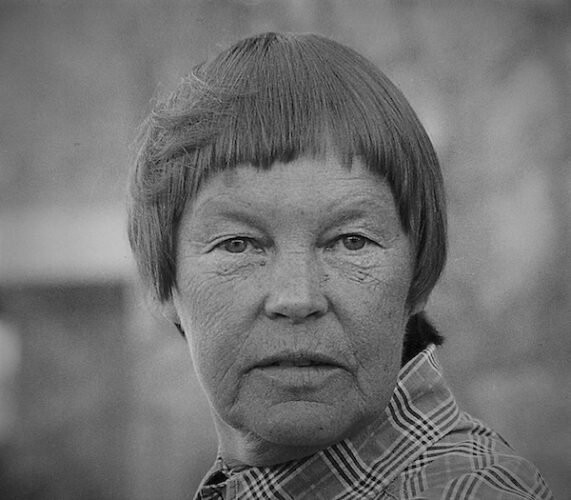
Poet May Swenson. Photo: May Swenson Papers at Utah State University and Washington University Special Collection
From this point, The Key to Everything’s momentum gains maximum traction, depicting a young poet in a hurry. Swenson groks how to be streetwise, network, and advance herself. Through one of her Living Lore “informers” (as the program’s participants are called), Swenson hangs around The Raven Circle, a poetry club that included artist Saul Baizerman, with whom Swenson took sculpture classes. There she connects with aging poet, novelist, playwright, literary editor, and anthologist Alfred Kreymborg. Brucia describes his significance to her: “May was having little success promoting her work…May found Kreymborg decrepit,” and “even when he wasn’t making crude sexual advances…she understood he could be useful for her career.” Swenson’s instinct was on the money. Kreymborg quickly convinced an editor friend to publish Swenson’s “Haymaking” in the prestigious Saturday Review of Literature. Nearly fifteen years after putting down roots in Gotham, Swenson’s literary career was finally taking off.
He wasn’t done yet. Kreymborg also hooked Swenson up with James Laughlin, influential founder of New Directions. Laughlin published her poems in his annual magazine. Then snapped her up as a manuscript reader. Kreymborg soon got Swenson approved for the writers’ colony at Yaddo, where, fortuitously, she encountered Elizabeth Bishop. “May,” Brecia explains, “was intrigued and inspired by Elizabeth’s poetry and success.” Bishop was “well-bred and accomplished.” Unfortunately, “Elizabeth made May feel socially inept.” In a missive to fellow Pulitzer-prizewinner Robert Lowell, Bishop condescendingly labeled Swenson “a little poet.” Over time, however, Bishop grew enamored of Swenson’s lyric sensibility and, like Kreymborg, boosted her career. In 1959, Swenson signed a first-refusal contract with The New Yorker. Printing over sixty of her jewel-like poems, she regularly showcased for decades in the most glamorous display case in American literature. The Key to Everything winds down around this juncture, packing Swenson’s remaining twenty-two years into the last two chapters. Brucia foregrounds Swenson from her early twenties to late forties, the most eventful period of her life.
Optimistic, a canny survivor, relentless, genderfluid—Swenson described herself as “I am one of those to whom miracles happen.” She deserved every break she enjoyed. Considering herself a “hybrid creature,” like the mythical centaur, she was “both” at once. Non-binary, decades prior to our understanding of that term, when asked about “relationships with the opposite sex” by a male Mormon suitor, she “dismissively” answered that there was “no opposite sex.” That says it all. No hierarchies, no differences. Humans and animals and the universe were one glorious love-in. Brucia notes that George, one of Swenson’s ten siblings, described his sister thus: “she put her words into dreams.” The Key to Everything: May Swenson: A Writer’s Life acquaints us with the fiery heart that infused dreams into polished verse. Yet, there will continue to be a part of her that eludes every biographer’s net. May Swenson remains the ultimate “poem to solve.” The ending stanzas of “The Key to Everything” hint as much, winking in advance to potential future chroniclers. The closer we get, the further she accelerates into the distance. The chase goes on: “once you’d / get there you’d / remember and love me / of course I’d / be gone by then I’d / be far away.”
Michael Londra is a poet, fiction writer, and literary critic. His poems “Psalms from a Diner” (published in The Blue Mountain Review), “Mudra,” and “Haute Etudes” (from The Fortnightly Review) were translated into Chinese by poet-scholar Yongbo Ma. “Time is the Fire,” the prologue to his forthcoming Delmore&Lou: A Novel of Delmore Schwartz and Lou Reed appears in DarkWinter Literary Magazine. He talks New York writers in the YouTube indie doc Only the Dead Know Brooklyn (dir. Barbara Glasser, 2022). Contributing the introduction and six essays to New Studies in Delmore Schwartz, coming next year from MadHat Press, he can also be found in Restless Messengers, spoKe, Asian Review of Books, and Cha: An Asian Literary Journal, among others. Born in New York City, he lives in Manhattan.
1 Comment
Leave a Comment
Lively review. The lively person poet shines through.