Concert Review: Violinist James Ehnes and Pianist Andrew Armstrong in Recital
By Jonathan Blumhofer
Both players are longtime friends and recital partners; the pair thrive on tackling big stylistic and musical contrasts that are tied together by performances that were both interpretively thoughtful and technically accomplished.
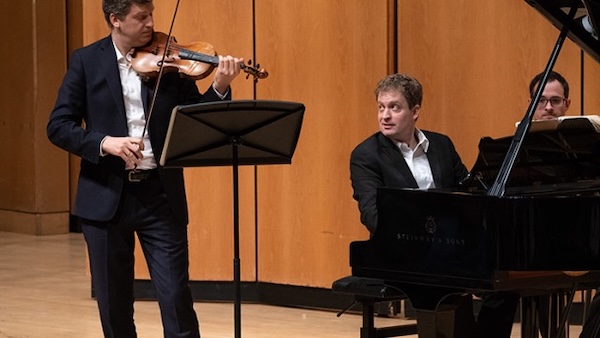
James Ehnes and Andrew Armstrong performing at Northwestern University in 2019. Photo: Elliot Mandel
What’s a recital that doesn’t include any Bach or Gershwin?
Not the one violinist James Ehnes and pianist Andrew Armstrong offered on Monday night at Tuckerman Hall. The opening event of the second season for the Worcester-based Armstrong’s A Little Night Music concert series, their appearance thrived on big stylistic and musical contrasts tied together by performances that were both interpretively thoughtful and technically accomplished.
The Bach in question, the last two movements from the unaccompanied Violin Sonata No. 3, offered Ehnes 10 minutes to shine alone onstage. He embraced them. An artist of enormous range, the Canadian virtuoso got at something approaching the essence of his musicality in these excerpts, a faultlessly voiced, singing account of the Largo and a fresh, brilliant take on the Allegro assai. The latter’s climactic bariolage episodes, with their dancing, beautifully directed voice leading, were particularly thrilling.
Armstrong followed this, eventually, with a snapping rendition of the first of Gershwin’s Three Preludes. Though the full set was announced in the program, he didn’t play the last two movements.
Instead, the pianist prefaced the Prelude with a striking composition of his own: a reverie inspired by a Tuscan summer festival with which he’s associated. In it, hazy dissonances and dreamy echoes of birdsong alternate with the hymn tune “Old Hundredth”; they move in and out of focus before eventually being swept away by the chime of church bells.
The recital’s first half featured the night’s big items: Mozart’s Violin Sonata No. 32 and Ravel’s Violin Sonata No. 2.
On the surface, these are wildly different works. There’s nothing particularly bluesy, for instance, about the former (though its slow movement wanders down some dark alleyways). Then again, Ravel’s evocation of that genre in his sonata’s second movement is decidedly smoky and Parisian.
Regardless, Ehnes and Armstrong, who’ve been busy these last years recording all sorts of repertoire together (though, interestingly, not Mozart or Ravel), found enough commonalities between these selections and their composers to convincingly tie them together.
There was the musics’ shared lyricism, for one. Ehnes teased out the vocal qualities of the Mozart with easygoing warmth and charm, while similar spots in the Ravel were managed with clarity and style.
Both players, who are longtime friends and recital partners, knowingly dug into the conversational aspects of these scores. Dovetailed phrases in the Mozart were smartly matched and the impish attacks in its finale rightly witty.
Much the same can be said for their take on the Ravel: the Allegretto’s saucy, pecking exchanges were models of personality. So was that section’s haunting, tremolando passagework. Meantime, the opening bars of the finale called to mind a toy car getting wound up; the ride that followed was fittingly wild.
Just as striking was the duo’s command of tone color and dynamics, be those the sudden shadows that emerged in the slow movement of the Mozart or the coy, smoky turns of phrase in Ravel’s “Blues.” Taken together, then, Monday’s traversals added up to more than the sum of their parts; if nothing else, they clearly drew a line from Ravel — who deeply admired Mozart — back to his idol.
What Ravel thought of his American contemporary Amy Beach is anyone’s guess, though Ehnes and Armstrong clearly have an appreciation for her lovely Romance. They played that songful number with a sweetness that was decidedly unsentimental and some welcome flashes of heat.
More of the last came in Henri Wieniawski’s fiendish Scherzo Tarantelle, which closed the night. Though, as Ehnes noted earlier in the evening, “everything you need to know about playing the violin” is to be had in Bach’s sonatas and partitas, the 19th-century Polish virtuoso found a few nifty accessories (mainly relating to harmonics and an expanded upper register) to add to the fiddler’s toolbox.
Ehnes took to them with the exuberance of a kid in a candy store — but a mature kid who remembers to brush his teeth after he empties his Halloween basket. There was an uncommon precision and musicality to how he dispatched the scherzo’s reams of runs, arpeggios, and more that elevated this music far beyond the level it usually achieves in performance. At the same time, his reading was perfectly natural, spirited, and characteristic.
Armstrong, whose part in the scherzo is much less involved, nevertheless played the perfect straight-man, anchoring the reading with an accompaniment that was both quietly colorful and rhythmically secure.
A Little Night Music continues with cellist Edward Arron and pianist Jeewon Park joining Armstrong in selections by Bach, Mozart, Schubert, Pärt, Grieg, Shostakovich, and Sousa at 7 p.m. on November 22 at Tuckerman Hall. tuckermannightmusic.org
Jonathan Blumhofer is a composer and violist who has been active in the greater Boston area since 2004. His music has received numerous awards and been performed by various ensembles, including the American Composers Orchestra, Kiev Philharmonic, Camerata Chicago, Xanthos Ensemble, and Juventas New Music Group. Since receiving his doctorate from Boston University in 2010, Jon has taught at Clark University, Worcester Polytechnic Institute, and online for the University of Phoenix, in addition to writing music criticism for the Worcester Telegram & Gazette.