
Poetry Review: Jerome Sala’s “Glop”—Un-American Studies
By Michael Londra
In his slyly subversive collection, Sala skewers consumer culture and capitalism’s digital temptations, finding room for poetry where money’s promises run out.
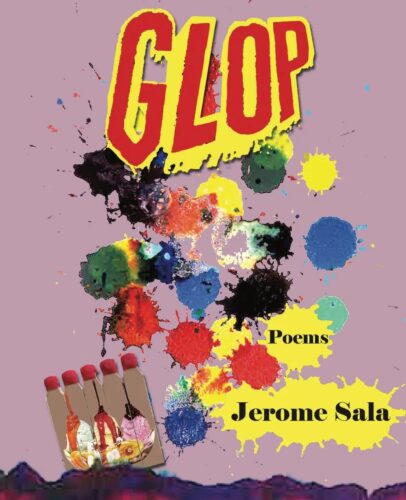
Glop by Jerome Sala. BlazeVOX, 110 pp., $18
 “Money is a kind of poetry,” Wallace Stevens once wrote. Perhaps he meant that the freedom that financial security confers is a thing of beauty. Or he could’ve been thinking about money as a metaphor—a linguistic paradigm that represents our desires and fears. A third interpretation could be that capitalism is not just an economic system, but a meaningful form of artistic expression. Money and poetry share a similar status — they are both mysterious objects. To the uninitiated, both can be equally impossible to make appear, on the page or in a bank account.
Jerome Sala’s verse collection Glop posits yet another argument altogether. A former copywriter and creative director with a PhD in American Studies, Sala is better placed than most poets to explore the nexus between the business world and lyric utterance. To begin with, his humorous title embodies the subversive poet and playwright Bertolt Brecht’s concepts of Spass (“fun”) and Haltung (“attitude”). Indeed, Glop is nothing if not a fun read powered by Brechtian attitude: “Napoleon clothed ponds / with thoughts of immensity / and Hegel tailored the emperor’s conceptual suit / in the style of World Historical Figure. // But no matter how much I think / I still can’t find clothes that fit right” (“The Understated Power of Oversized Clothes”).
Sala, in fact, could be an escapee from one of the German master’s Weimar stage productions. Emerging from Chicago’s competitive late-seventies punk performance art scene, he won the city’s Heavyweight Championship of Poetry in 1981—a forerunner to the national poetry slam craze of the nineties. But, while Brecht remained faithful to Marxism, Sala groks that capitalism and socialism are Gemini twins. Glop skewers what Samuel Johnson dubbed the “vanity of human wishes,” no matter the economic system.
Take the volume’s eponymous poem, “Glop.” Here Sala parodies the fetish for constant innovation. This entrepreneurial imperative paradoxically undermines what developers are supposed to be improving: “Some madman in a flavor lab / designed the banana vanilla almond milk / in my cereal this morning. // Slightly purple, somewhat gloppy…it is not just milk / but almond milk / and not just almond milk / but vanilla almond milk. / So, to the different / a difference has been added…Perhaps this banana almond milk / makes a statement— / a slurpy cognitive map / which slips down the gullet / heralding a shift in eras: / from pop culture to glop culture.”
“Something I’ve Not Bought” applies glop culture critique to the consumerist temptations of the gig economy: “Something I’ve not bought / is following me. / I see it in my Facebook feed, / peeking out from the top of my email stream— / the stream they promised they’d never sell…I see the tracks of its ads / like tears running down my screens.” The poem also explores the attendant anxieties: “In the morning, it’s there on my phone…It seems to pop out of the void…it knows I’ve spent a whole day / not buying it…if I ever click on it, / I’ll never be rid of it. / It will inhabit the very soul / of my machine, demanding ransom.” The poet’s strategy is an uneasy détente: “If I shrug it off, / I know it will be okay— / a stranger waving at me / from an ocean liner / I pretend not to see.”
Can one preserve one’s mental health given all the digital dangers? “No Sell” offers some insider pro tips: “We think every word we speak is a sales word. // We’re selling our reputation / our self-worth…But I’m of the school of no sell. / None of our sentences actually attempt to sell anything. / They are shot out of an economic cannon we cannot see. / They are confetti dancing over the void…Every day the stock market throws this party / to celebrate itself. / Even to watch it from afar is a treat. / If you inhabit this distance…you are either loaded / or some kind of artist.”
“Contentment,” on the other hand, is a portrait of the exploitation of those who supply what we stare at daily on our screens. The poem highlights Sala’s eye for a pun: “The freelance content provider is content…He just received the check…He can take the day off…Tomorrow and tomorrow there is time / for telling more tales / that generate increased clicks…Life is the journey between one content farm / and the next.”

Poet Jerome Sala. Photo: courtesy of the artist
Unsurprisingly, Sala hijacks inane clickbait headlines for the titles of some of his most serious poems, such as “Mob Wife Aesthetic Takes Over the Runway,” “Are You Being Manipulated at Work?” “Most Hated Celebs—Exposed!” and “First Photo of New Fantastic Four Cast,” in which he noodles on Marvel movies: “Together they march, arm in arm—a year given shape, anthropomorphized, / like some believe the gods give form to natural forces. / They exert an impressive control over whole demographic nations on the planet of leisure.” After correctly naming the Human Torch, Invisible Woman, and the Thing, Sala misidentifies Mr. Fantastic as Elastic Man—his only glop faux pas. This misstep is notable, since Glop overflows with diverse allusions: Slavoj Žižek, James Garner, William Bronk, The Bhakti Sutras, Huckleberry Hound, Blade Runner, Larry Rivers, and Joy Division, among others. Memorable lines are almost as frequent as the dropped names: “Is the universe a con game invented by a quantum storyteller” (“The Consultation Business”); “suddenly history appears / a feral kid / afraid of being captured” (“Feral”); “Infinity also / is a bullshit artist” (“Poseurs”); and “the land of the free becomes / the land of the freebie” (“On Becoming Smaller: A meditation on shrinkflation”).
Drawing on his doctorate in American Studies, Sala inverts conventional ideological viewpoints into what might be called “un-American studies.” Take, for example, Freud’s notion of “Libidoökonomie” or “libidinal economy.” When the sublimation of unconscious drives into art is correlated with political economy—the academic discipline that examines the interconnection of financial markets and political systems—Freud’s metapsychological creed is made to underwrite an “economic hypothesis,” linking what’s “inside” to what’s “outside.” Putting his own spin on the old libidinal curveball, Sala invents “poetic economy.”
Sala’s best poem in Glop, “Unconscious Economy,” is an extended riff on this materialist leitmotif. It starts with the poet at his local bank: “When you step inside you breathe money— / then when you walk back out, / you can feel money make money // in its sleep. Of course, money never sleeps; / its wire highway ships numerals day and night.” For Sala, the bank is an intermediate space where the two parties—poetry and money—can seek an awkward truce: “But we are human; it is money. / For us to communicate, we need to pretend / we speak the same language.” Poetry and money, therefore, are consonant because both tell the truth: “This is your way of saying hi to yourself…Money works hard to hold up a mirror.”
This is why Jerome Sala’s Glop—though it starts from the same conceit—butts heads with Wallace Stevens. To me, “Money is a kind of poetry” sounds like a fat cat’s taunt: a man lording his wealth and his shelf of published books over commie bohemians who dare insist that true poetry has nothing to do with filthy lucre. Stevens, of course, reveled in laissez-faire Republicanism—precisely what Glop resists. Sala’s poetic economy offers an un-American alternative: to thrive in the gaps between grand abstractions like “money” and “poetry.” Breathing room for the soul is preserved: “we exist / in the multiple voids / between a banker’s keystrokes. / It’s not bad here. / The empty space is alive” (“I Saw the Sign”). Glop turns out to be hopeful. A poem is better than money: it is portable shelter, a protection that’s easy to carry. “Learn to play the long game,” Sala sings in “Vitamin Sea,” “become a tortoise with a magnificent shell.”
Michael Londra is a poet, fiction writer, and critic whose work has appeared over thirty times in The Arts Fuse. He recently introduced the Poets Confront AI and Surveillance Capitalism event at Poets House, available on YouTube. He can also be seen discussing New York writers in the YouTube indie documentary Only the Dead Know Brooklyn (dir. Barbara Glasser, 2022). “Time is the Fire,” the prologue to his soon-to-be-completed novel about Delmore Schwartz and Lou Reed, was published in DarkWinter Literary Magazine. His poetry was translated into Chinese by scholar-poet Yongbo Ma. Two of his contributions to the Asian Review of Books were named Highlights of the Year for 2024 and 2025; one of these was translated into Vietnamese. “Life in a State of Sparkle—The Writings of David Shapiro,” published in The Arts Fuse, was selected for the Best American Poetry blog. His work appears or is forthcoming in Lana Turner: A Journal of Poetry & Opinion, Restless Messengers, The Fortnightly Review, spoKe, Cha: An Asian Literary Journal, and The Blue Mountain Review, among others. He contributed six essays and the introduction to New Studies in Delmore Schwartz, forthcoming next year. Born in New York City, he lives in Manhattan.
Tagged: American poetry, Bertolt Brecht, BlazeVOX, Capitalism, Glop, Jerome Sala, Michael Londra, Poetry, Poetry reviews, consumer culture, contemporary poetry, digital culture, money and art, satire, surveillance capitalism