Book Review: “The Pope Against Nuremberg” — A Sanctuary from Justice
By Thomas Filbin
In The Pope Against Nuremberg, historian Gerald J. Steinacher examines how Catholic Church officials shielded war criminals—and placed institutional interests above moral accountability.
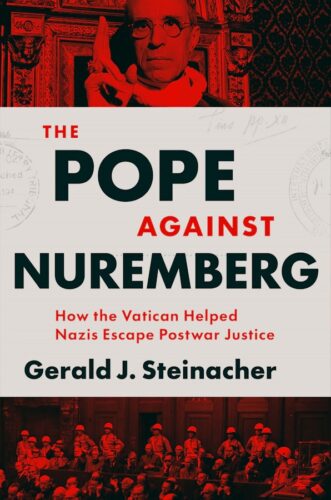
The Pope Against Nuremberg: How the Vatican Helped Nazis Escape Postwar Justice by Gerald J. Steinacher New York University Press. 349 pp.
If harming others is a sin, helping the perpetrators escape justice compounds the offense. By that measure, the complicity of those who shielded Nazis and Third Reich sympathizers—people who should have known better—ranks among the gravest moral failures of the postwar era.
Historian Gerald Steinacher’s illuminating, meticulously documented account lays bare the Vatican’s foot-dragging and resistance to Allied efforts to bring German war criminals to justice. Drawing on newly opened Vatican archives, he shows how senior figures in the Catholic Church devoted energy and ingenuity to protecting men whose crimes should have placed them beyond any claim to sanctuary.
Those of us who were teenagers in 1961 and followed Adolf Eichmann’s trial in print and on television confronted the terror of Nazism. Far less publicized, but essential to understanding its aftermath, was the role of the sympathizers and silent accomplices who helped its perpetrators evade accountability.
My law professor, Thomas Lambert, understood what was at stake. A junior Navy officer in 1946, he was selected to serve as a Nuremberg prosecutor. He had graduated from the University of California, Berkeley, and Yale Law School and had been a Rhodes Scholar at Oxford in the 1930s. During a summer break at Oxford, he and several classmates traveled to the Continent. One night, while they were staying in a German youth hostel, the Gestapo kicked down the door in search of Jews. They left the Americans and British alone. Lambert said the encounter taught him the value of the American Constitution—and how dangerous it was to assume that the rights it protected were recognized everywhere.
Steinacher’s account reveals a different response to that same lawlessness: not a resolve to confront it, but a willingness to shield its perpetrators. After Mussolini’s government fell and Allied forces advanced through Italy, the Vatican invoked its sovereignty to resist American efforts to arrest and prosecute Germans who sheltered within its jurisdiction and claimed diplomatic immunity.
Behind that resistance lay a moral calculus that cast Soviet communism as a greater evil than fascism—and made fear of one an excuse for complicity with the other. Ernst von Weizsäcker, the senior Nazi official appointed ambassador to the Vatican in 1943, cultivated close relations with the pope and worked to “shift the narrative and focus away from Nazi war crimes and toward the threat of communism.”
The evidence at Nuremberg left no room to plead ignorance of Nazi barbarism. Testimony and documents established its systematic character; footage of a bulldozer pushing heaps of corpses into mass graves at Bergen-Belsen gave that evidence a sickening immediacy. Yet a durable myth assigned that savagery to the SS while it absolved the Wehrmacht, Germany’s regular armed forces.
As Steinacher explains, the tribunal declared the SS a criminal organization but made no such declaration about the regular armed forces. That legal distinction served as a sweeping moral alibi: “This distinction laid one foundation for the myth that the Wehrmacht had nothing to do with the Holocaust. In turn, millions of German men who had served in the Wehrmacht got essentially a legal and moral free pass for decades to come.”
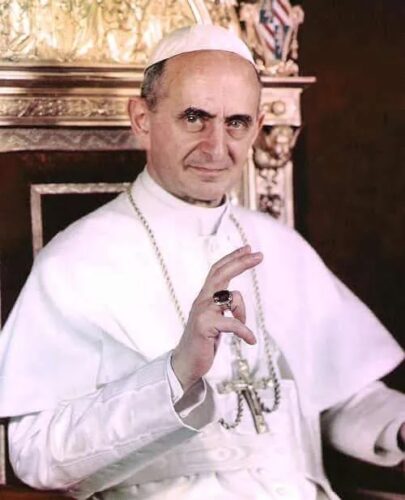
Pope Paul VI. Photo: My Catholic World
Supreme Court Justice Robert Jackson, the chief U.S. prosecutor at Nuremberg, used his closing statement in July 1946 to demolish the defense argument that men such as Göring, Ribbentrop, and Field Marshal Keitel could issue the orders yet bear no responsibility for the killing. “If you were to say of these men that they are not guilty, it would be as true as to say there had been no war, there are no slain, there has been no crime.”
Nor were all the perpetrators military men. Hans Frank, governor-general of occupied Poland, was a lawyer who had served as legal adviser to Hitler and the Nazi Party during their rise to power. In his homeland, he presided over a reign of terror, forced labor, and mass murder. Arthur Greiser, another Nazi official, pursued the brutal “cleansing” of Polish territory with the zeal of a man convinced that Germans were the master race and Jews beneath contempt.
When Greiser was condemned to death in 1946, the pope intervened to seek clemency. Steinacher writes: “Whatever the reasons for it, though, the Poles angrily rejected the pope’s intervention. Greiser was publicly hanged before a crowd of 15,000 observers.” His execution took place in Poland in July, three months before the Nuremberg executions—a separate reckoning in the country where he had committed his crimes.
The Nuremberg executions did not end the pursuit of Nazi war criminals. Some had fled abroad or assumed new identities; others lived more or less openly. Adolf Eichmann, a principal architect of the Holocaust, received help from a papal aid commission and obtained Red Cross travel papers. On June 14, 1950, he boarded a ship in Genoa bound for Argentina. He remained there until 1960, when Mossad agents seized him and took him to Israel for trial. Steinacher documents the aid and protection Catholic churchmen extended to men who should have faced justice.
The chapter “The Vatican Ratline” traces the Church’s role in helping Nazis escape prosecution. Krunoslav Draganović, a Yugoslav collaborator, sought Vatican help to block the extradition of war criminals. British intelligence described him as a “notorious friend of the Croatian fascist state during the war, and a key resource in later helping Axis war criminals finding escape routes.” Yet he enjoyed powerful protection. According to Steinacher, Monsignors Montini and Tardini, two of the pope’s closest aides, worked with the man who became known as the “golden priest.”
Neither association proved an obstacle to advancement. Tardini became a cardinal and Vatican secretary of state. Montini became Pope Paul VI.
Steinacher’s extensively researched book does more than establish a record of cooperation. It calls a religious institution to account for betraying the principles it claimed to defend. The churchmen in these pages did not merely fail to practice what they preached. They placed the protection of their institution—and their fear of its ideological enemies—above justice for the victims of mass murder.
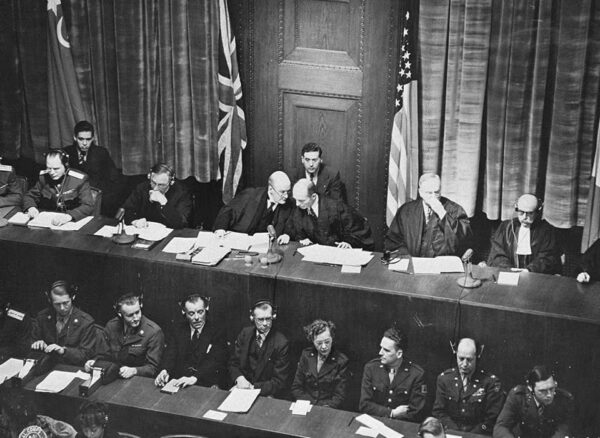
Judges of the International Military Tribunal. United States Army Signal Corps . Photo: courtesy of the Harry S. Truman Library & Museum, 2004-437
Otto Preminger’s fine film, The Cardinal (1963), offers a sweeping portrait of twentieth-century Catholicism and dramatizes the Church’s failure to confront Nazism. Bishop Fermoyle, a Boston-born American cleric played by Tom Tryon, has risen through the Vatican hierarchy. Sent to Austria in 1938 at the time of the Anschluss, he confronts a Church leadership willing to accommodate Hitler’s annexation. Cardinal Theodore Innitzer, the archbishop of Vienna, played with unnerving plausibility by Josef Meinrad, endorses annexation in the referendum, fearing that resistance will bring Nazi reprisals against the Austrian Church. On the night of the vote, he steps onto his balcony and gives the Nazi salute. He calls it a gesture of peacemaking, a necessary concession to preserve the Church. It is capitulation to evil. Over coffee and strudel with Fermoyle, he disguises his cowardice in the civilized language of diplomacy.
Against such evasions, Steinacher sets the achievement of Nuremberg: “Nuremberg represented a triumph of the rule of law and due process, an alternative to revenge killings or collective punishment. The Nuremberg trials were not perfect (as is true of similar war crimes tribunals), but they were much different—and arguably better—than previous attempts at just reckoning after war.” His distinction between justice and vengeance is essential: “Forgiveness can never be imposed on victims, and the pursuit of accountability should not be mistaken for vindictiveness.”
Nuremberg was neither an isolated event nor should be considered a relic of a finished past. Its legacy extends to the present, including later war crimes trials involing Yugoslavia and Rwanda. Steinacher’s vivid account deserves a lasting place in public memory—not merely as a record of justice pursued and obstructed, but as a warning to those who wage war and those who shelter its criminals: the end of the fighting must not mean the end of accountability.
Thomas Filbin’s reviews have appeared in The New York Times Book Review, The Boston Sunday Globe, and The Hudson Review. His novella Carousels was recently published. He lives near Boston and teaches writing at Suffolk University.
Tagged: Catholic Church, Gerald J. Steinacher, Holocaust, Nazi escape routes, Nuremberg trials, The Pope Against Nuremberg, Thomas Filbin, Vatican, book-reviews, historical accountability, history, postwar justice, ratlines, war crimes