
Film Reviews: Escaping Putin’s Russia, Serving Vichy France — Three Films at the New York Film Festival
by David D’Arcy
Julia Loktev’s six-hour portrait of exiled TV Rain journalists headlined a festival program along with a tale set in Andrey Zvyagintsev’s corrupt provincial Russia and Emmanuel Marre’s understated study of collaboration under Nazi occupation.
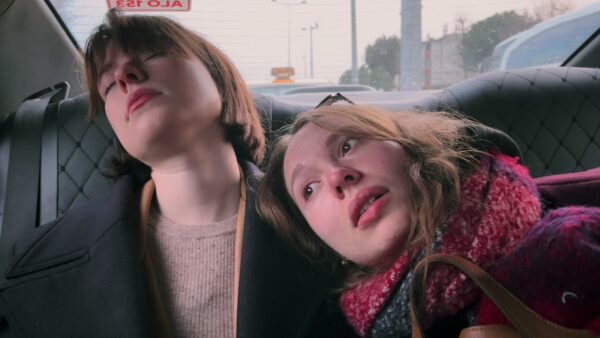
A scene from My Undesirable Friends: Part-II–Exile. Photo: NYFF
The death toll in Ukraine is rising on both sides. The toll of displacement is much higher, especially among Ukrainians. We see the human cost in My Undesirable Friends: Part II — Exile, Julia Loktev’s account of the expatriate lives of her friends at TV Rain, the television news organization and rare independent media voice that the Moscow government closed in 2022 because of its coverage of Russia’s invasion of Ukraine. The documentary follows My Undesirable Friends: Part I — Last Air in Moscow (2024), about TV Rain’s abrupt end. (Arts Fuse review)
The journalists there, who were forced by a new Russian law to identify themselves as “foreign agents,” saw things getting worse and left the country. They lost their livelihoods and their safety. Their audience lost a link to crucial information about their own government and its murderous war next door and subversion campaigns in other neighboring countries. Moscow’s pursuit of these journalists did not end once they went into exile.
The country-hopping documentary, which runs almost six hours, examines what happened to truth in Russian media through the voices of those who tried to report it. Here, they themselves become stories.
The TV Rain journalists fled, usually with one suitcase, two at best. Loktev and her camera follow some of them to Istanbul, which has its own dark history. It was where the Washington Post journalist Jamal Khashoggi, seeking a marriage license at the Saudi consulate in 2018, was killed and dismembered with a bone saw by a death squad dispatched by a U.S. ally in Riyadh.
The Khashoggi comparison is not far-fetched. Given Khashoggi’s fate, the film’s title takes on special importance. “Undesirable,” as the journalists are referred to in Parts I and II, has a specific bureaucratic meaning: it refers to the state’s attitude toward them. Their Moscow office is filled with poster-sized photographs of murdered journalists—evidence for anyone reluctant to believe the worst. “Undesirable” is a step away from “expendable.”
Given what we know about Putin, it is remarkable that these reporters accomplished as much as they did. To some, it had seemed inevitable that Putin would strike back. “Journalism is publishing what someone else does not want published,” one of the journalists says.
And simply publishing what the authorities wanted published was not an option. “Propaganda is like radiation,” says another. “It poisons you.”
Eventually, they reconstituted in Riga, Latvia—a credibly anti-Putin location, or so they thought—and TV Rain resumed broadcasting. A mistake by a contributor who referred to Russian troops as “our” ignited a scandal over a remark that the journalist tried and failed to defend on Latvian television. Rain’s operation was shut down, which meant that the staff lost their visas and could no longer stay.
They and their suitcases dispersed again: some to Prague, some to Poland, one to Israel (until she decided not to remain), and some to Georgia (Tbilisi was another place where it was not safe to be seen as anti-Russian). Some traveled on fellowships to the United States. Some fell in love.
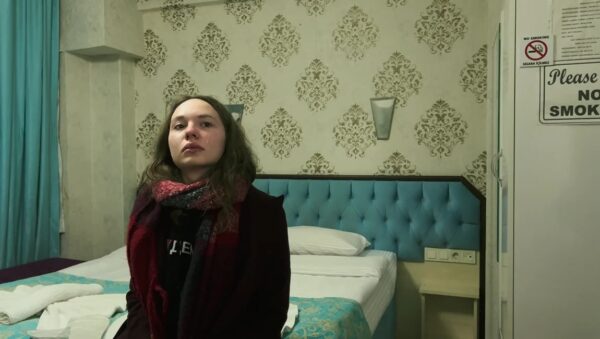
A scene from My Undesirable Friends: Part-II–Exile. Photo: NYFF
Loktev was there all the time with her camera. Yet, as she expresses in interviews, she did not begin as a documentary filmmaker but as a director of experimental features. My Undesirable Friends: Part II — Exile presents dramatically unfolding scenes in which all aspects of life converge—somewhat like the things you stuff in a hurry into a suitcase and unpack as a mess that needs organizing. Such, for better or worse, is what exile can be when it is not life-threatening: no money, no permanent home, no job, no roots, lots of apprehension, and lots of friends with the same problems. Loktev was the friend who had left Russia years earlier with her family and therefore had an adopted home in the United States.
As in a feature film, the characters in Loktev’s documentary had stories beyond their own hardship: war reporting, coverage of trials ending in long sentences before compliant judges—as so many Russian trials are—and the arrests and detention of protesters. The reporters were the first to admit that the telling of these stories was diminished because the events were not being witnessed in Russia.
But they were alive to tell those stories—something of a miracle as you watch Loktev’s film, which was as frank and probing as the first chapter of their story, My Undesirable Friends: Part I — Last Air in Moscow, in which we see TV Rain operating as a dogged observer of the Kremlin.
As the exiles gather in hostels and hallways, Loktev deftly weaves in events the journalists could not get close enough to cover. These episodes document how the brutal, corrupt Russian regime operates. The reporters obtained footage of protests—where arrested demonstrators could expect stiff prison sentences. Some followed the aftermath of the 2024 death of opposition leader Alexei Navalny in a remote penal colony. Prison authorities, most likely acting on orders from higher-ups, conveniently misplaced the man’s body when Navalny’s widow arrived to collect it for burial.
The father of Anna Nemzer, a TV Rain journalist and editor, died after writing her a poignant letter. She could not return to Russia because doing so would risk arrest. Her enforced separation showed one of the ways the authorities continued to punish the regime’s opponents.
At another point, when the TV Rain staff reunited in exile, they welcomed a Russian woman who claimed to have represented dissidents. On camera, she spoke convincingly to the journalists. Then she vanished. Afterward, the journalists could not confirm any of the credentials she claimed; she later turned up in Moscow. Once again, Vladimir Putin’s long arm did not loosen its grip.
These stories carried you through six hours of the finished film. A sequel would be hard to resist; so would the hours of raw footage that Loktev shot.
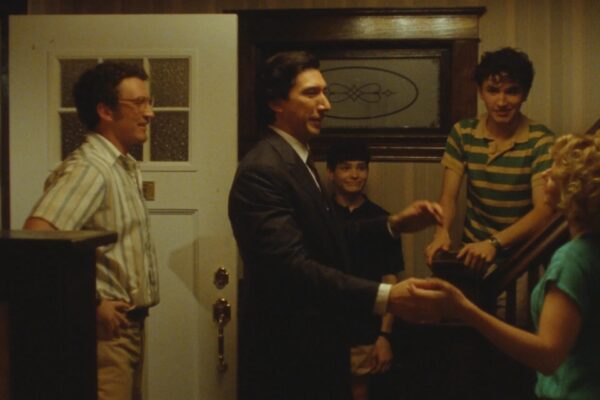
A scene from Paper Tiger. Photo: Neon
The exhaustive and compellingly watchable My Undesirable Friends: Part II — Exile was not alone among this year’s New York Film Festival films about Russia, which ended on October 12. The festival opener was James Gray’s star-filled Paper Tiger, a family-versus-Russian-mob drama. Also set in Russia: Andrey Zvyagintsev’s Minotaur, a dark, elegant, and respectful tribute to Claude Chabrol’s The Unfaithful Wife (La Femme Infidèle, 1969), placing a story of infidelity—and a vengeful husband’s balancing of revenge and opportunism—against the self-enrichment politics of business owners in a provincial town.
In 1969, Chabrol cast his own wife, Stéphane Audran, in the leading role. Zvyagintsev does not go that far.
I’ll leave Minotaur to other reviewers on this site. The film points to the harm created by those complicit with corrupt authority—here, a harm far greater than an angry man killing his wife’s boyfriend. And, lest anyone need reminding, Russia’s most dreaded villain today is not a fictional character but Vladimir Putin.
Zvyagintsev has left Russia and now lives in France, the homeland of his Minotaur muse, Claude Chabrol. A co-production, Minotaur is officially a French film and France’s nominee for the international Oscar. Emmanuel Macron, who already has his hands full with angry teenaged protesters, might now want to hire some food tasters. If Minotaur wins an Oscar, expect political blowback. Consider, too, that the United States has just agreed to buy diesel fuel from Russia, enriching by billions of dollars a country it has sanctioned.
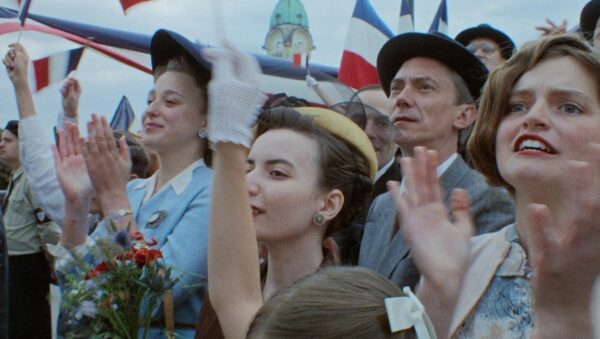
A scene from Emmanuel Marre’s A Man of His Time. Photo: KVIFF
Also at the New York Film Festival, from France and Belgium, was Emmanuel Marre’s A Man of His Time, which won the screenplay prize at this year’s Cannes Film Festival. Based loosely not he experiences of Marre’s great-grandfather, it follows a French official who sought the advantages of serving the government established in the spa city of Vichy after France’s surrender to Germany in 1940. The film’s French title is Notre Salut (“Our Salvation”), which gives a sense of the corrupt Vichy regime’s empty official sanctimony.
Monsieur Henri Marre went to Vichy looking for work and was willing, as he puts it, to do anything. After being sent behind German lines to recover an official’s cats—if that is not “anything,” I don’t know what is—he enters the corridors of power, if the offices of a humbled collaborationist government can be called that.
Also at the New York Film Festival, from France and Belgium, was Emmanuel Marre’s A Man of His Time, which won the screenplay prize at this year’s Cannes Film Festival. Based loosely not he experiences of Marre’s great-grandfather, it follows a French official who sought the advantages of serving the government established in the spa city of Vichy after France’s surrender to Germany in 1940. The film’s French title is Notre Salut (“Our Salvation”), which gives a sense of the corrupt Vichy regime’s empty official sanctimony.
Monsieur Henri Marre went to Vichy looking for work and was willing, as he puts it, to do anything. After being sent behind German lines to recover an official’s cats—if that is not “anything,” I don’t know what is—he enters the corridors of power, if the offices of a humbled collaborationist government can be called that.
Henri Marre, played by Swann Arlaud, has a gift for organization ideal for a bureaucrat, and he is put to work—sometimes with housing, sometimes with transport—but the film never dwells on the likelihood that he may be sending Jews eastward to a horrific fate in the camps. It should be noted that the camps where Jews and Spanish exiles were detained in Vichy France were themselves a horror.
I kept thinking of “the banality of evil” while watching A Man of His Time. Without debating whether the term retains any validity today—evidence and testimony have shown that Adolf Eichmann’s hatred of Jews was anything but banal—this portrait of a middling French bureaucrat during the Nazi occupation is less about anything diabolical than about the quiet satisfactions of keeping the lights on. Beyond the complicity of a man eager to please, the film offers little more than a creature of striking grayness aspiring to functionary status.
Emmanuel Marre and his team give the film the look of its time, chiefly through drab interiors. How it won the screenwriting prize at Cannes this year is beyond me. Still, it is a film of dramatic restraint, paradoxically set amid mass murder, and worth watching at least for its understated production design.
David D’Arcy lives in New York. For years, he was a programmer for the Haifa International Film Festival in Israel. He writes about art for many publications, including the Art Newspaper. He co-produced and co-wrote the documentary Portrait of Wally (2012), about the fight over a Nazi-looted painting found at the Museum of Modern Art in Manhattan.
Tagged: A Man of His Time, Andrey Zvyagintsev, Cannes, Claude Chabrol, Emmanuel Marre, Exile, French cinema, James Gray, Julia Loktev, Minotaur, My Undesirable Friends, My Undesirable Friends Part II, NYFF, NYFF 2026, Nazi occupation, New York Film Festival, Notre Salut, Paper Tiger, Russia, Russian cinema, Russian journalism, Swann Arlaud, TV Rain, Ukraine, Vichy France, Vladimir Putin, documentary, film criticism, film review, press freedom
