
Book Review: And Quiet Flow the Dons
By Thomas Filbin
Colin Kidd’s lively history follows universities in Oxford and Cambridge from postwar confidence through rebellion, Thatcherite assault, and a troubling loss of institutional nerve.
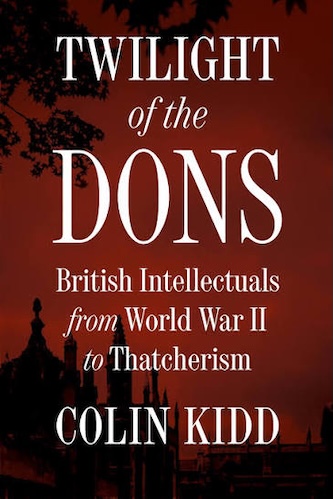
Twilight of the Dons by Colin Kidd. Princeton University Press, 271 pp. $35.
 Oxford and Cambridge universities in the U.K. sound a mythical ring in American ears. Oxford’s beginnings date to 1096, while Cambridge was founded in 1209 after a rebellious pack of Oxford scholars left for happier digs. Supposedly, Oxford’s townsfolk had not been friendly to them—and vice versa. Both universities boast so many layers of patina of history on their stone towers and grassy quads that American institutions seem like infants by comparison.
Colin Kidd is currently Wardlaw Professor of Modern History at the University of Glasgow, but he is a longtime Oxonian who was twice a fellow of All Souls College, Oxford (1987–94 and 2005–19). So he knows whereof he speaks in this animated survey of the instutions. All Souls is one of the university’s colleges, but it has the distinction of having no students. Fellows are chosen to spend their time doing research and writing. Nice work if you can get it.
In the spirit of full disclosure, even though I teach at a university now, when I was nineteen you would not have bet a quarter that I would become anything but an abysmal, pathetic failure. I had dropped out of—or flunked out of—two colleges, been dumped by a girlfriend who saw nothing in me, and failed the U.S. Army physical in the middle of the Vietnam War, even though I was attempting to volunteer. It was my version of joining the French Foreign Legion — a radical way to escape from one’s life.
By age thirty, however, I had earned bachelor’s and law degrees. Finally, I had become mature enough to succeed at school. In middle age, wishing to climb a higher mountain, I secured a sabbatical from work through a connection at Oxford and had the chance to be an academic visitor there for a term. I could study anything and everything, attend lectures, seminars, and events. I could use all the libraries, museums, and academic centers I wanted—with no questions asked. It was heaven — without qualifying footnotes. Years later, after retiring from work, I completed a master’s degree in English at Harvard.
I say all this not as a boast but as an invitation to anyone who feels they missed the train, slept through an opportunity, or bumbled stupendously in youth while others zoomed past. If you are still breathing, it is not too late.
Oxford has been called the city of dreaming spires, and I urge you to take the one-hour train ride from London, even for a day, to walk about and soak it in. Cambridge, too, is accessible — on a different line. There is an aura and weight of time in those places that will make you believe that the human race, despite all its missteps, stupidities, and Neanderthal behavior, might just accumulate the learning and knowledge that will prevail and make the world a better place.
Kidd begins his journey after World War II, when life and the world had changed, but old habits in dusty, musty universities clung to life. C. P. Snow’s 1951 novel The Masters probed the intrigue and machinations of higher-education politics at the time. In many ways, the ancient folkways and mores of British higher education continued to prevail, with privilege still holding tightly to the reins. Still, that world would be under assault as the “red brick” universities—newer institutions—developed. Higher education was no longer just for the upper crust.
One reason postwar Oxbridge was different is that men who had served in the military were now starting college. It was harder for a professor to intimidate a twenty-two-year-old who had seen combat than an eighteen-year-old still green behind the ears. Oxbridge was drawn into the conflict; Kidd notes that “Dons contributed to every sphere of the war effort, sometimes in the upper echelons of military strategizing, sometimes on the front line.” Michael Oakeshott, a historian and philosopher and fellow of Gonville and Caius College, Cambridge, was an Army captain who served in the Netherlands and Germany in a special reconnaissance unit. Robert Blake, a future don at Queen’s College, Oxford, served in the North African desert, was captured by the Italians, spent fifteen months as a POW, eventually escaped, and survived on the run through a harsh winter. No meek book-boys were they.
The postwar years inevitably brought change to Oxford and Cambridge, as they did everywhere. Christianity lay at the bedrock of medieval universities, and after the Reformation the Anglican Church was England’s official, established religion. Kidd notes that “Even those dons who were most outspoken about Christianity happily acquiesced in the residual Anglican establishment found on their own turf.” Colleges had chapels, ordained fellows, and scheduled regular services. By the 1950s, religion’s traditional influence had waned, but it remained a presence.
The classicist Maurice Bowra, warden of Wadham College from 1938 to 1970, “was at bottom pagan, with a mischievous anticlerical strain, yet he maintained a respect for established religion and a precise, if ambivalent, attachment to specifically Anglican worship.” Attendance at chapel these days is minimal, however, and religion has become more nominal than actual. When I was there, I once attended Sunday evening vespers at The Queen’s College, founded in 1341, and there were more choristers than congregants.
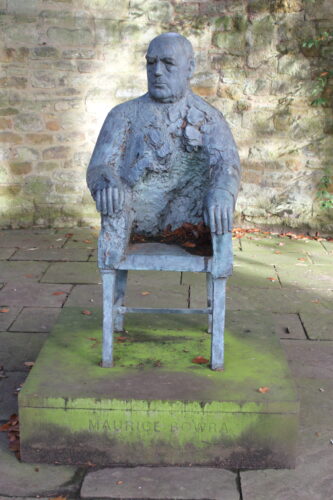
Sculpture of Maurice Bowra in Wadham College, Oxford. Photo: Wikimedia
By the 1960s and ’70s, Oxbridge’s rigid traditionalism embraced social change, which included an interest in America. American-studies programs sprang up, and a few academics took flight for positions in the U.S., lured by larger salaries. Harvard, MIT, Johns Hopkins, Stanford, and other institutions, in the hunt for highbrow prestige, established programs and lecture series to attract prominent names.
Resistance in the homeland remained, however. “America also brought out in some dons snobbish condescension about the vulgarity and garishness of this arriviste culture, including the solecisms of American English,” notes Kidd. Geoffrey Marshall, a politics don at Queen’s College, Oxford, invented an imaginary pressure group with the playful acronym SPIT: the Society for the Prevention of Inadvertent Transatlanticisms.
The student uprisings of the 1960s and ’70s in France and the United States were less violent in England. Rebellion took the form of a disdain for constricting codes, manners, and regulations for what the new generation regarded as worthless antique machinery. “The days of the quasi-monastic ethos of Oxbridge colleges” were coming to an end.
Kidd devotes a whole chapter to the upheaval of the 1980s; it is entitled “The Advent of Thatcherism: Whig Grandees, Tory Marxists.” Some dons, he writes, were supportive of Thatcher’s becoming prime minister, united by their contempt for student rebellions and the growing liberal attitudes of fellow faculty members. Thatcher’s secretary of state for education, Sir Keith Joseph—himself a fellow of All Souls College, Oxford—began an introductory meeting with civil servants by asking, “How do you close a university?”
Donald Trump’s current war on higher education revives Thatcherism in one respect, though it is driven less by a coherent rationale than by animus. Thatcher was blunt in demanding that dons abandon “their hallowed academic practices” and reduce “unit costs.” She treated higher education in the language of efficiency experts—the sort who clutch stopwatches while timing workers on an assembly line. Many dons understood that the declining status of history and classical languages also reflected a changing academic order: natural and social sciences, engineering, and medicine were gaining power in a rapidly transforming world.
Some academics took up the cudgels against Thatcher’s campaign to reshape the ancient universities. Ironically, Thatcher herself was an Oxford alumna, having attended Somerville College. Dame—later Baroness—Mary Warnock, head of Girton College, Cambridge, whose husband, Geoffrey Warnock, was principal of Hertford College, Oxford, opined that Thatcher had “a total lack of understanding how what universities were about.” Warnock also found something obscene in Thatcher’s predictably bourgeois shopping habits at Marks & Spencer, describing her dress sense and appearance as “not exactly vulgar, just low.”
Meow and ouch!
Predictably, postmodern pressures succeeded. Noel Annan, who became provost of King’s College, Cambridge, embraced, according to Kidd, the gilded comforts, pleasures, and high living of dons. Yet he took contemporary trends and demands seriously and was “a somewhat restless modernizer and neophiliac.” The writer does not romanticize Oxbridge’s reverence for tradition; he recognizes how readily it can harden into institutional sclerosis.
In his epilogue, Kidd distills the decades of change he has chronicled into a simple proposition: no institution can become so encased in tradition that it ignores the present and its demands. However weighty their histories, institutions must serve purposes relevant to the world they inhabit. The transformation Kidd documents, with intelligence and thoroughness, brought real benefits. Yet its erosion of the status and deference once accorded these hallowed places also exacted an unforeseen cost. “Individually,” Kidd concludes, “many dons remained as lively, ambitious, and ingenious as ever; but collectively, there was a shriveling of self-confidence, a narrowing of options, a waning of elan.”
Thomas Filbin’s reviews have appeared in The New York Times Book Review, The Boston Sunday Globe, and The Hudson Review. His novella Carousels was recently published. He lives near Boston and teaches writing at Suffolk University.
Tagged: "Twilight of the Dons", Cambridge University, Colin Kidd, Oxford University