
Theater Review: “All My Sons” — Unearthing the Rot Beneath the American Dream
By Robert Israel
Scott Edmiston’s sharply acted Lyric Stage revival of Arthur Miller’s 1947 drama reveals the moral rot lurking beneath postwar suburban prosperity—and its unsettling relevance today.
All My Sons by Arthur Miller. Directed by Scott Edmiston. Staged by Lyric Stage Company of Boston, 140 Clarendon Street, 2nd floor, Boston, through October 18.
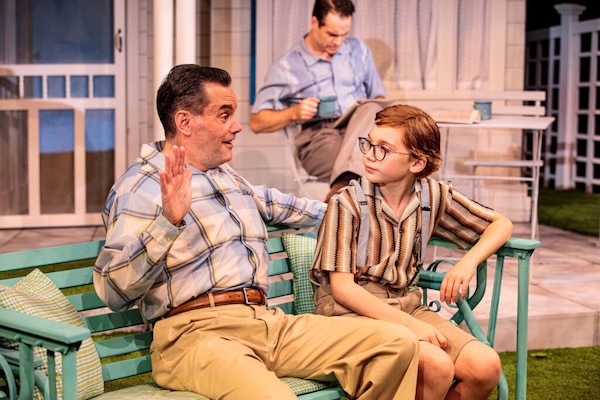
Bill Mootos and Julian Hirshfield in the Lyric Stage production of All My Sons. Photo: Benjamin Rose
In January 2027, Arthur Miller’s All My Sons, his first dramatic success, will celebrate its 80th anniversary. The play has local roots: Boston’s Colonial Theatre was the designated tryout stage, where Miller and director Elia Kazan fine-tuned the work before trucking it to Broadway. It was a success and ran for over 300 performances. Drawn from a true story, the play reaped numerous awards and was later adapted for film, catapulting Miller into the limelight—and into a lifetime of controversy, including an investigation by the House Un-American Activities Committee—while also freeing him to create his masterwork, Death of a Salesman, in 1948.
The Lyric Stage production, under Scott Edmiston’s keen-eyed direction, is well worth seeing. It arrives after a long hiatus: given its prominence in the canon of American dramatic literature, the play was last seen at the Huntington Theatre Company in 2010. (Arts Fuse review of the 2012 Barrington Stage production.)
Set in a small American town in post–World War II America, the play shows our republic’s collective democratic dream come to life. The characters we meet over the course of two and a half hours are comfortable, not only financially but romantically. Theirs is a Norman Rockwell magazine cover come to life: blue skies, green grass, white picket fences, a place where women wear starched aprons and floral dresses and serve tea, and men wear pressed chinos and shiny loafers and read afternoon newspapers, boasting about their unbridled successes in business.
But dark portents lurk in this idyllic suburban American neighborhood. In Miller’s version of paradise, some dreams may indeed come true, but at a cost. We’re reminded of this by the pesky tree that has been split in two by lightning and lies splintered in the otherwise picturesque backyard. Originally planted in tribute to Larry, the missing son, it represents moral decay. While this symbolism has been used before—notably by Edgar Allan Poe in his 19th-century tale “The Fall of the House of Usher,” to depict a family’s descent into madness—it works here because it illustrates the disparities between those who want to believe in honesty, justice, and the American way, and those who have cut corners to get to the finish line, focusing on men who have been accused of chicanery but insist that they be absolved of all wrongdoing. Miller is especially adept at exposing the ways in which truth and deceit have become intermingled in the family—these knots fester on multiple levels.
The cast is collectively effective and mostly succeeds in convincing us of the characters’ conflicting realities and hidden agendas. I was particularly impressed with lead actor Bill Mootos, who plays the paterfamilias, Joe Keller. He projects a sense of American bravado in one scene, but later shows how repressed dishonesty has eaten away at his confidence and, painfully, is destroying his intimate relationships. His wife, played by the superb Laura Marie Duncan, projects enormous cheerfulness and optimism until, unable to sustain that sunshiny disposition, she is overwhelmed by the heartache that comes with the collapse of her special, protected world. As her put-upon son, Chris Keller, actor Mark Souza is to be commended for being able to pivot between sorrow and joy, before finally being mired in the deepest shame. And, as George Deever, who appears dressed in black against the brightness of the set, Quinton Kappel draws on a sullen lankiness to project a gripping sense of despair and outrage.
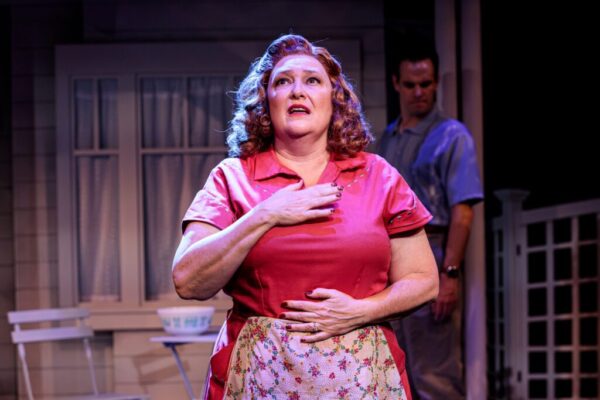
Laura Marie Duncan in the Lyric Stage production of All My Sons. Photo: Benjamin Rose
The production succeeds in large part thanks to exquisite costumes by the talented Chelsea Kerl, who captures the style of the late 1940s with impressive authenticity. Karen Perlow’s lighting spotlights individual characters during their entrances, quickly establishing a contrast between idyllic surfaces and threatening undercurrents.
Less effective is Janie E. Howland’s set, which does not fully screen off the backstage area. Fencing and latched gates border the stage left and right, but the curtain leaves entrances and exits exposed; audience members can watch actors hurrying into position before they appear. Extending the curtain would preserve the theatrical illusion, keeping attention on the world being created onstage rather than on the bustle required to create it.
In his program note, Edmiston argues that Miller is urgently needed to rouse us from our contemporary malaise: “His plays grab you by the collar and shout: ‘America should be better than this.’” I share his desire for a collective awakening and a return to abandoned ideals. But the moral decay Miller so brilliantly exposed in the late 1940s seems only to have metastasized. “America should be better than this” now lands as a thin protest against a country that has plunged far deeper into the morass.
Robert Israel, an Arts Fuse contributing writer since 2013, can be reached at [email protected].
Tagged: All My Sons, Arthur Miller, Bill Mootos, Laura Marie Duncan, Mark Souza