Film Review: “Resident Evil” – Comedy Contagion
By Nicole Veneto
Zach Cregger’s comedic instincts have overtaken his skill as a horror director. Resident Evil is more like a gory stoner comedy than an all-gas-no-brakes horror ride.
Resident Evil, directed by Zach Cregger. Screening at AMC Assembly Row, Apple Cinemas Cambridge, Kendall Square Cinema, and other movie houses around New England.
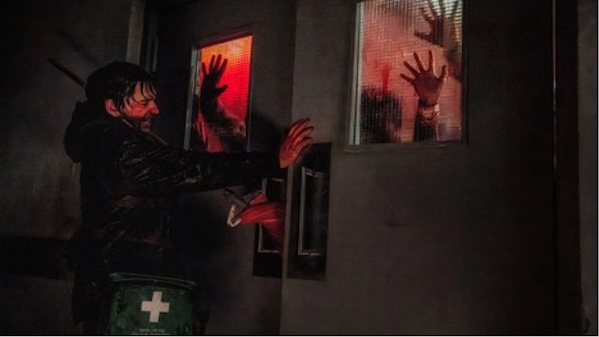
Medical courier Bryan (Austin Abrams) goes to hell and back to make a delivery in Resident Evil. Photo: Sony
You’d be mistaken to think that Zach Cregger’s Resident Evil started out as an original concept that was retrofitted into an IP franchise film. The assumption is understandable, given that Cregger is one of the few recent Hollywood directors to find success outside the scope of intellectual property. Per Cregger, around the time he was making Barbarian, producer Roy Lee encouraged him to pitch an idea to Constantin Films for a new Resident Evil movie, the only multimedia property he had any interest in adapting. That doesn’t dismiss the possibility that elements of Cregger’s Resident Evil adaptation were already floating around in his head. In fact, a good chunk of the film feels like it was pulled from the same mental reservoir where Whitest Kids U’ Know sketch ideas reside. For the first time, though, Cregger’s comedic instincts have overtaken his skill as a horror director; the careful tonal balance he mastered in both Barbarian and Weapons is noticeably off-kilter in Resident Evil, resulting in something more like a gory stoner comedy than an all-gas-no-brakes horror ride.
But let’s back up a bit. Cregger’s Resident Evil is the eighth film adaptation of Capcom’s Resident Evil franchise, the monumentally influential video game series developed by Shinji Mikami and Tokuro Fujiwara for the PlayStation console in 1996. The essence of the original Resident Evil games (known as Biohazard in Japanese) is a liberal borrowing from George A. Romero’s Night of the Living Dead films, focusing on the outbreak of a bioengineered mutagenic T-virus in a macabre mansion that turns the citizens of Raccoon City into flesh-eating zombies, animals into terrifying plant-hybrids, and the Umbrella Corporation’s research subjects into monstrous super-soldiers. More importantly, Resident Evil defined the nascent survival horror genre, utilizing a 3D gameplay system wherein players must solve puzzles (often involving keys), carefully manage item/weapon inventories, and explore pre-rendered environments while eluding threats.
Previous screen versions of Resident Evil, such as vulgar auteurist Paul W. S. Anderson’s films (2002-2016), loosely adapted the games’ lore into nü-metal statement pieces starring Milla Jovovich, while a more faithful translation, in the form of Johannes Roberts’s Resident Evil: Welcome to Raccoon City privileged schlocky fan-service over style or substance. Cregger, now the director of an Oscar-winning performance, takes a novel approach to both Resident Evil and video game adaptations as a whole: translating the immersive experience of playing a video game into the visual language of horror filmmaking itself. To this end, Resident Evil is mostly successful, if only because Cregger is both an experienced gamer and uniquely suited to the source material. (Both Barbarian and Weapons are audition pieces of sorts, fixated as they are on dark, domestic spaces — namely basements — infected by a preternatural evil.)
The gamble is that Cregger’s Resident Evil features no characters, locations, or storylines from the games. Instead, we follow Austin Abrams’s Bryan, a medical courier tasked with transporting a plot-relevant MacGuffin to Raccoon City General in the midst of the T-virus outbreak concurrent with Resident Evil 2. The most ingenious adaptational decision Cregger makes is that a glorified Postmates driver like Bryan makes for a piss-poor Resident Evil protagonist, tantamount to giving a doomed NPC an important side mission. For instance, it hardly occurs to Bryan that locks need keys, so he wastes precious ammo from guns he barely knows how to use by shooting padlocks — which he routinely fails to open. Much of Resident Evil is spent watching a guy fuck up puzzles, random encounters, and quick time events because he never catches on to the basic gameplay mechanics. And if you think Bryan will rise to the occasion and get better at this stuff as the movie progresses, don’t hold your breath.
Clever as this approach and Cregger’s efforts to incorporate the games’ fixed camera angles and third-person perspectives are, the film itself comes up noticeably short as a synthesis between source material and filmmaker. Unlike either Barbarian or Weapons, Cregger doesn’t scramble the plot structure or pass the narrative off to any other characters. The latter would be more than fitting for Resident Evil considering how many games follow parallel path structures. Rather, Cregger’s challenge to himself was to “step on the gas at about eight minutes in and never take [my] foot off the floor” for 90 minutes. This can (and really should) be enough to sustain the pacing and jump-scare suspense that characterize Cregger’s previous films, never mind every Resident Evil entry. Unfortunately, the film consistently undercuts itself by bringing in Bryan’s constant, expletive-heavy quipping and running meta-commentary. I don’t expect a Resident Evil movie to be free of silly, campy dialogue — that comes with the territory. I do, however, expect more from a Zach Cregger film than a nonstop barrage of stale, Judd Apatow-esque humor.
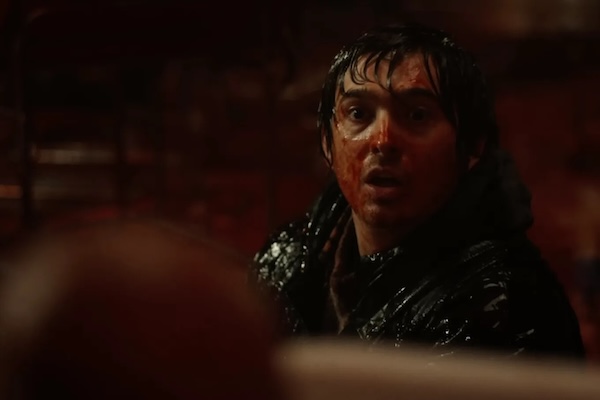
Buffoonish medical courier Bryan (Austin Abrams) doesn’t think it is a laughing matter in Resident Evil. Photo: Sony
Cregger’s Resident Evil can more accurately be described as a feature-length Whitest Kids U’ Know sketch about a guy who’s really, really bad at playing a Resident Evil game. To this effect, Austin Abrams plays Bryan as a horror-comedy buffoon à la Bruce Campbell, an incompetent everyman ill suited for the situation at hand. But when every other word that comes out of Abrams’s mouth is “fuck,” “shit,” or some terminally millennial combination of the two, that’s just putting a hat on a hat. Apparently, Cregger “stripped out as much of the jokes as possible” after test audiences found the movie too funny. I guess one-liners like “Fuck yeah, videogames!” and “Stupid, fucking… monsters” were too crucial to excise from the supposedly joke-free theatrical cut. The tonal dissonance is especially confounding because Cregger’s great strength has been his ability to balance abject horror with the subversive instincts of sketch comedy. Here, though, the japes not only deflate the tension, but also stymie the otherwise gung-ho pacing and reduce it to a herky-jerky crawl.
Frustrations with Resident Evil’s tonal imbalance aside, the film does chart a new path forward for video game movies. Despite what a vocal minority of gamers will tell you, Resident Evil is probably the best effort in recent memory. (Apologies to all the Gans-heads hailing this year’s Return to Silent Hill as a misunderstood masterpiece. What else can I say but live your truth.) Cregger is keen to adapt the gameplay experience rather than regurgitate a story that’s already been told several times over: the newest incarnation of Resident Evil branches out into unexpected thematic territory. If Weapons was Cregger’s eulogy to fellow Whitest Kid member Trevor Moore, Resident Evil is a work of paternal anxiety. Bryan’s primary motivation for survival is to get back home to his unexpectedly pregnant girlfriend to discuss their next course of action. Ludicrously gory set pieces and a grotesque Katamari ball of mutated corpses refract Bryan’s fears of fatherhood, culminating in a speedrun through an infected, uterine maternity ward. His ultimate fate literalizes the loss of personal autonomy impending parenthood signifies, a personal nightmare made manifest in one last gag.
Children are a recurring motif throughout Cregger’s films, a reflection of his own mixed feelings about becoming a parent and of his history with alcoholism and fraught relationship with his own father. The filmmaker has described his father as an alcoholic, and has connected that experience to Weapons. (He and his wife, actress-turned-director Sara Paxton, have not publicly disclosed whether they have children.) The corporate demands of IP filmmaking typically leave little room for personal statements; the extent to which Cregger makes Resident Evil his own while staying true to the immersive survival-horror experience is an admirable effort, even if the comedy ultimately outweighs the terror.
Nicole Veneto is a locally revered abject woman and acclaimed millennial hag with an MA in Women’s, Gender, and Sexuality Studies from Brandeis University, where she concentrated on feminist media studies. Her writing has been featured in MAI Feminism & Visual Culture, Film Matters Magazine, and Boston University’s Hoochie Reader. She’s the co-host of the podcast Marvelous! Or, the Death of Cinema and a features programmer for the Boston Underground Film Festival. You can follow her on Letterboxd, Substack, and her podcast on Twitter @MarvelousDeath.
Tagged: Austin Abrams, Resident Evil, Shinji Mikami, Tokuro Fujiwara