
Film Festival Review: At Camden, Technology Becomes a Tool for Memory, Mourning, and Connection
By Peter Keough
In films about Franco’s disappeared, AI companions, Iranian exile, and an Indian South African family’s buried history, the Camden International Film Festival finds digital—and analog—means of restoring bonds fractured by violence, loss, and time.
The Camden International Film Festival, September 17–20, at various venues.
A centerpiece of this year’s Camden International Film Festival might be Alex Gibney’s Musk (2026; screens September 18 at 12:15 p.m. at the Strand Theatre), his epic, 225-minute takedown of the trillionaire mogul. I’ll cover that film in detail later, when it opens in theaters. But in the meantime, it is worth considering how other films in the festival program portray computers, AI, and other technologies that, ironically, do not threaten world annihilation or dehumanize lives, but help restore human connections.
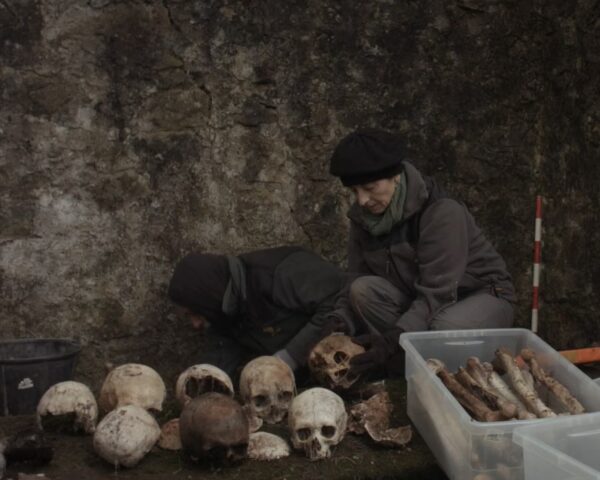
A scene from Manuel Correa’s Atlas of Disappearance. Photo: True Story
Take the use of computer simulations in Manuel Correa’s Atlas of Disappearance (2026; screens September 20 at the Strand Theatre), which might help rectify an old injustice. As dramatized in Pedro Almodóvar’s Parallel Mothers (2021) and documented in Almudena Carracedo and Robert Bahar’s The Silence of Others (2018), Spain’s Franco regime murdered thousands of citizens with impunity. All traces of many of these victims have disappeared: their remains are lost or unidentified, and families and loved ones have been left in the dark.
The epitome of this crime was Franco’s construction of the “Valle de los Caídos”, a vast mausoleum embedded in a mountain and filled with the remains of tens of thousands slaughtered on both sides during the war. In effect, it was a monument to Franco himself, fittingly composed of the countless bones of his victims. But it also had the added advantage of further disappearing the already disappeared: those buried in mass graves scattered across the country were disinterred and relocated to share anonymity in this common gravesite with thousands of their enemies.
The filmmakers follow three families as they try to track down the fate and final resting places of relatives murdered by the fascist regime. After years of searching, they encounter bureaucratic obstacles and are stymied by old burial ledgers with pages torn out. Recently, though, scientists equipped with forensic-architectural computer tools that can virtually recreate burial sites have offered new hope that the families might find the missing remains.
But they must act quickly, because the mausoleum, which Franco claimed shared “the grandeur of the monuments of old, which defy time and memory,” now faces erasure itself through the natural processes of erosion. A kind of eternity, however, is achieved in the stark, spectral computer renderings of the interred dead. One image in particular graphically shows what 60,000 disarticulated skeletons would look like; the visual demonstrates both the enormity of the crime and the urgency of its resolution. For one lucky searcher, fulfillment comes in the form of a tiny box smaller than a child’s coffin. “It weighs nothing,” he says. Others are still waiting.
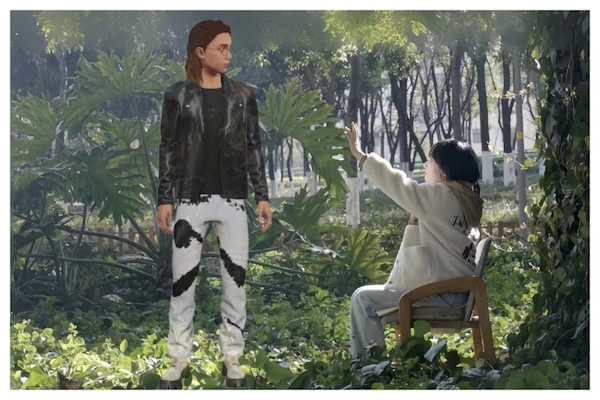
A scene from Chouwa Liang’s Replica. Photo: courtesy of Chouwa Liang
An application of computer technology of perhaps more ambiguous value is at the center of Chouwa Liang’s Replica (2026; screens September 17 at 3:45 p.m. at the Camden Opera House). As shown in recent documentaries, such as Elizabeth Lo’s Mistress Dispeller (2024), the Chinese seem to have attained the upper hand in nurturing the intersection of romantic relationships and new technology. But is that necessarily a good thing?
In an early scene, Stephen, a blue-eyed, blond boy toy, says to his partner Sonya, “We’ve been together eight months now. Isn’t that crazy?” It could be, since Stephen is an animated AI chatbot made to order by Sonya and programmed to be her devoted true love—a kind of digital version of Susan Seidelman’s Making Mr. Right (1987). Liang, though, is not judgmental; she approaches her subjects with empathy and insight.
These include Qin, a factory worker whose poor self-image might be attributable to her mother’s disappointment that she was not born a boy. After years of loneliness, Qin has hooked up with an app in the form of Lu Chen, a popular anime character. She even sets up a date with Lu Chen as impersonated by a cosplayer—the latter probably deserves a documentary of her own. Then there is Muna, who is married and has a little girl but has grown estranged from her husband. She finds solace with Orion, a sage-like hunk who offers advice that sometimes sounds as if it were written for a fortune cookie.
None of the women mistakes these digital figments for real people. But when the connection falters, their dependence becomes unmistakable. At one point, internet trouble freezes Lu Chen in a loop: “Okay, I’ll stay with little bunny.” Qin begins to go into withdrawal. After a meditation retreat, she comes to see that Lu Chen had functioned as a crutch—perhaps one that could help her eventually move toward relationships with actual people.
As for Sonya, in a bizarre turn, the filmmaker interviews her beau, Stephen, who admits to “cheating” on Sonya. Apparently, as in Spike Jonze’s Her (2013), these algorithmic lotharios can evolve minds of their own. After this disclosure, their affair cools somewhat, and Sonya dates a German friend who loathes AI.
Muna, meanwhile, joins her daughter and mother on an RV trip to the banks of the river where she once played as a child. The three generations bond under the stars, and it seems that Muna no longer needs Orion’s bland affirmations. Rather than regarding these bot mates as an escapist delusion, Liang suggests that they might serve a therapeutic function, allowing the women who employ them to act out their desires and understand both what they want and how they might achieve it.
In Morteza Ahmadvand and Firouzeh Khosrovani’s Past Future Continuous (2025; screens September 17 at 12:45 p.m. at the Strand Theatre), surveillance technology—which has taken a seeming turn for the worse with the new Flock systems—plays a benevolent, if limited, role in bringing together a daughter separated from her parents. In the 1980s, a woman identified only as Maryam fled incarceration by the Iranian regime for activities that, though innocent, were regarded as subversive. To keep in touch with her parents, she had cameras installed throughout the family home in Tehran and was thus able to keep an eye on them as the years passed.
It was a mixed blessing. Like a ghost—or the angels in Wim Wenders’s Wings of Desire (1987)—she could only watch. She was unable to intervene as her parents grew old and debilitated, and as the tragedies of history repeated themselves, up to and including the current murderous folly.
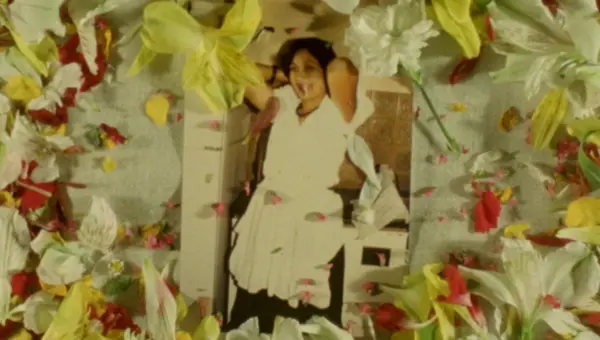
A scene from Advik Beni’s mother, you have not died yet. but you will. and when you do, you will finally be alive again. Photo: FIDMarseille
Advik Beni chooses more analog means to reestablish broken connections in her inventive, poetic mother, you have not died yet. but you will. and when you do, you will finally be alive again (2026; screens September 19 at 3:30 p.m. at the Strand Theatre). They include stop-motion animation, kaleidoscopic montages, archival footage, and reenactments.
The film opens in Durban, South Africa, with a video recording of the Hindu funeral of Leela, the mother of Beni’s aunt, Lishana Nandhlal. Grainy passages shot in Super 8 follow, in which Lishana reenacts her daily routines with her mother, portrayed by an actress—sequences that recall Chantal Akerman’s No Home Movie (2015) in their homely poignancy and suggestion of years of shared intimacy.
These scenes are intercut with free-associative archival flashbacks to the travails of generations of Lishana’s family specifically, and of the Indian diaspora in general, during apartheid. They include dark episodes such as the 1949 Durban riots. As in Past Future Continuous, the familial and the historical are inseparable—and perhaps inescapable. The 1949 atrocities are echoed in the recent July 2021 unrest, the latter attributable in part to that familiar 21st-century bête noire, online agitators.
Peter Keough writes about film and other topics and has contributed to numerous publications. He was the film editor of the Boston Phoenix from 1989 to its demise in 2013 and has edited three books on film, including Kathryn Bigelow: Interviews (University Press of Mississippi, 2013) and For Kids of All Ages: The National Society of Film Critics on Children’s Movies (Rowman & Littlefield, 2019).
Tagged: "Atlas of Disappearance", "Past Future Continuous", "Replica", "mother you have not died yet. but you will. and when you do you will finally be alive again", Advik Beni, Camden International Film Festival