
Concert Review: Carl Palmer’s Emerson, Lake & Palmer Tribute Defies Skepticism
By Jason M. Rubin
Joined by the ELP Legacy band and archival footage of Keith Emerson and Greg Lake, the drummer delivers a technically astonishing and emotionally respectful evening at the Cabot Theatre.
Emerson, Lake & Palmer at the Cabot Theatre, Beverly, on September 12
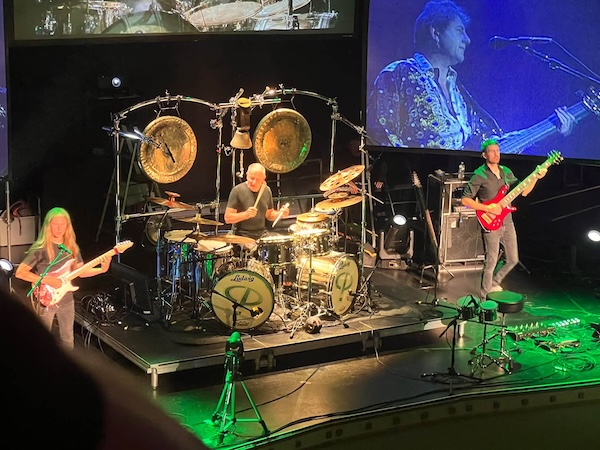
Carl Palmer in performance. Photo: Steve Belmonte
I’ll be honest: from the get-go, I thought this was a bad idea. Carl Palmer, the lone surviving member of progressive rock supergroup Emerson, Lake & Palmer, playing a concert accompanied by films of his deceased former partners. I know there have been concerts featuring holograms of performers such as Elvis Presley and Ronnie James Dio, seemingly rising from the dead – which I think is a much worse idea – in a sort of AI spectacle for people who don’t care about authenticity (but apparently believe in life after death). But the music Palmer made with keyboardist Keith Emerson and bassist/guitarist/vocalist Greg Lake is complex and aggressive, requiring extraordinary virtuosity, and the idea of drummer Palmer (the P in the group, which also stands for precision, passion, and percussion) using his erstwhile colleagues as a sort of click track felt to me like a money grab at worst and, at best, a well-intentioned failure of good taste and good sense.
I’m happy to say that I was proven wrong. In the first case, few drummers could pull off such a thing convincingly, and Palmer is one. His playing was nothing short of electrifying. A devotee of Gene Krupa and Buddy Rich, Palmer, at age 76, has incredible technique and stamina. Second, the show wasn’t exactly as billed. It wasn’t just one live musician and two reels of celluloid; Palmer, for at least half the night, played directly with his ELP Legacy band, featuring guitarist/vocalist Paul Bielatowicz and bassist/Chapman Stick player Simon Fitzpatrick, who also accompanied the filmed pieces. Bielatowicz had the unenviable task of replicating both Emerson’s keyboards and Lake’s guitar and vocals. He acquitted himself surprisingly well with the former, but he wasn’t close to acceptable taking on Lake’s stentorian baritone. Meanwhile, Fitzpatrick blew all minds by deftly tackling a survey of ELP’s Mussorgsky suite, Pictures at an Exhibition, solo on the Stick.
To be honest, I would have been just as happy seeing the concert films Palmer played to in their entirety, and to see the ELP Legacy band on its own but, despite a few minor glitches in timing, it all went off remarkably well, even though the juxtaposition of live musicians on stage and filmed musicians on screens was rather distracting at times.
The set list, of course, was driven in large part by the vintage of the filmed performances, and with the passage of time, one sees that the knocks about ELP being bombastic were true. The side-long epic “Tarkus” from 1971 is nothing less than an assault on the audience. Yet Emerson and Lake, both of whom died in 2016, were each featured individually in calmer offerings: Emerson with an extensive piano solo and Lake with his acoustic balladry. To that end, making the thing much more palatable to me was knowing that the show was presented respectfully and with the full cooperation of the Emerson and Lake estates. So it wasn’t a money grab – though at the merch table you could buy an autographed snare drum for $450 – as much as a lone survivor’s tribute to his fallen comrades on the 10th anniversary of their passing. In that way, it was not only an exciting concert but a moving one as well, especially when Lake was featured doing his signature song, “From the Beginning.”
The show featured material from all their studio albums, with the merciful exception of 1978’s much-maligned Love Beach. The band played two sets, finishing with “Fanfare for the Common Man,” an unsuspenseful choice salvaged only by the antics of Emerson on film, shoving, striding, and stabbing his Hammond organ. Without leaving the stage, they finished with another dull choice, the theme from Peter Gunn. But really, how much more of this multifaceted wall of sound could I take? Probably not much more.
Still, all in all, I’m glad I went, and I would recommend this show to any prog fan. Interestingly, another prog power trio was also playing in Boston that night: Rush, whose drummer, Neil Peart, is the one deceased member, replaced not by film but by the impressive Anika Nilles.
Jason M. Rubin has been a professional writer for 40 years. He has written for The Arts Fuse since 2012. His books include SHORTS: A Sizable Collection of Short Fiction (2025); Villainy Ever After (2022), a collection of classic fairy tales told from the villains’ point of view; and Ancient Tales Newly Told (2019), a pairing of two historical romances, one set in 17th-century England and the other in Biblical Jerusalem and Sheba. Jason also teaches journaling workshops. He holds a BA in Journalism from the University of Massachusetts Amherst. Learn more here.
Tagged: Carl Palmer, Emerson, Emerson Lake & Palmer, Lake & Palmer