Classical Music Preview: Eric Nathan’s Violin Concerto Finds Hope on a Mountain
By Aaron Keebaugh
The Rhode Island Philharmonic will perform the world premiere of a new work shaped by a New Year’s Eve encounter with Ukrainian refugees—and the consoling force of “Amazing Grace.”
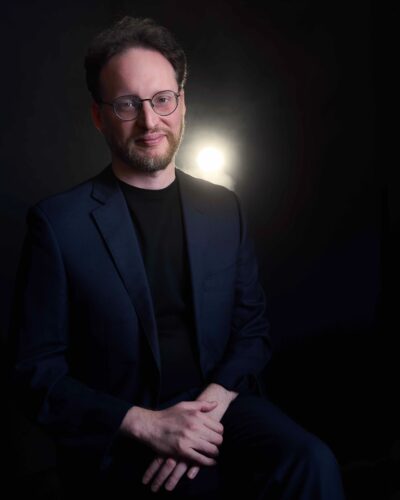
Composer Eric Nathan. Photo: courtesy of the artist
Composer Eric Nathan spent last New Year’s Eve on a remote Italian mountaintop with two poets fleeing the war in Ukraine. As the clock inched closer to midnight, he sat down at a piano to comfort them with a recognizable tune, “Amazing Grace.” As Nathan reached the final lines, one of the poets recited the closing lyric aloud: “I once was blind, but now I see.” The small company sat in silence, contemplating the words.
For the refugees, the new year offered hope that the war, now entering its fifth year, might end and that they could return home. Nathan was inspired by the poets’ optimism, moved by the resilience it takes to overcome formidable obstacles, physical as well as personal. A few days later, he sketched the first notes of his Violin Concerto, drawing on those wintry memories.
Nathan’s Violin Concerto will receive its world premiere this weekend at Providence’s Veterans Memorial Auditorium, with violinist Yevgeny Kutik and the Rhode Island Philharmonic.
It is the latest major score from one of the leading musical voices of his generation. The performance also ushers in a new partnership between Nathan and the RI Phil. This month, he begins a three-year residency with the orchestra. During this period, he will compose two additional large-scale works: a Requiem for chorus and orchestra and his First Symphony. Ruth Reinhardt will conduct the Violin Concerto, inaugurating the partnership.
Commissioned by a consortium of eight orchestras, including the Rhode Island Philharmonic, Nathan’s concerto, subtitled The Mountains We Climb, is dramatic in nature — it evokes the struggle, tension, and ultimate triumph of people overcoming a great challenge. Hints of, as well as direct quotations, from “Amazing Grace” ring through the 29-minute score, infusing the composition with an aspirational message.
“I think, ultimately, the answer to how we ‘climb the mountain’ is that we have to broaden our perspective and see other people,” Nathan said in an interview with the Arts Fuse. “I was thinking about the line at the end of ‘Amazing Grace’ — ‘I once was blind, but now I see’ — which is a change of perspective but also a way of seeing other people and seeing yourself.”
With its roaring sonorities and bold statements, the orchestra represents the mountain: monumental and implacable. The solo violin stands for the climber, set against imposing natural forces. At the musical summit, a solo oboe sounds “Amazing Grace.” The gesture recalls a similar moment in Richard Strauss’s An Alpine Symphony, but Nathan likens it to his duet for two unaccompanied oboes, Just a Moment, in which the two voices call out to each other as if from across a void. Aleatoric elements include the sound of rushing air from wind instruments — the conductor sweeps a hand across the ensemble, and a rippling wind replies. The violinist responds throughout with ruminative assurance accented by graceful flourishes — the music is a portrait of personal triumph.
Nathan’s biggest compositional obstacle was accommodating the contrasting styles of three different violinists. Kutik, Stefan Jackiw, and Curtis Stewart will perform the work with the ensembles that commissioned it.
“But here, from the very beginning, there were three soloists who were each giving their own interpretation of the piece,” Nathan said. “That may help the concerto stay in front of the public a bit longer. If you’re lucky, you get a few performances of it. But usually, it’s maybe once, and then never again.”
Never again? Nathan’s gifts for craft and orchestration have earned him a wide following among musicians, including RI Phil conductor Reinhardt. This weekend will mark her first time conducting Nathan’s music, but she is confident. Her careful study of several of his works has given her the chops to be a sterling advocate.
“He’s incredibly versatile,” Reinhardt said in a Zoom interview. “The instrumentation really works. It’s very idiomatic. I don’t believe that there are a lot of things that you need to adjust in order to make it work.”
“Very often, as a conductor, you have to help a piece by telling [the musicians], ‘Oh, you need to play much softer so that somebody else can be heard,’” she added. “I have a feeling that with Eric’s pieces, you don’t have to do that at all.”
Born in 1983, Nathan credits TV’s Mr. Rogers with setting him on a musical path. As a child in Westchester County, New York, he watched and rewatched VHS recordings of episodes that featured jazz trumpeter and bandleader Wynton Marsalis and the Empire Brass Quintet. Studies in piano and trumpet inevitably followed. But, because he hated practicing, Nathan realized that he preferred playing tunes of his own invention. He wrote most of his earliest compositions for himself to perform. Later, his creative maturation and evolving technique led him to connect with other musicians and, thus, the wider world.
Today, Nathan has earned critical acclaim as a composer of chamber and orchestral works. He has received three commissions from the Boston Symphony Orchestra, including the Concerto for Orchestra, which opened the 2019–20 season. The Milwaukee Symphony Orchestra co-commissioned Opening. Five orchestras in the United States and Mexico also commissioned his flute concerto, The Seas Between Us. Meanwhile, he has held residencies with the New England Philharmonic and currently directs Collage New Music in Boston. Nathan also serves as an associate professor of music at Brown University.
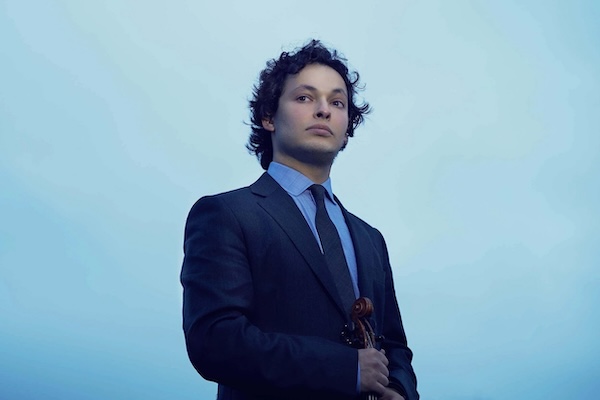
Violinist Yevgeny Kutik. Photo: Corey Hayes
Nathan’s compositional skills owe some of their heft to such stellar teachers and influences as George Tsontakis, John Harbison, and the late Steven Stucky. His music resonates with social themes as well as historical places. He has continually drawn inspiration from spaces, whether they be old buildings, ruins, or natural surroundings. His first piece for the Boston Symphony Chamber Players was inspired by a 2013 visit to Rome’s Basilica of Santa Sabina. That trip, which he took after winning the Rome Prize, introduced Nathan to the beauties of Italy, where he still often returns.
Nathan’s Double Concerto grew out of his daily walks among 15th-century castles during a 2022 residency at the Civitella Ranieri Foundation. “There’s a castle from the 15th century that is built upon another castle that burned down during the 11th century,” Nathan recalled. “Then there’s this walkway with a tree-lined path that was created around them. I was walking down this path to this church, and there are tombstones and beautiful cypresses, which I learned are trees planted in cemeteries because their roots grow vertically, not horizontally, and don’t disrupt the graves. There’s this sense of memory everywhere that you go. And you get that sense of history.”
Like his New Year’s Eve mountaintop revelation, Nathan’s encounters with places steeped in history have widened his sense of other eras and ways of seeing. “I think the thing that’s common to [my pieces] is that they’re talking about humanity, life, and our world.”
The composer’s Violin Concerto promises to pursue that same human connection amid vast and widening cultural and political divisions—arduous mountains to climb in their own right.
Aaron Keebaugh has been a classical music critic in Boston since 2012. His work has been featured in the Musical Times, Corymbus, Boston Classical Review, Early Music America, and BBC Radio 3. A musicologist, he teaches at North Shore Community College in both Danvers and Lynn.