
Book Review: Edward Gorey, Up Close—and Not Quite in Focus
By Allen Michie
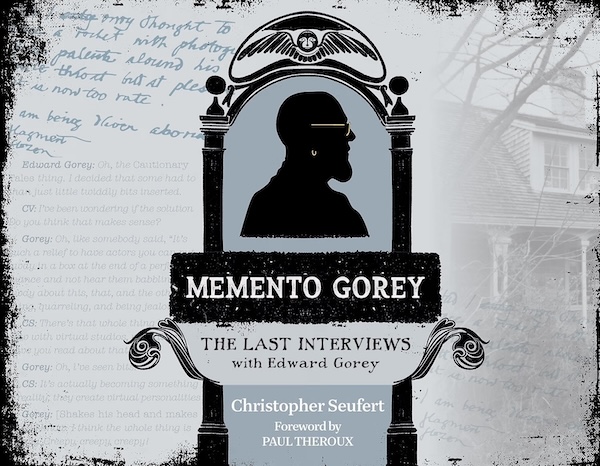
Christopher Seufert’s Memento Gorey offers an intimate, cluttered, sometimes illuminating portrait of the artist’s final years, but its unedited conversations rarely penetrate the mystery at their center.
Memento Gorey: The Last Interviews with Edward Gorey by Christopher Seufert. Schiffer, 224 pages, $34.99.
Edward Gorey was a chronically disorderly person who made compulsively ordered drawings: small, precise masterpieces of infinitely detailed crosshatching, often composed of multiple overlapping patterns. Many of his drawings suggest the highly posed stills of Louis Feuillade’s silent films or the ballet choreography of George Balanchine, both of whom he studied and loved obsessively. Late in life, however, he cultivated a kind of chaotic, shifting eccentricity. His house—now the Edward Gorey House museum—was a curated cabinet of curiosities, but also a complete mess. How, then, does one write about Gorey and convey a sense of who he was? Which Gorey, and at what point in his life, is one writing about?
Several excellent books about Gorey have appeared since his death in 2000. Mark Dery’s comprehensive and authoritative biography, Born to Be Posthumous: The Eccentric Life and Mysterious Genius of Edward Gorey, appeared in 2018. It was closely followed by Ascending Peculiarity: Edward Gorey on Edward Gorey, a collection of interviews edited by Karen Wilkin. One of my favorites, Elephant House: Or, The Home of Edward Gorey (2003), is a book of photographs of Gorey’s home as he left it when he died. The artistic lighting and framing transform his various collected objects—stones, blue bottles, stuffed animals, cluttered furniture—in ways that would no doubt have pleased Gorey’s sensibilities. Gregory Bischak’s elegantly designed E Is for Edward: A Centennial Celebration of the Mischievous Mind of Edward Gorey (2021) is an amply illustrated overview of Gorey’s major works for newcomers, loosely organized by theme. Many readers may not spend much time with the text, as is often the expectation with hefty coffee-table books, but those who do will find several provocative insights and interpretive theories. Most recently, Carol Verburg published The Theatrical Adventures of Edward Gorey: Rare Drawings, Scripts, and Stories (2024), an excellent start on examining the vast collection of Gorey’s previously unpublished work that remains in the vaults.
The newest contribution to the bookshelf of Goreyana is Memento Gorey: The Last Interviews with Edward Gorey, by Christopher Seufert. It is an odd volume—admittedly, about an odd man—but it fills an important gap in our understanding of him by focusing exclusively on his final years, when Gorey shifted significantly in his artistic expression. Interspersed throughout are more than 100 photographs of Gorey and his home. The images of the house and grounds, taken just days after Gorey died, can be seen as a rough draft for the much more polished, but less revealing, Elephant House.
Seufert’s book transcribes the interviews he conducted with Gorey, his friends, colleagues, and admirers for a documentary feature about Gorey. He has been working on the film for 25 years. Earlier this year, Seufert told me that he was seeking distributors. He has also released the soundtrack for the documentary. We now have the soundtrack and the transcript, but not the film itself. Perhaps the release of the pair is intended to appease fans who are losing patience—particularly those who donated to the Kickstarter campaign over the years. Or perhaps this is all we are going to get from the project. I am pessimistic at this point, though still reluctantly willing to give Seufert the benefit of the doubt.
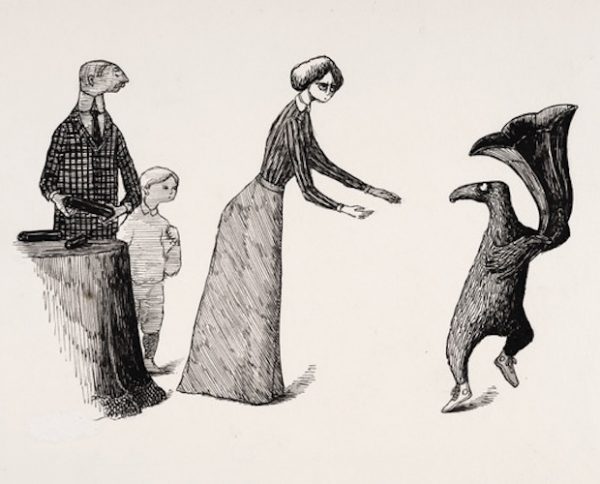
Edward Gorey, “It wrenched off the horn of the new gramophone,/ And could not be persuaded to leave it alone.” Illustration for The Doubtful Guest, 1957. Photo: courtesy of the Wadsworth Atheneum
Seufert may be a fine filmmaker, and he certainly earned the trust of his subject during the four years he spent with Gorey, from 1996 until his death in 2000. But Seufert is not a natural interviewer. He is so eager to make Gorey relaxed and comfortable in conversation that he rarely presses him or prompts him to go beneath the surface. The interviews are nowhere near as essential as those collected in Ascending Peculiarity, conducted by Dick Cavett and journalists from The New York Times, The Boston Globe, The New Yorker, and other publications.
Several of Seufert’s interviews are with Carol Verburg, Gorey’s friend and theater producer. The better segments touch on Gorey’s favorite artists and writers, but many of the conversations are concerned with the inconsequential trivia of his daily life. The pictures of Gorey’s home supply more information than most well-adjusted people—unlike myself—will need to know. We learn what crackers Gorey kept in his cabinet, how he repurposed an old toilet as a tabletop, which magnets adorned his refrigerator, and that he liked Stouffer’s frozen creamed chipped beef. This is all perversely readable, if not exactly irresistible, for Gorey’s many fans.
Gorey was protective of his privacy. He agreed to the interviews, but I am not entirely sure that he would have appreciated the posthumous photography of everything he owned. Seufert assures us that there are many more photographs in his archive, and that he plans to publish additional selections. Several interview subjects do their best to spin the evidence positively, but the unavoidable fact is that Gorey was a bit of a slob—as are many creative people, of course. His white sneakers were black with wear. His freezer had rusted through. His yard was hopelessly overgrown, his car littered with old newspapers, and his hallways a maze of stacked clutter.
His staggering collection of thousands of books, spilling out of the house and into a barn, along with teetering stacks of VHS tapes—the complete runs of The Golden Girls and The Mary Tyler Moore Show may surprise his Goth fans—shows an expansive mind at work. But it is also more evidence that he was a hoarder. One interviewee points out that Gorey curated his house as if it were a personal museum, constantly changing its displays and altering the winding route through its rooms. All of this anarchy stands in stark contrast to the absolute precision and control of Gorey’s small, crosshatched drawings. His simple drawing desk was tiny: one pen, lots of clutter.
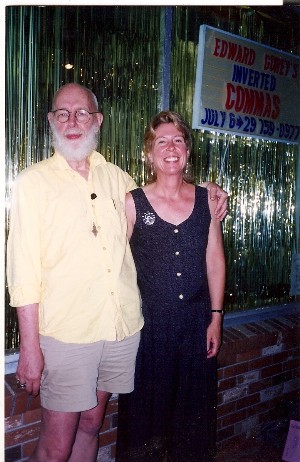
Edward Gorey with friend and collaborator Carol Verburg. Photo: courtesy of the artist
The goal of Memento Gorey is to offer a portrait of the artist as an old man, attempting to show us Gorey as his close friends knew him. Readers seeking an account of his entire life should turn to Dery’s Born to Be Posthumous, while those interested in the evolution of his aesthetic should consult Ascending Peculiarity or, for newcomers, E Is for Edward.
Some of the appreciations in the book’s second half move from life to art, and they offer some penetrating insights. The best interview is with Verburg, Gorey’s closest collaborator and friend in his final years.
Verburg had a front-row seat for the final stage of Gorey’s artistic life, and this is the book’s most original contribution. Gorey returned to the experimental theater of his undergraduate years at Harvard and turned his attention to, of all things, puppet shows at local community theaters on Cape Cod. Why? According to Verburg, who produced or co-directed dozens of these performances, Gorey did not want to be pigeonholed by the macabre drawings that had made him famous. This resistance could also be seen in his rather jarring shift in wardrobe: sunny yellow tops and perennial shorts.
Verburg believes that he wanted to expand his vision:
What he became interested in was applying his peculiar perspective to all different kinds of stories and scenarios, possible elements. And he, I think also, one of the changes through time that worked for Edward was that his interest in imaginative theater grew. He became more interested both in narrative or pseudo-narrative theater, theater that appeared to be storylike, and at the same time, he constantly undercut it.
These puppet shows represented a sharp change in Gorey’s aesthetic. His handmade puppets were generally quite crude: a blob of papier-mâché suggesting a head, attached to a single piece of fabric cut like a glove. In the production of Gorey’s play Heads Will Roll, actor Eric Edwards recalls that “we must have had more than a hundred different gloves. It was this show about a material, and then we had other things where the puppets were things like kitchen utensils and shoehorns and the oddest objects you could imagine that were puppets.” Edwards marvels that Gorey could even draw emotion from clothespins.
Some productions combined human actors with puppets. Even the shy Gorey himself occasionally made an appearance—once as a young messenger boy. The artist directed in a friendly, hands-off manner that gave considerable leeway to his trusted group of regular actors. The surrealistic shows were assembled quickly, sometimes poorly attended, and thoroughly enjoyed by Gorey as well as his performers. They bore titles such as Six Who Pass While the Lentils Boil, Lost Shoelaces, and Moderate Seaweed. One posthumous masterpiece: his libretto for an opera titled The White Canoe: An Opera Serial for Hand Puppets, with music by Daniel Wolfe.
Sadly, few of these performances were filmed for posterity; we are depending on Seufert’s B-roll being preserved somewhere. Dery’s biography covers this period of Gorey’s life well, but these new, extended firsthand accounts from the directors and actors who were there remain valuable. Seufert’s book is an important companion to Verburg’s Edward Gorey Plays Cape Cod: Puppets, People, Places & Plots, which remain our primary source for this fascinating and confounding stage of Gorey’s artistic life.
Memento Gorey has three parts: conversations with Gorey—“conversations” is a better word than “interviews”—testimony from colleagues in his puppet-show era, and interviews with creators influenced by Gorey, whether or not they knew him personally. The latter include novelists Paul Theroux, Neil Gaiman, and Daniel Handler, a.k.a. Lemony Snicket; artist and biographer Clifford Ross; and filmmaker Terry Gilliam. All are plainly delighted to go on the record with their admiration for Gorey. Handler’s debt runs particularly deep. Gorey provided an early paradigm for Handler’s tales of unfortunate events befalling children: “So, he’s turned out in many ways to be actually quite ordinary even though what he did was make the extraordinary ordinary. He drew and wrote a world in which catastrophic things were happening with utter regularity, and so it makes sense to me that he had a strange brain inside an average head.”
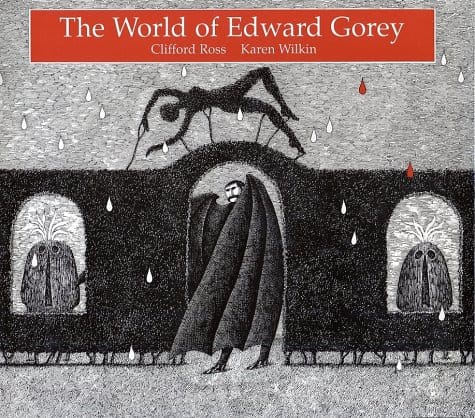
Clifford Ross, co-author of The World of Edward Gorey (1996) and the first curator of an exhibition of Gorey’s work, was one of Gorey’s closest friends. He speaks movingly about Gorey as both man and artist:
I think Edward is a true north, in a way, a north star for me, in the sense that he was committed to a life that he fashioned himself, and I don’t think he had a real drive for success, although I think he cared that the work he did was good or the best he could do. I think he wanted to spin a web, a web of his own dreams, and it just came out of him. . . . Edward really was the iconic figure, in many ways for me, of what it meant to be a dedicated artist.
Ross also contributes several jaw-dropping biographical tidbits. He recounts a conversation with puppeteer Jim Henson that led Disney executives to consider adding an “Edward Gorey World” to one of the company’s theme parks. (Can you imagine it? Wouldn’t the kiddies have loved a Willowdale Handcar ride?) Presented with the idea, Gorey refused to travel to Los Angeles and rejected the preliminary contract out of hand.
We also learn of Gorey’s run-in with police, who wanted details about the real mummy head that he inadvertently left in a closet after moving from his New York apartment. Ross recalls: “It was the furthest thing from his mind, and that’s so him; as far as I could tell, anyone else would be quite aware that they had a mummy’s head. To him it was just ‘Oh, yeah, a head.’ Like he’d simply forgotten about it.”
There are many other gems in these interviews, although Seufert does not always make the excavation easy. Despite a statement to the contrary in his preface, the interviews appear to be unedited. We get complete transcripts which, while important to archivists, can make for tedious reading. Passages such as this contribute little or nothing:
Seufert: I was just thinking, could you just angle your chair a little bit more this way now, just a few inches. Yeah, okay.
Verburg: My body or my chair?
Seufert: Yeah, either one, that’s fine. I just wanted to keep that angle because I think you were already talking to Eric, and it looks funny in the camera.
Similarly, even in the conversations with Gorey, much of the dialogue is safe to skim, even for the most devoted fans:
Seufert: I never knew what the word “city block” meant, growing up in Chatham; it never meant anything to me.
Verburg: Oh, my gosh!
Seufert: But now I do know what that means.
Gorey: Well, I grew up in Chicago.
Seufert: People in Boston know . . .
Gorey: Yes, Boston has blocks.
Seufert: San Francisco doesn’t really have blocks.
Verburg: It doesn’t?
Seufert: Not really.
Verburg: It does where I live.
Seufert: But no one ever uses the term.
Gorey: Of course New York is very confusing because the crosstown blocks are like ten times more than the uptown blocks.
Verburg: Yeah.
Gorey: Chicago has relatively the same size [of] blocks throughout, I think, square!
Seufert writes that his plan in Memento Gorey “was to have a softer touch with Edward, shooting more as I got to know him more. Our relationship as friends, in this case, was crucial to the outcome, as I saw it…. Over time he became a bit of a grandfather to me, as a byproduct of this approach as part of the production…. So my shooting scripts and pointed interview questions were generally replaced by Edward taking over the directing role by default, himself, and I was happy to lean into that approach.”
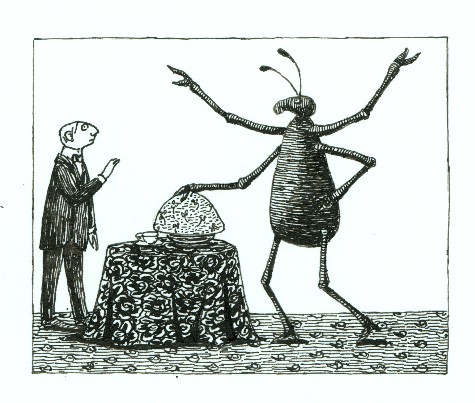
“I am the Bahum Bug,” it declared. © 2011 The Edward Gorey Charitable Trust
Herein lie both the book’s strengths and weaknesses. On the one hand, when a filmmaker is drawn too close to the material—when the subject under the microscope becomes a grandfather figure—the result may show a side of the person the public would never otherwise see. But that intimacy can come at the expense of asking the necessary questions that can illuminate the essence of an artist’s elusive genius.
Allen Michie works in higher-education administration in Austin, Texas. He has been reading Edward Gorey’s work since he was far too young for such things.
1 Comment
Leave a Comment

Some errata pointed out by Mark Dery: “Ascending Peculiarity” was published in 2001, not 2018. The author of “E Is for Edward: A Centennial Celebration of the Mischievous Mind of Edward Gorey” is Gregory Hischak, not Bischak.
Thank you to Mr. Dery for the corrections!