Concert Review: Mavis Staples and Alabama Shakes Turn Tanglewood Into an “Army of Love”
By Robert Israel
At the Koussevitzky Music Shed, two generations of artists joined forces in a rousing concert of gospel, rock, resistance, and solidarity.
Alabama Shakes, with Mavis Staples, Koussevitzky Music Shed, Lenox, Mass., September 5.
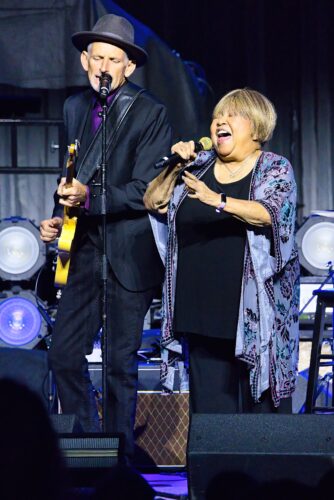
Mavis Staples & guitarist Rick Holmstrom at Tanglewood. Photo: Hilary Scott
At first glance, the pairing of the high-powered rock-and-roll group Alabama Shakes with Mavis Staples—a roots/gospel/pop artist—seems a bit of a stretch. The stylistic differences between the two are vast. Rock blasts its way into our consciousness, while roots music stirs us with quieter persuasion. Yet, as evidenced by the outpouring of enthusiasm that both performers expressed for one another at Tanglewood in Lenox on September 5—and the audience’s overpowering embrace—the two share ironclad ideological bonds, both boldly advocating for solidarity and activism to alter, if not transform, what Staples calls “our sad and beautiful world” (her newest release).
Staples, who, at 87, is fifty years older than Brittany Howard, the leader of the Shakes, has gigged with the likes of The Band, Jeff Tweedy (of Wilco), Ben Harper, David Byrne, Hozier, and many others. She did not join the Shakes on stage but at one point expressed high praise for the band. And Howard, who voiced several shout-outs to Staples, said she was “honored” to share the venue with her, an artist she claimed she has been listening to devotedly “all her life.”
Staples wants us all to enlist in the “Army of Love.” It was the same message I heard her proclaim from the stage of the Berklee Performance Center ten years ago; now, as she approaches her ninth decade, this message has become even more urgent. “We’ve got to eradicate the hatred,” she shouted and sang. In a call and response, she stated, “The writing’s on the wall. Tell me what it says!” In another song, she enjoined, “Join me on the march down Freedom’s Highway,” recalling the pioneering days of her civil-rights activism with Dr. Martin Luther King Jr. and the work fostered by her late father, Pops (the founder of her family’s group, The Staples).
And, in her last selection, drawing on the full raspiness of her “come home to Jesus” gospel, she shouted: “I’ve come too far! I won’t turn back! We all got lots to do. We’ve got to get rid of the dictator. We’ve got to abolish I.C.E. We’ve got lots to do. We’ve got to stop them from telling women what to do with their bodies!” It was a soul-stirring performance.
After a break between acts, Brittany Howard and her eight-piece band, which included her original band members, sang about love, time, tension, resistance, and connection. “I can’t help but react to the world around me. And in our society right now, in the United States, it’s tumultuous and chaotic and confusing,” she told the New York Times recently.
The words of these songs—blasted from jumbo speakers so that the capacity crowd in the shed and those who were crammed onto Tanglewood’s rolling lawn could hear them—were oftentimes indecipherable. Such is the peril of rock lyrics—they are downed out. But Howard filled in the gaps, proclaiming that we need to join forces and help our neighbors, adding that we must not only initiate societal change but steer it toward wider acceptance.
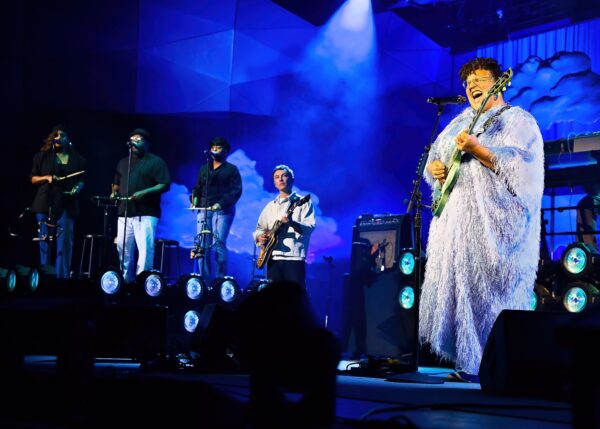
Alabama Shakes, guitarists Brittany Howard & Heath Fogg at Tanglewood. Photo: Hilary Scott
A native of Athens, Georgia (the hometown of the rock group R.E.M.), she now lives in Nashville, Tenn., and, like Mavis Staples, is embarking on a multi-city tour. The group, which included backup singers and two keyboardists, never toned down the volume; physical effects of the experience resonated with me after the performance. But asking for a reduction in volume is never going to happen when hundreds of fans, who had already committed the lyrics of Howard’s songs to memory, seemed totally at home with the high decibel level.
Tanglewood has hosted many artists when they were in their seventies and eighties, sometimes pairing them with younger musicians. John Fogerty and Steve Winwood, who performed on September 6, are 81 and 78 years old, respectively. Judy Collins, who performed earlier this summer, is 87. James Taylor, a Lenox resident and long-time performer (and benefactor) at Tanglewood, is 78.
Mavis Staples showed signs of fatigue during her set, twice struggling to rise from an onstage chair. But once she reached the microphone, she seemed transformed—a reminder of music’s inherent power.
Robert Israel, an Arts Fuse contributor since 2013, can be reached at [email protected].