
Poetry Review: In “Precisely Now,” Lawrence Joseph’s Prophetic Fury Meets Love’s Fragile Serenity
By Jim Kates
A lawyer-poet’s arguments against war, racism, plutocracy, and despair are sharpened by moments of sensual attention and stubborn devotion.
Precisely Now by Lawrence Joseph. Farrar, Straus and Giroux, 96 pages, $18.
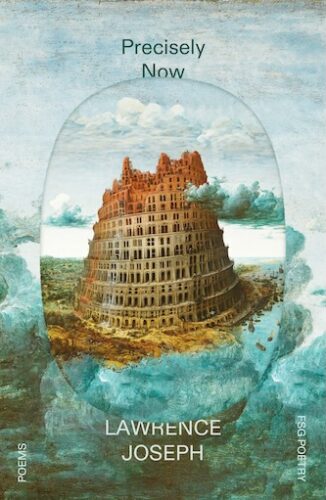
The recalcitrant prophet is called kicking and screaming to walk the streets of the city, stripping the emperor of his imaginary clothes, denouncing iniquity and finding sparks of redemption in love. “I shall send thee, and whatsoever I command thee thou shalt speak.” It is a tale as old as Jeremiah in Jerusalem and as brand new as Lawrence Joseph in mid-twenty-first-century New York, Precisely Now.
Same same old changing same,
rain turns into sleet, sleet into snow . . .
What is, what isn’t, there is and there isn’t
a God in it, in love’s metric commitments are.
tangible, cyber time is pressed to the edge of absolute
zero, the coronavirus hasn’t happened yet,
in my line of vision innocents are murdered.
Joseph can find consolation in small things, direct sensory engagement with the world: “who and what I love will not be rent from me, // I whisper, gold-bronze light pressed on / wildflowers along a chain-link fence.”
Love comes, speaks to me, touches
my face and hair, the tenderness
all through me, keeping me alive. In the body
I am living in I write your love keeps me alive.
We should note that this whisper is set against the howling jeremiad of most of the poems, which accumulate among them a contemporary catalogue of sins, crimes, and catastrophes — bombs, executions, “plutocratic thievery,” swinging bayonets, and a “tangerine-jowled face and white-blond hair.” Twin towers dissolve into rubble. Disease forces his chosen city into lockdown. Despair is wide-ranging, from the social, “I’m Arab and I’m told Arabs / aren’t people,” to the corporal, “I’m thinking of my dead in a hospital bed. / Thoughts being pounded by whatever is being // injected in me,” to the global:
Permanent war, permanent crisis,
whatever you wish to call it.
The language of the poems sometimes takes on more of the cadence of a legal argument (Joseph is a lawyer by profession) than of verse: “And his Attorney General — is / Ku Kluxer III really his name? — / invokes not just law but God’s law, / Paul, Romans 13, / the divine order of things demands / government treat the poor like inventory.” But what comes across most consistently through both the argumentative and the lyric is the speaker’s fury and his insistent engagement with a world gone wrong.
Precisely Now acknowledges other times. There is a past: “I’m old enough to remember an America / faithful to its dream . . . ” as distinct from “this foul hour, this foul year.” In that past, Joseph came from Detroit, an incubator of great, gritty poets, to bring his Midwestern realism to the capital of capital. While these poems range much farther than the Big Apple, that city stands, as it has so often stood, for the country and the world as a whole.
And there is a future, which we have to wait for until the very last poem to read:
Now light. Intimacy’s light.
Light’s metamorphosis, a god afloat
in azure air.
. . .
Wheel turning, cherry trees in bloom.
Let it be, if it be ours. Love I compose.
Except for those cherry trees, reminiscent of A. E. Housman, the collection is unremittingly bleak. If it’s dancing you would be, Joseph seems to be warning with Housman’s Terence — there are brisker pipes than poetry. (Ale may do more than Mary Oliver can to justify God’s ways to man.)
Is Precisely Now to be read as a prophetic call to action? Can it be so read? An Old Testament God spared Jonah’s Nineveh and a New Testament God redeemed Isaiah’s Israel. I don’t think Joseph means to place himself in their company, perhaps more in the ranks of the Ginsberg of Howl. We all hope things are not as bad as they might be. We fall back on life-affirming invocations of love.
Still, as every singer of the blues knows and as Joseph admits, there is also an affirmation in acknowledging, “I’m not in a good place right now.”
J. Kates is a poet, feature journalist, reviewer, literary translator, and the president and co-director of Zephyr Press, a nonprofit press that focuses on contemporary works in translation from Russia, Eastern Europe, and Asia. His latest book of poetry is Places of Permanent Shade (Accents Publishing) and his newest translation is Sixty Years Selected Poems: 1957-2017, the works of the Russian poet Mikhail Yeryomin.