
Book Review: A Haunted House, Some Hard Truths
By Sarah Osman
Kelly McWilliams’s No One Leaves the Manor turns a haunted-house setup into a sharp, lyrical reckoning with race, class, disability, and trauma.
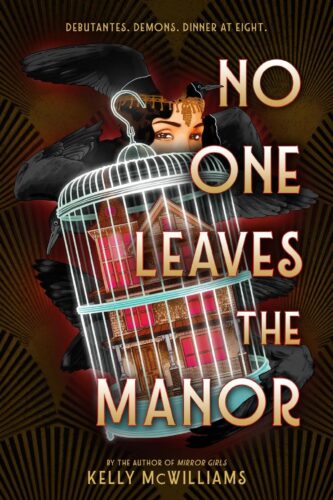
No One Leaves the Manor by Kelly McWilliams. Little Brown Books for Young Readers, 400 pages, $19.99.
One of the reasons I’m drawn to horror is that the genre often mirrors what society fears at a given moment. Frankenstein drew on fears of immoral science. Vampires paralleled anxieties about the Other and women’s sexuality. The zombie craze of the early 2000s, as critic Chuck Klosterman noted, grew out of panic at the mundane. The current big bad of the 2020s is trauma, compounded by our inability to diminish its power.
The idea of trauma as a monster isn’t new, but the trope has become so popular that it can feel inescapable. In a crowded field, Kelly McWilliams’s YA novel, No One Leaves the Manor, stands out as one of the sharpest examinations of the trauma-horror trope.
On its surface, No One Leaves the Manor is a typical haunted-house story: will our heroes survive an overnight stay? But despite its seemingly clichéd title, the novel is a captivating dive into the trauma of race, class, sexuality, and disability.
The story is set in the early 1920s. Dorothea Williams, a biracial charmer, uses her good looks to pull off heists, aided and abetted by her brother, Chester. Dorothea can easily pass in the white world, but Chester cannot. Years before, the siblings’ mother had vanished mysteriously while performing at the aloof Greystone Manor. Early in the narrative, Chester wants to go straight, but Dorothea is up for one more theft. She’s been invited by the mistress of Greystone Manor, Mrs. Kane, to take part in a contest in which Dorothea will compete alongside three white debutantes for Mrs. Kane’s vast fortune.
At the manse, Dorothea eyes her competition: Elspeth, who has dyslexia; Birdie, who survived polio; and Vaughn, whose mother was deemed mad and who badly needs to win the competition. As the girls get to know each other, Chester does his best to pull his sister out of the match. He knows something fishy is going on. He befriends Mariam and Tate, a Jewish father-daughter duo who run the only diner open to him. Chester’s fear is about more than an encounter with the ghostly; he faces the very real threat of being caught in a sundown town. His connection to Mariam and Tate also allows McWilliams to touch on the rampant antisemitism of the ’20s.
Each chapter is told from a different point of view: Dorothea, Chester, Elspeth, Birdie, and Vaughn. Birdie’s chapters are the most distinctive of the lot; they are written in both verse and prose, reflecting her complex relationship with religion. Still, each character has a distinct voice, so no two chapters sound alike. The characters and their experiences are skillfully intertwined throughout the narrative.
As the debutantes fight Greystone Manor, a character in itself, they also battle a patriarchal structure that keeps each of them down. The manor is the novel’s central device: the house draws out the girls’ trauma, which they are then forced to confront. What makes their pain so compelling is that it is deeply rooted in the repression and inequalities of the ’20s. By exploring groups that lacked meaningful social power and representation then, McWilliams probes political issues that still resonate today.
In terms of its horror payoff, No One Leaves the Manor is a tense, suspenseful read, full of sinister scenery and creepy imagery. To her credit, McWilliams doesn’t rely on jump scares or overtly grotesque language. This isn’t a slasher; it probes the nooks and crannies of psychological terror.
McWilliams writes with a lyrical flair. Even screeching, tortured birds leave a poetic impression. That balance between beauty and horror is partly what makes this novel so disturbing.
Trauma, like monsters, is a literary perennial. But No One Leaves the Manor is a singular achievement in the horror genre.
Sarah Mina Osman is based in Los Angeles. In addition to The Arts Fuse, her writing can be found in The Huffington Post, Success Magazine, Matador Network, HelloGiggles, Business Insider, and WatchMojo. She has an MFA in Creative Writing from the University of North Carolina Wilmington and is working on her first novel. She has a deep appreciation for sloths and tacos. You can keep up with her on Instagram @SarahMinaOsman and at Bluesky @sarahminaosman.bsky.social.