
Visual Arts Review: “Persistent Curiosity” — Urgent Questions
By Lauren Kaufmann
A Provincetown exhibition pairs data and aesthetics to reveal how artists and scientists alike are driven to understand — and protect — the ocean’s shifting world.
Persistent Curiosity: Charting the Rippled Fabric of the Sea at the Provincetown Art Association and Museum, on view through July 19.
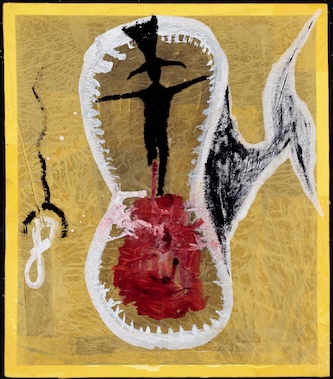
Bert Yarborough, Moby Dick II, 2000. Photo: courtesy of PAAM
Persistent Curiosity celebrates the 50th anniversary of the Center for Coastal Studies (CCS). As a marine research, education, and rescue organization based in Provincetown, CCS is one of the country’s preeminent coastal preservation nonprofits. Over the years, CCS scientists have devised strategies to mitigate the impact of coastal erosion and sea-level rise. They’ve researched whale habitats to better understand why whales gather in the waters around Cape Cod, and they’ve monitored and protected the waters around the Cape.
The exhibition stands at the intersection of the artistic and scientific worlds that are so closely intertwined on Cape Cod. Co-curated by PAAM CEO Chris McCarthy and CCS Scientist/Artist-in-Residence Mark Adams, the exhibit features a variety of genres, including sculpture, painting, drawing, video, and music. Works of art address marine ecology, whale biology, coastal landforms, and working life by the sea.
The title of the exhibit evokes a synthesis among scientists who study the local environment and artists who are inspired by its natural beauty. In a panel discussion at PAAM, co-curator Mark Adams noted that the phrase “persistent curiosity” was coined by Graham Giese, a coastal geologist and one of the founders of CCS. The phrase nicely sums up the motivation that drives scientists to keep going —an unrelenting inquisitiveness. It is because of their unstoppable desire to study scientific phenomena in detail that we understand the natural world in which we live.
The second half of the exhibition title — Charting the Rippled Fabric of the Sea —is a poetic expression of the intersection between science and art. While scientists map the sea through data, artists capture the allure of the surrounding seascape. Though their aims may differ, both are deeply drawn to these waters, where their interests and passions often converge.
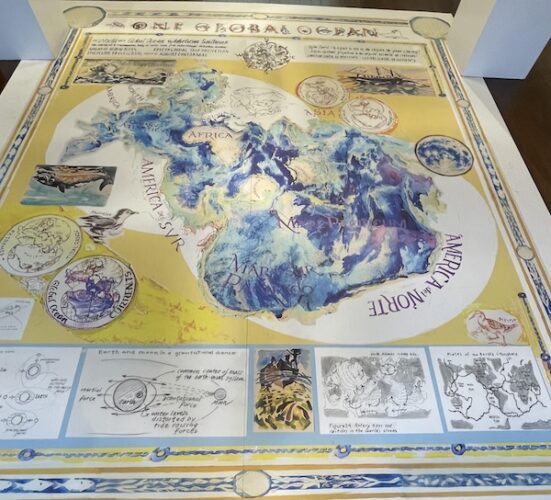
Mark Adams, Global Oceans Seafloor Map (Spilhaus projection), 2026. Photo: courtesy of Lauren Kaufmann
As a coastal geologist and artist, Adams is uniquely suited to curate an exhibition like this one. After 30 years working as a cartographer for the National Park Service, he is now an artist-in-residence at CCS. At the center of the gallery is his magnificent floor map, Global Oceans Seafloor Map (Spilhaus projection), 2026. The work presents the world’s oceans, surrounded by insets: a diagram of the gravitational dance between the earth and the moon; visualizations of rotary tides and co-tides; and a map of the earth’s lithospheric plates. Along the map’s edges, Adams paints creatures — birds and fish that inhabit both water and shoreline. The piece functions as a compelling centerpiece, clearly establishing the exhibition’s primary focus.
Nathalie Miebach’s work is a natural fit for this exhibition. She creates intricate woven sculptures that translate scientific data — drawn from meteorology, ecology, and oceanography — into three-dimensional form. Her piece The Ghostly Crew of the Andrea Gail reimagines the “perfect storm” of October 1991, the same event chronicled in Sebastian Junger’s 1997 book The Perfect Storm. That storm, which claimed the lives of six crew members aboard the Gloucester-based fishing vessel Andrea Gail, serves as both subject and structure for Miebach’s work. Constructed from reeds and wood and shaped by data collected from ocean buoys and weather stations during the storm itself, the sculpture exemplifies her distinctive fusion of scientific rigor and artistic invention
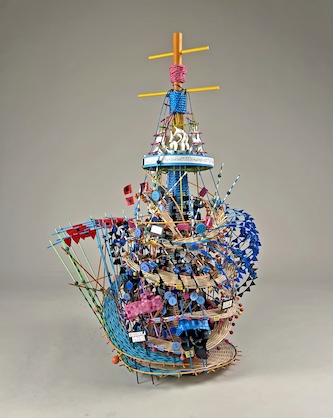
Nathalie Miebach, The Ghostly Crew of the Andrea Gail, 2019. Photo: courtesy of Nathalie Miebach
Two mixed-media collage works by Bert Yarborough draw inspiration from Herman Melville’s novel Moby-Dick. In one, the gaping maw of the whale frames the silhouette of a one-legged man teetering within. Yarborough’s abstractions evoke the terror of the white whale — the creature that severed Captain Ahab’s leg and set in motion his all-consuming quest for revenge. The novel’s epic force continues to resonate for those in the fishing industry, who must remain constantly aware of the sea’s immense and unpredictable power. Though commercial whaling has long since ended, Cape Codders remain acutely attuned to the dangers inherent in fishing and boating.
Adjacent to Yarborough’s collages is a series of five interconnected videos featuring the work of Site-Specific Dance, a troupe that performed Erosions on Race Point Beach in Provincetown last year. The dancers stretch across the shoreline, slipping and sliding into the yielding sand as fragments of text appear between scenes. One screen declares, “We are inextricably linked with our environment,” while another asks, “What do we have?” The company’s immersion in carefully chosen landscapes becomes a compelling means of probing the relationship between human bodies and the natural world they inhabit.
Annie Lewandowski, a composer and senior lecturer in music at Cornell University, studies humpback whale song as a way to better understand these complex creatures and advocate for their protection. In recent years, she has brought students to the Outer Cape through her course “Music on the Brain: Marine Stewardship and Creative Collaboration.” In collaboration with CCS, Lewandowski guides students as they observe and record the region’s natural soundscape. The exhibition features her evocative recordings of whale song — a resonant auditory layer that provides a fitting backdrop for this ocean-centered exhibition.
May Tveit gathers salt hay from Nauset Marsh, then coats it in urethane and automotive paint, transforming it into glossy, three-dimensional bundles. One gleams in a vivid purple, another in lime green — colors that sharply contrast with the hay’s natural muted brown. In 2009, Tveit installed these treated bundles alongside traditional sheaves at sites throughout the Cape Cod National Seashore. The project, she explains, is intended to highlight the growing distance between everyday life and the stewardship of the coastline.
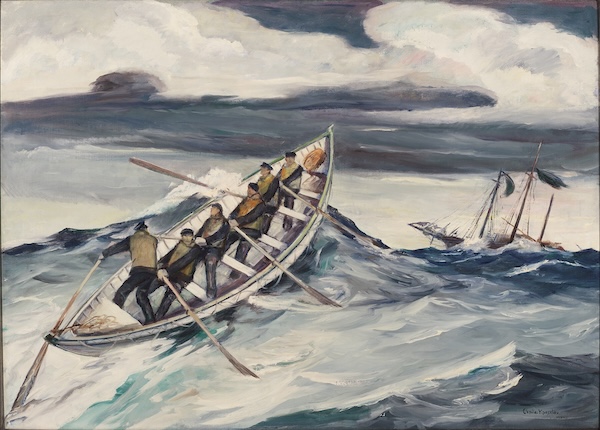
Charles Kaeselau, The Gale, 1934. Photo: courtesy of PAAM
In addition to the contemporary pieces, the exhibition includes several works by older Cape Cod artists. Winter in the Harbor, c. 1902, by William Halsall (1841-1919) is an oil painting of a sailing ship, a placid scene with a lovely pale pink background. Clamdiggers by Lucy L’Engle (1889-1978) shows three men at work, toting buckets for collecting clams. The Gale, 1934 by Charles Kaeselau (1889-1972) is an effectively dramatic depiction of a boat at sea during a storm, with six men fiercely rowing back to shore.
Study for Eroded Shore by Ross Moffett (1888–1971) depicts a pile of twisted wood along the beach, set against the ocean beyond. In addition to his work as a painter, Moffett played a significant role in Cape Cod archaeology. Unfortunately, the label provides little context about his life or his contributions to the region’s history. While visitors familiar with the Outer Cape may recognize his name, those without that background would benefit from more interpretive detail to situate his work.
The exhibition as a whole offers a window into the intersection of science and art at the tip of Cape Cod. Though the ecosystem is fragile, the Outer Cape’s stark beauty remains unparalleled. Bringing together contemporary and historic works, the exhibition underscores the urgency of recognizing — and acting on — the need to preserve this special place.
Lauren Kaufmann has worked in the museum field for the past 14 years and has curated a number of exhibitions.
Tagged: "Persistent Curiosity: Charting the Rippled Fabric of the Sea", Center for Coastal Studies
1 Comment
Leave a Comment
Great review, thank you. This sounds like a really interesting exhibit.