
Arts Commentary: The Kennedy Center and the Boston Symphony Orchestra — A Tale of Two Crises
By Jonathan Blumhofer
A court-ordered reset in Washington and a self-inflicted rupture in Boston expose deeper failures of leadership, transparency, and trust.
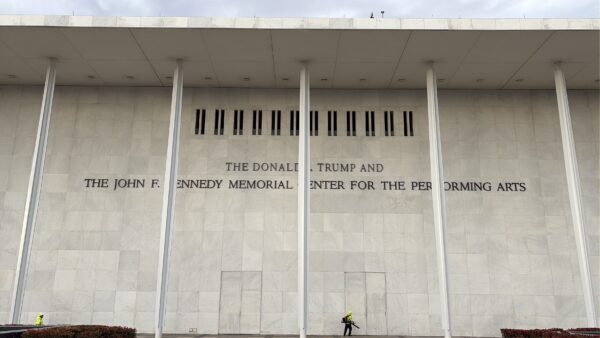
Donald Trump’s name was added to the Kennedy Center façade on December 19, 2025. It was removed from the façade on June 13, 2026, by order of the U.S. District Court for the District of Columbia. Photo: Wikimedia
Sometimes the wheel turns slowly, Lorne Michaels is credited with saying. But it turns.
So it happened that, on Friday night — actually Saturday morning, following last-ditch appeals and thunderstorms — construction crews finally removed the president’s name from the façade of the Kennedy Center.
The event drew robust streaming numbers and a determined live audience outside the venue. There wasn’t much to see, since work proper didn’t begin until the wee hours and then, allegedly on White House orders, it was obscured by a giant tarp. Nevertheless, come midday Saturday, the John F. Kennedy Memorial Center for the Performing Arts was again, on the outside at least, much as it has been these last 50 years (though, suspiciously, scaffolding still covers much of its name).
Either way, the situation on the inside remains bleak. Though the same court ruling that reaffirmed Congress’s sole right to rechristen the premises delayed the announced two-year shutdown of the place (planned to begin after July 4th), the Center’s upcoming season remains vacant.
In fact, the same day Trump’s name was due to come down, Washington National Opera, which departed its longtime home this winter, sued the Center to recover its endowment. At the same time, the board of the Center refuses to approve the National Symphony Orchestra’s budget, which means that the orchestra’s upcoming season has yet to be finalized and announced. And, of course, the rest of the arts center’s usually hefty offerings — Broadway shows, touring ensembles, educational programs, family events — remain on hiatus, while the Center’s staff is a shell of its pre-2025 self.

Boston Symphony Orchestra president and CEO Chad Smith. Photo: Kayana Szymczak
Meantime, last Thursday The New York Times published an interview with Boston Symphony Orchestra president and CEO Chad Smith. At the very least, the piece seemed an acknowledgment that total silence in the face of an uproar caused by a shabbily managed decision — namely the choice to terminate BSO music director Andris Nelsons’s contract without any publicly disclosed cause — was untenable.
Though the article didn’t reveal many new details, it did allow Smith to contradict himself — “It was certainly not our intention for this to be rolled out in this manner,” he now says of the conductor’s firing, whereas in March the process “rolled out in the way it had to roll out” — and to aver that he’s not, as his most vocal detractors demand, going anyplace. Nelsons, though, is: the possibility of reinstating the conductor is “off the table.”
Even so, the BSO’s future remains brighter than the Kennedy Center’s, if only for the short term. The Tanglewood season opens in early July and runs for eight weeks. But at the end of it, the orchestra’s collective bargaining agreement expires, and management’s dismissal of the ensemble’s popular music director seems to have senselessly poisoned decades of goodwill built up between the players and Smith’s predecessors, notably Mark Volpe (who stepped down from the position in 2021). “There has been a huge shattering of trust and belief in management after this,” Players’ Committee chairman Todd Seeber told the Times.
Smith does talk about healing rifts but doesn’t see that happening until the next music director is selected (according to the article, the search is scheduled to begin in the fall). Yet that’s a process that normally takes years and, if Nelsons’s curt dismissal was imperative to correct urgent problems of falling attendance and diminishing ticket sales and donations — problems not unique to the Boston Symphony, it should be pointed out, nor primarily of an artistic nature (thus not part of the conductor’s purview) — it is an open question of what will remain of the BSO if this self-inflicted wound is allowed to fester and simply run its course.
Not that the institution needn’t adapt to changing realities of audiences, listening expectations, and revenue. The difficulties the BSO faces relating to attendance and finances are real but solvable with creativity and bold leadership. In this, Smith seems ideally placed: he came to Boston from the Los Angeles Philharmonic, where he spent years overseeing one of the country’s most vibrant orchestras.
But whatever promise his appointment held and whatever results he’s aiming for have been badly tarnished by the debacle of removing Nelsons without informing the players beforehand or more decorously breaking the news to patrons. At this point, it’s difficult to imagine the institution starting to effectively repair the breach its president and board have caused absent Smith and board chair Barbara Hostetter demonstrating a considerably greater degree of humility and transparency than they’ve thus far shown.
If there is a silver lining to the BSO’s situation — and the Kennedy Center’s, for that matter — it’s that there appears to remain considerable, vocal support for the orchestra and independent arts establishments, generally, across demographic lines. The so-called “Red Flower Movement” is a visible reminder that the relationship between these institutions and their audiences isn’t a one-way street from the C-suite to the seats. Accordingly, a renewed understanding of these companies’ missions and, perhaps, a reconsideration of how openly they’re run is in order.
As far as the BSO goes, its administration needs to articulate the specifics of the “future vision” over which the conductor and board irreconcilably split. Smith’s silence on this matter after three months is inexcusable, and the whole situation is beginning to take on the surreal air of the first Trump administration’s “Infrastructure Week” teases.
Additionally, the players’ role in organizational decision-making needs to be rethought. True, this is a touchy subject and the model of European self-governed ensembles, which comes up now and again in comments sections on various sites, is not available to Boston; it exists in Europe only because of generous public subsidies for arts institutions.

BSO Associate principal flute Elizabeth Klein. Photo: courtesy of the Boston Symphony Orchestra
But there clearly is the need for greater input — including, perhaps, some form of board-level voting power — and open lines of communication between musicians and management moving forward. Smith publicly answering associate principal flute Elizabeth Klein’s questions as posed in The Berkshire Eagle seems, at this point, a necessary foundation for any rebuilding of goodwill between the parties.
Ultimately, though the orchestra and its audience won’t be returning to a pre–March 6th setting, there may yet be opportunities to salvage a positive outcome from this mess. But accomplishing as much will first require course corrections from Smith and the board. As Deborah Borda, the CEO’s predecessor in L.A., put it to the Times, the storm her protégé unleashed “isn’t serving anybody.”
Similarly, the Kennedy Center can’t return to the status quo ante. Earlier this month, Douglas McLennan penned a thoughtful writeup on what might come next for the place, even as we may have to wait some time for anything to materialize.
Nevertheless, his vision is aspirational and not unreasonable. Noting that the building on the banks of the Potomac is “national in its charter and in almost nobody’s actual life,” he envisioned an arts center with an active, national footprint, one that helps to bring the arts to underserved communities across the country through funding initiatives, outreach, and tours.
One obvious hitch to any such plans, of course, is money: Congress has been notoriously averse to providing support for arts and culture projects. And there’s no promise that the attention garnered by removing Trump’s name from the building will carry over to the actual operations of the Center itself.
Still, the showing was impressive enough — and on a Friday night, at that — to provide a welcome glimmer of hope. Also, some witty ripostes.
“Live your life in a way that a large crowd doesn’t gather at midnight to cheer your name being removed from a building,” was among the more memorable ones I came across. It’s good advice — and a timely reminder for Smith, Hostetter, and company to consider as they ponder their next moves.
Jonathan Blumhofer is a composer and violist who has been active in the greater Boston area since 2004. His music has received numerous awards and been performed by various ensembles, including the American Composers Orchestra, Kiev Philharmonic, Camerata Chicago, Xanthos Ensemble, and Juventas New Music Group. Since receiving his doctorate from Boston University in 2010, Jon has taught at Clark University, Worcester Polytechnic Institute, and online for the University of Phoenix, in addition to writing music criticism for the Worcester Telegram & Gazette.
Tagged: Boston Symphony Orchestra, Chad Smith, Donald Trump, National Symphony Orchestra, The Kennedy Center
1 Comment
Leave a Comment
It is worth keeping in mind that the judge can remove the Kennedy Center board of trustees entirely for malfeasance (including, presumably, contempt of court), incompetence, self-dealing, or just being in general quarrelsome and difficult. Something of the kind happened a few years ago at the former Corcoran Gallery in Washington. The court removed the trustees, abolished the museum, and redistributed the collections. I assume this threat is why the Kennedy Center trustees have so promptly and meticulously followed the court’s instructions. The exterior signage was left to the last minute while the trustees still hoped for a stay on appeal, which did not come.