
Film Review: “The Devil Wears Prada 2” — Cerulean Idealism, Crimson Satire
By Peg Aloi
David Frankel’s wildly popular fashion fairy tale returns with a biting media critique and Meryl Streep’s cucumber-cool Miranda facing down tech billionaires.
The Devil Wears Prada 2, directed by David Frankel. Screening at Somerville Theatre, Kendall Square Cinema, AMC Assembly Row 12.
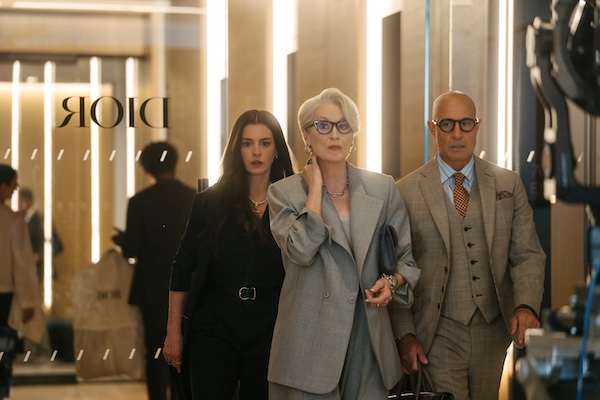
(L-R) Anne Hathaway as Andy Sachs, Meryl Streep as Miranda Priestly, and Stanley Tucci as Nigel Kipling in The Devil Wears Prada 2. Photo: Macall Polay
The Devil Wears Prada (2006) was based on a thinly veiled fictional account of a young journalist (Lauren Weisberger) who worked briefly for Vogue as the assistant to editor-in-chief Anna Wintour (the eponymous devil). Reinvented as Miranda Priestly, played by the inimitable Meryl Streep, editor of the high-profile fashion magazine Runway, she is a fearsome boss who is often rude and dismissive, especially to her employees. Assistant Andrea “Andy” Sachs (Anne Hathaway) rolls with the punches, despite being constantly exploited and humiliated. At one point, Miranda delivers a condescending yet insightful lecture on the meaning of the color blue in Andrea’s unsophisticated workwear outfit, and also inexplicably refers to the willowy Andy as “the smart, fat girl” (a dig at the magazine’s unhealthy body-shaming culture). Andy is somewhat charmed by the glitterati lifestyle, but she finally decides that the exhausting world of high fashion is not for her. Before she moves on, however, in a vulnerable moment, Andy glimpses the humanity beneath the rude bluster of Miranda’s persona. Twenty years on, human vulnerability is a major theme in The Devil Wears Prada 2, which turns out to be surprisingly fresh, relevant, and sumptuously entertaining.
The coming-of-age career girl quandaries of the first film are brought up to speed in the opening scene (after we see the first of many cheeky Easter eggs — a huge banner reading “Spring Florals”). Andy is at an awards dinner for journalists in Manhattan and, just after her name is read aloud as a nominee for an investigative piece she wrote for a fictional publication called Vanguard, she gets a jarring text-message alert, as does everyone else at her table. It’s immediately obvious what’s happened: it’s a profoundly sympathetic moment for just about any writer or reporter these days (including yours truly). In what must be about the hundredth round of major layoffs at media outlets in the last three years, Andy Sachs has been sacked, along with many of her colleagues. She wins the award, but now she needs a new job.
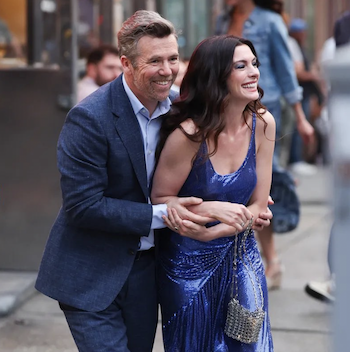
Patrick Brammall and Anne Hathaway in The Devil Wears Prada 2. Photo: Macall Polay
Coincidentally, Runway publisher and CEO Irv Ravitz (Tibor Feldman) needs to do damage control in the wake of a PR disaster, and that brings Miranda front and center after the magazine promotes a vendor with questionable labor practices and human rights violations. In what seems an absurd twist of fate, Irv’s efforts to raise the magazine’s journalistic profile after this blunder land Andy a new job — features editor at Runway. After her emotional acceptance speech at the awards dinner goes viral online, her profane declaration that “Journalism fucking matters!” makes her a seemingly perfect candidate to displace the woman who held the job previously. The irony! Of course, this brazen revolving-door symbolism is the very essence of fashion, and Irv’s impulsiveness puts Andy in the position of being both selected and shunned. Meanwhile, Miranda, stressed but cucumber-cool, acts as if she’s never met Andy before, while fashion editor Nigel (Stanley Tucci, back with his impeccable style and comic timing) immediately quips, upon seeing Andy, “Look what TJ Maxx just dragged in.” Still, there’s a faint tremor of affection in his voice. The old gang is back together, it seems, with some notable upgrades.
Miranda has remarried: a subdued, sweet Kenneth Branagh plays her concert-violinist husband, and he seems to be good for her. Miranda’s current executive assistant Amari (Bridgerton’s Simone Ashley) is a stylish, efficient replacement for the unforgettable Emily Charlton (Emily Blunt), who was Andy’s mentor and nemesis 20 years ago. Amari sits beside Miranda in staff meetings, frequently delivering sotto voce reminders that “you can’t say that” when Miranda uses outmoded or insensitive language. Andy’s presence at these meetings is greeted with chilly disdain, even when she offers helpful suggestions. She has no choice but to put her head down and get ferociously good at her job.
One of the first fashion luminaries she has to meet is, of course, Emily, who is guardedly cordial. Emily is divorced with two cute kids, while Andy announces she’s single and not really looking. Emily still avoids carbs, craves bespoke couture, and holds a management position at Dior, a role she seems born to. But her calculating ambition is evident in her oddly nurturing role as romantic partner to billionaire weirdo Benji Barnes (a hilarious Justin Theroux), a tech bro who’s dabbling in the world of high fashion. Like Jeff Bezos, Barnes’s ex-wife Sasha (a subdued, elegant Lucy Liu) has become a philanthropist who eschews publicity. It needs to be said, the film’s entire cast, returning and new, is impeccable, the production design lush, the energy infectious. Andy’s sudden good fortune feels like a beacon of hope, her hard work a call to action. She lands an interview with Sasha for publication in Runway, a feather in her editorial cap that earns Miranda’s grudging respect and appreciation. Andy is still cautious, however, noting how Miranda has repeatedly failed to publicly acknowledge or reward Nigel’s capability, loyalty, and vision. There’s an air of “it is what it is” at the magazine, reflecting the enshittification of all things related to culture. Did I mention journalism is in trouble?
In addition to filing important stories on social and cultural issues related to fashion, Andy is a de facto brand ambassador for Runway, which includes a high-profile event in Milan where the magazine’s future hangs in the balance. In a world gone digital, a world where legacy magazines are no longer run by visionaries who care about issues and aesthetics but by aspirational billionaires who care only about profit margins and bonuses for executives … whither haute couture? The disappearance of Runway is upsetting, because, well, we’ve been watching the breakdown of media for years now. I can’t say all will be well, but Hollywood is still in the business of giving gifts that fill us, at least temporarily, with hope and optimism.
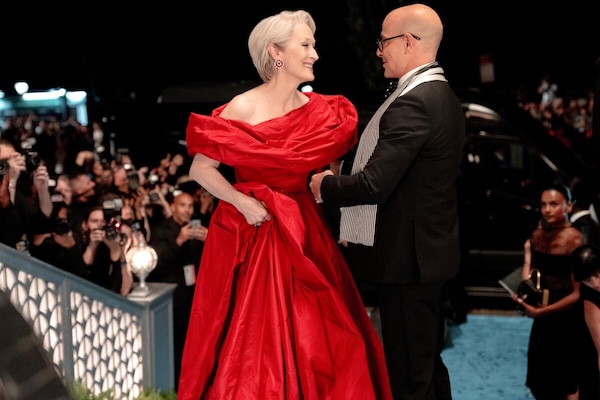
Meryl Streep as Miranda Priestly and Stanley Tucci as Nigel Kipling in The Devil Wears Prada 2. Photo: Macall Polay
Fans of the first film will love the veritable tsunami of references throughout the sequel: Andy walks blithely across a busy Manhattan street, eating a bagel; her progression through outfits in various shades of blue; and, eventually, a vest-like, perhaps upcycled version of her own cobalt — nay, cerulean — cable-knit sweater, worn in a scene where her careless smirk prompts Miranda to artfully humiliate her as an unfashionable intern. Andy’s friend Lily (Tracie Thoms) returns, still thrilled to get a free designer bag, still protective of Andy’s personal life. When Peter, a handsome, successful, seemingly nice guy (Patrick Brammall), shows interest in Andy, Lily — upon learning he is single — pointedly asks, “Why?” I liked Peter well enough; he’s sweet and witty but, well, bland. Given the higher stakes the sequel goes for, I wanted romance to play a stronger role. Perhaps because fashion as a pursuit seems aligned with fantasy, with fairy tale notions of pleasure. Andy’s making more money than she ever dreamed possible, doing what she’s always wanted to do, surrounded by beauty, yet she is enamored with a drab developer guy. The film doesn’t even show us their first kiss, which seems a wasted opportunity for a bit of onscreen magic.
Despite its glamorous, glossy look, the first film’s budget was tiny compared to this one. There are countless cameos featuring celebrities, designers, and models, including a fabulous, low-key performance by Lady Gaga, now a bona fide film star. The costumes are stunning. Patricia Field designed the first film’s looks, but the sequel belongs to Molly Rogers, who also designed costumes for Sex and the City. From Miranda’s outrageous, voluminous cherry-red gown to Andy’s sexy midnight-blue sequined sheath, the clothes are distinctive mash-ups of contemporary and vintage styles, with some characters even referring to great thrift-shop finds of couture treasures (a nod, perhaps, to our precarious economic times). Clothing is an everyday necessity, yet the film suggests our choices can command attention and awe, a way to hone our identity and sense of self.
Is fashion for everyone? Is fashion journalism crucial for a well-functioning society? Maybe. Fashion is often portrayed as a shallow distraction when in fact it is, historically and artistically, one of humanity’s most interesting achievements. The Devil Wears Prada 2 doesn’t preach, but to its credit it embraces society’s healthy, ongoing obsession with beauty, with art, with creation. May these desires excite us enough to push onward, defying the specter of an approaching apocalyptic hellscape of AI and Temu.
Peg Aloi is a former film critic for the Boston Phoenix and member of the Boston Society of Film Critics, the Critics Choice Awards, and the Alliance for Women Film Journalists. She taught film studies in Boston for over a decade. She has written on film, TV, and culture for web publications like Time, Vice, Polygon, Bustle, Dread Central, Mic, Orlando Weekly, Refinery29, and Bloody Disgusting. Her blog “The Witching Hour” can be found on substack.
Tagged: "The Devil Wears Prada 2", Anne Hathaway, David Frankel, Meryl Streep
1 Comment
Leave a Comment
Suffice to say that La Streep is now all over the internet bragging that she got the producers to double the price they were willing to pay for her. This is a perfect summation of what this film, and the vampiric industry it hallows, represent.