
Book Review: Not with a Crash but a Siege — The Real Story of Constantinople’s Fall
By Thomas Filbin
Anthony Kaldellis recasts the fall of Constantinople as a long process of attrition, shaped by strategy, fear, and the limits of Western indifference.
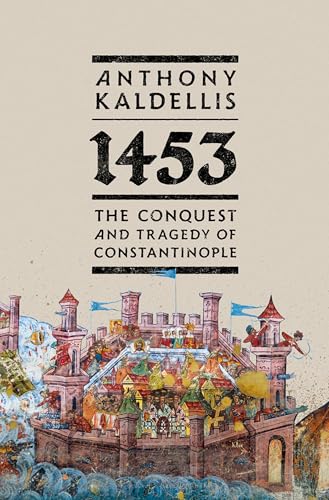
1453: The Conquest and Tragedy of Constantinople by Anthony Kaldellis. Oxford University Press, 334 pp. $29.99.
 When I was an undergraduate, decades ago, I enrolled in a summer course on Eastern Europe for the least noble of reasons: it fit my schedule. The professor — a fusty, faintly antiquarian man of Armenian descent, with a Harvard PhD and formidable expertise in Eastern European history — faced the initial challenge of persuading us that Europe, as shaped by the Roman Empire, was not a monolith. Most of my classmates were familiar with Britain and Western Europe, but largely ignorant of the eastern half of the Roman world, which developed its own identity and outlasted Rome by nearly a millennium. Its inhabitants included Greek-speaking Romans alongside Albanians, Armenians, Bulgarians, Serbs, Croats, and Levantine Arabs, among others. Over time, successive Islamic conquests gradually eroded this empire, until it was reduced to Constantinople and its surrounding territories.
Anthony Kaldellis’s compelling study of the final collapse of the Eastern Roman Empire advances a striking reassessment of both its demise and its broader historical significance. Like the so-called “fall of Rome,” the end was not a single catastrophic event but the result of a prolonged process of attrition and transformation. Over centuries, the expanding Islamic world — and ultimately the Ottomans — absorbed what remained of “Rome,” at least as it persisted in the cultural imagination. Kaldellis centers his narrative on Ottoman strategy, tracing how it systemically dismantled a once formidable empire. The book emphasizes military history, not at the level of technical minutiae, but as a means of clarifying how victories are secured and defeats incurred. Constantinople’s formidable walls were only one part of its defensive system; moats, ditches, and tunnels reinforced the city’s resilience. Yet these advantages were undercut by a critical weakness: a limited and often poorly trained defending force, composed as much of necessity as of military discipline.
The defense of Constantinople was fueled by a profound fear of what Ottoman rule would bring. For its Christian inhabitants, conquest signaled not only political defeat but the prospect of enslavement, the fracturing of families, and the wholesale transfer of land and property to the victors. The failed Ottoman siege of 1422 had bolstered confidence that the city could again withstand attack, encouraging a belief — ultimately misplaced — in its own resilience in 1453. At moments of panic, some considered surrendering Constantinople to a Latin power — such as Venice — yet this pragmatic possibility was never realized. Meanwhile, Western Europe had little economic incentive to intervene; ongoing trade interests with the Ottomans — combined with the long shadow of failed crusades — had convinced many rulers that reclaiming or dominating the eastern Mediterranean was no longer a feasible option. The result was a city left largely to its fate, caught between fading confidence and geopolitical neutrality. (Yes, delusions of controlling the Middle East continue to this day.)
The 15th century marked the arrival of gunpowder warfare, and Kaldellis underscores its decisive impact on Constantinople’s fall. The sultan deployed 37 cannons, including the enormous “Big One,” which eyewitnesses say was enormously intimidating. Its blasts did more than batter walls —they shattered morale. “Although the defenders had heard cannon fire in the past,” explains the historian, “…this bombardment was on a different scale of volume, frequency, and duration.” It produced fear among civilians as walls and towers cracked under the siege. Debris was scattered everywhere; the entire city became a war zone. The din and the staggered interludes of shooting left civilians unhinged.
This turned out to be a one-sided battle. The city’s defenders became increasingly desperate trying to beat overwhelming odds:
Bells sounded throughout the city, calling men, women, and children to their assigned duties. They carried stones to the battlements to throw down upon the Turks who were scaling the ladders; a slightly later source refers to vats of scalding oil.… There was not much more that they could do. Many were weeping and shaking in terror.
Kaldellis argues that the Ottoman army was built to excel at two tasks: defeating opposing forces and extracting wealth from conquered territories. In 1453, those aims were realized with brutal efficiency. Much of Constantinople’s population was enslaved, its riches seized as spoils, and violence — including sexual violence — was treated as an extension of victory. The city itself was not simply captured but remade: churches became mosques, new languages took hold, and its cultural character shifted decisively. Yet the historian resists the notion of a seamless succession from Rome to Ottoman rule, noting that the empire did not conceive of itself as a continuation of its Roman predecessor. Identity, he suggests, is never so easily overwritten. Indeed, Constantinople reshaped the Ottomans even as they transformed it, with consequences that far exceeded the city’s modest size and population at the time of its fall. “Constantinople changed the Ottomans as much as they changed it,” notes Kaldellis, “… it had an impact that was far out of proportion to the small territory and few people who were conquered in 1453.”
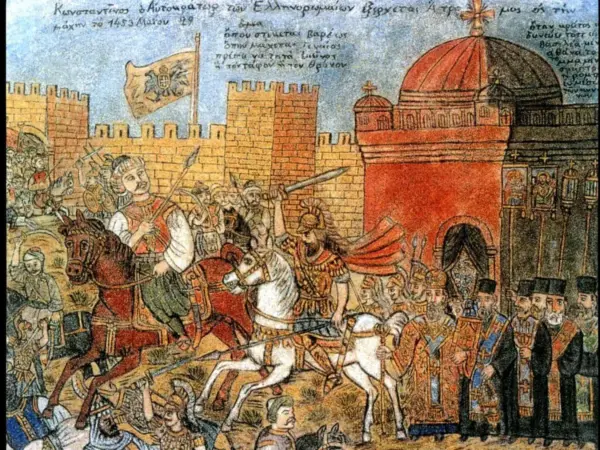
Emperor Constantine XI fought to the end as Constantinople fell to the Ottomans on May 29, 1453, marking the collapse of the Byzantine Empire. Credit: Theophilos Hatzimihail, Wikimedia Commons
This book, while centered on the fall of a great state, gestures toward broader social and political transformations. Yet it also raises a powerfully relevant question: how much does history weigh on us now, when technology, more than emperors, seems to be what drives change? History is studied less than computer science in today’s universities; even our current president appears not only ignorant of the past, but uninterested in it, aside from his own self-aggrandizing fantasies. In the film In Bruges, Brendan Gleeson’s weary hitman urges Colin Farrell’s restless partner to absorb the medieval city around them. Farrell shrugs it off: “History is about shit that’s already happened.” The line lands because it echoes what has become a wider cultural indifference. A man once mentioned the “Ottomans” to a friend, who assumed he meant an outdated piece of furniture he’d never want.
Istanbul remains on my bucket list — a city where East meets West, where old and new coexist uneasily. In that sense, its tensions mirror the polarities that make up all great civilizations. Change is constant, however much we resist it. If we returned to America in 3026, would we feel awe, horror, wonder, fear — or all at once? Might we recognize ourselves at all, or find only a distant echo, like Rome in new clothes? Plus ça change…
Thomas Filbin’s reviews have appeared in The New York Times Book Review, The Boston Sunday Globe, and The Hudson Review. He teaches writing at Suffolk University in Boston.
Tagged: "1453: The Conquest and Tragedy of Constantinople", Anthony Kaldellis, Constantinople, Eastern Roman Empire
The Western invention of the word “Byzantine” was a deliberate ideological attempt to rewrite history. It sought to diminish the global weight of the Islamic Ottoman victory and sever the connection between the ancient Roman legacy and Sultan Mehmed II’s ultimate triumph. In truth, the Ottomans overthrew Rome, and Fatih Sultan Mehmet became the true Roman Emperor.
But it demeans his achievement and saves you from bad taste in your mouth! Good enough reason for many narrow minded people..
“Two Romes have fallen, the third stands, and a fourth there will not be”. – Ivan the Terrible
It’s very true that the Western world invented the word ‘Byzantine’…by a dopey German no less, years after the East Roman Empire had fallen. It makes reference to Byzantium, the small Greek city that existed before Rome took over and created the great city of Constantinople. It is the most idiotic word to choose , as it has nothing to to with the East Roman Empire at that time. The inhabitants of Constantinople considered themselves to be Romans and called themselves as such. Even the Turks referred to the people in Constantinople as ‘Romani’. The change in name had nothing to do with the Ottoman victory and more so to differentiate the supposed ‘Greekness’ of the East Roman Empire from the western half, hence the reference to Byzantium. A very stupid conclusion as even though Greek was spoken in the city for 1000 years, it was run under Roman administration, Roman law and Roman culture. I don’t think the Sultan was thinking of calling himself the new Roman Emperor. That’s your Islamic stretch and it’s pure nonsense. The Ottoman Empire was in ascendancy at that stage and considered itself to be Ottoman, nothing ‘Roman’.
The current (US) President all too well understands 20th and early 21st century history and the immense danger openly posed and stated by the Iranian regime and its several dangerous, state-swallowing proxies. As the longtime Dean of Second World War history, Gerhard Weinberg has repeatedly written and stated, if any aggressive foreign dictator says that he (or she) is going to do something, you had better listen carefully and not assume he is just exaggerating or half-joking, just because you don’t understand or believe it. That, Weinberg says,is the single most important lesson from the Second World War. And it is also a lesson that was NOT learned by either Obama or the ‘never-met’-a-dictator-I didn’t-like’ Jimmy Carter (as Alan Dershowitz has shown in his 2008 book).
So when someone says they are going to annex Greenland or Canada he should be taken seriously also.
What could make an Ottoman Sultan into a Roman Emperor? The conquest of land? And why would he want to? Both Roman and Ottoman seem to me rather incompatible connotations.
Stop lying to the world and twisting facts. Sour loser
Why does the reviewer feel he must drag President Trump into a book review? There is nothing about the current political climate even remotely resembling 1453. Those infected with TDS simply cannot pass up a chance to spew their bile it seems.
If you are in Rome do what do the Roman do!
And here comes the liberal scholar throwing daggers at the second greatest president of these United States. He needs to stay in his lane and stick to history not politics because he just sounds uneducated.
…and who in your opinion is the greatest president? Millard Fillmore?
Most of you know nothing about this conquest. There should have been hundreds of movies that you could see how Sultan Mehmed moved the ships on the land over tree trunks that’s dipped in oil. Thousands of soldiers pulled those ships and brought them to inner sea to bombard the walls from the sea. Biggest cannons ever made till then was used.
There are many other genius tactics. You can’t find any movie because it wasn’t a victory of ottomans over Romans. It was the biggest victory of Islam over Christianity. I always thought what if my ancestors never converted to Islam which hundreds of thousands of them got killed by Arabs and finally said please stop we will convert.
What if they stayed shamanists. If they did there would be no conquest of Istanbul because the reason of that conquest mostly depends on a quote of prophet Mohammed who said “Verily you shall conquer Constantinople. What a wonderful leader will he be, and what a wonderful army will that army be!” This is why you can’t see any movies about it. So no Islam no istanbul. If there was no Islam probably Turks didn’t have to fight against multiple crusades to protect a city that 5 billion calls holy. If they were not Muslims a crazy sultan called Selim wouldn’t try to capture abbasids and take the caliphate believing if he gets that title all Arabs will automatically obey him and be loyal to ottomans. That didn’t work out. Couple centuries later most of Arabs stabbed Turks in the back with the help of Lawrence of Arabia.
All I know is your billions of people are divided, live with hatred and anger just because two people claimed that they are the messengers of god that doesn’t exist. One day that I won’t see, these religions will collapse just like the others. I assure you.