Jazz Interview: Jazz at Lincoln Center’s Todd Stoll — Jazz Education’s Farm Team Keeps Growing
By Steve Provizer
The Jazz at Lincoln Center vice president of education discusses the growth of Essentially Ellington, the rise in student playing, and the organization’s push for wider access.

The relationship between jazz as a financially viable performing art and jazz education is a conundrum. As a genre, jazz doesn’t even show up in many statistical analyses of music consumption. Even classical music has more fiscal clout. There seem to be fewer venues for jazz performances, or at least no growth in the number of available venues. And yet, there remains a staunch ecosystem for the development of the music in middle and high schools, band camps, and at the college level. Call it the “institutionalization,” as it were, of jazz education: the rough and tumble of ad hoc mentorship is being increasingly replaced by classrooms and rehearsal halls.
The fact that young people are still picking up trumpets and saxophones and learning Miles Davis and Charlie Parker solos doesn’t necessarily bode well for the future earning capacities of most of these students. But it is good news for jazz listeners, because it means there will be a “farm team” that will continue to develop strong young voices to carry the jazz torch.
An institution that has been one of the main players in this process was Jazz at Lincoln Center (JALC), which began in 1987 with a concert series organized by trumpeter Wynton Marsalis, who has remained the face of JALC since that time. JALC has not been without its controversies through the decades—Marsalis’ sometimes controversial statements and pointed critiques of JALC’s racial and gender policies—but the institution’s education programs have incontestably been an important part of the jazz development matrix.
One of the foundational educational elements is the Essentially Ellington High School Jazz Band Competition & Festival, which is now in its 31st year. Todd Stoll is the Vice President of Education at JALC and manages the JALC education programs, which includes the Festival. Stoll was trained on the trumpet at the Cincinnati Conservatory of Music, founded the Columbus, Ohio Youth Jazz Orchestra in 1991 and directed it for 20 years. He answered some questions about the festival and JALC via email.
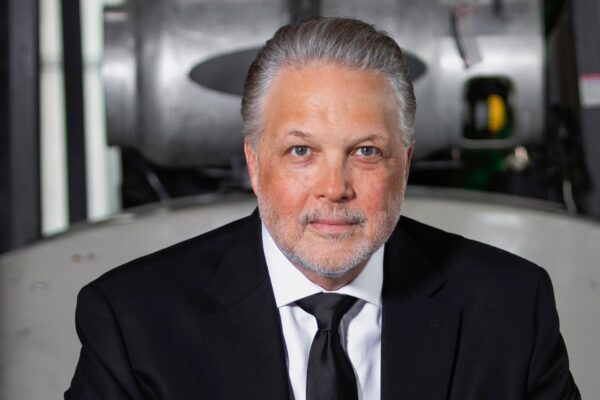
Todd Stoll, Vice President of Education at Jazz at Lincoln Center. Photo: Jazz at Lincoln Center.
Arts Fuse: Tell us how you became involved in JALC and exactly what your role is.
Todd Stoll: I have been Vice President of Education for nearly 15 years and was a former Essentially Ellington competition finalist band director in the early 2000’s. I manage Jazz at Lincoln Center’s global suite of education programs—2,500 separate classes, workshops, clinics, and performances—reaching nearly 200,000 participants per year.
AF: When you scrutinized the programming, what did you want to change, eliminate, or create?
Stoll: We hope for more local programming for NYC school students, and a pipeline of programs for students from middle school through high school and into college. Our goals are toward greater access for all students regardless of circumstance.
AF: A statement on your LinkedIn page says: “I believe in the power of transformational arts education; that music and the arts can inspire our society and help re-define our social goals and structures beyond that of the mass-produced. That a national movement to define our culture and make peace with our past can move all Americans towards a better understanding of themselves and the world at large.” Can you tell us how any of that is realized “on the ground,” so to speak.
Stoll: We live in the single most mass-marketed time in human history. Kids (and many adults!) only know (generally) what is put on a screen in front of them. Jazz can help them broaden their perspective and understand both our history and our potential for the future. To play jazz well requires a massive amount of equilibrium with yourself, the rhythm section, and the material you are dealing with— melody, harmony, rhythm, and form— just at a basic level. Add large ensemble music and you now have sacrifice. One must sacrifice to play in balance to make the “whole” better. One must give up the “self.”
AF: How do you envision JALC’s relationship to conservatories or other college level institutions that teach jazz?
Stoll: We want to do a few basic things:
- Inspire them with a high level of creativity, artistry, and virtuosity from the Jazz at Lincoln Center Orchestra and surrounding musicians.
- Provide resources at a very high-level including scores by the very finest jazz composers and arrangers
- Encourage them to teach the music from a cultural and historical perspective, not just the music marketed to them by publishers and salespeople.
AF: April 30-May 2 is the Essentially Ellington High School Jazz Band Competition & Festival. Tell us about the history of the competition.
Stoll: This is a three-decade effort to elevate school jazz bands, their directors, and the communities that support them. In our 31st year, we have distributed over 400,000 charts, free of charge, to more than 7,000 schools worldwide. While the music of Duke Ellington is at the center of the event, beginning in 2008, we added those of other seminal, important and many times overlooked composers and arrangers including Mary Lou Williams, Benny Carter, Dizzy Gillespie, Gerald Wilson, Melba Liston, Benny Golson, and others.
We also host non-competitive regional festivals that have grown from five in 2012 to 27 in 2026 in every region of the United States, and in Australia. We also have plans to host more international festivals in the coming years.
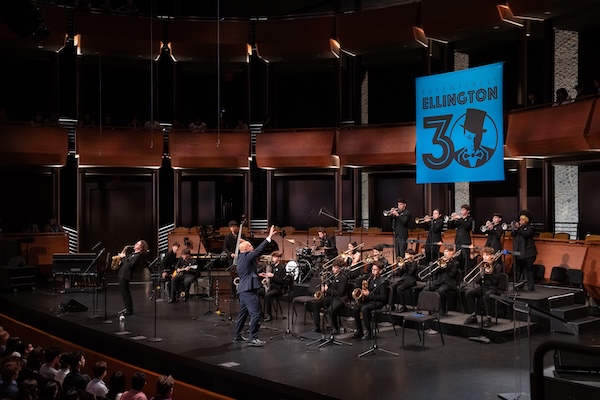
The 30th Annual Essentially Ellington High School Jazz Band Competition and Festival. Directed by Joan Chamorro and 2nd place in the competition, the Sant Andreu Jazz Band from Barcelona, Spain, performs at the Rose Theater on Saturday, May 10, 2025. New York. Jazz at Lincoln Center. Photo: Gilberto Tadday/Jazz at Lincoln Center.
AF: Is there anything different about this year’s competition?
Stoll: We saw about a 20% uptick in applicants in 2026, a bump we expected after celebrating the 30th anniversary in 2025. This year’s finalists include five brand new schools and five Title I schools (public educational institutions that receive federal funding due to a high concentration of students from low-income families) that have much greater challenges than some of our other schools.
AF: Have you seen a change in the level of competence among the entrants?
Stoll: The level of playing has elevated to a near professional level. The top bands at this event are playing at a level that we couldn’t have predicted 20 years ago. When I competed in Essentially Ellington as a band director in 2002, there were only a handful of students that could really improvise on harmony. Now? It’s as if EVERYONE can play on harmony. And then the expressive elements— playing with vibrato, swooping, growling, brass instruments using plungers—all those high-level expressions, that were more or less lost to our “modern” style, have come back and kids and audiences love it! Those are the HUMAN elements of playing as well as adding depth and profundity to the music. This program has dramatically changed how jazz education functions in the U.S. and abroad.
AF: Does JALC respond in some way to changes in arts funding across the broader educational landscape?
Stoll: Yes, we make our best efforts to support schools that lose funding, or perhaps never had the appropriate level of funding. We provide travel stipends for many of the bands coming to NYC, scholarships to our programs for directors and kids, and generally try to be as financially supportive as we can be.
AF: Wynton Marsalis has been important to JALC, and he is retiring this year. How do you think his departure will affect the institution?
Stoll: Wynton will remain actively engaged with the music—as a composer, performer, educator, and advocate. As our Founder and a member of JALC’s Board, he will continue to help shape artistic direction and organizational strategy. From July 23, 2026 through June 19, 2027—his final season as Artistic Director—we will celebrate the full scope of his vision: the music, the education, and the institutional foundation he has built. I will, of course, invite him back for educational events as he is available.
Steve Provizer writes on a range of subjects, most often the arts. He is a musician and blogs about jazz here.
Tagged: Essentially Ellington High School Jazz Band Competition & Festival.