
Dance Review: Angkor Troupe’s “Swan Lake” — Trauma into Triumph
By Debra Cash
Turn the lake into a lotus pond and you can take it from there.
A Khmer Swan Lake by Angkor Dance Troupe. Directed by Phousita Huy, presented by Merrimack Repertory Theatre at Nancy L. Donahue Theatre at Liberty Hall, Lowell, through April 26.
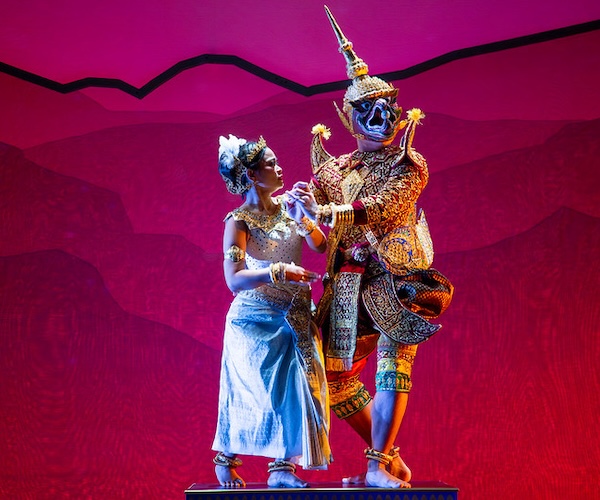
A scene from Angkor Dance Troupe’s A Khmer Swan Lake. Photo: Meg Moore
Swan Lake is a tragedy of mistaken identity. Co-choreographed in Russia by Marius Petipa and Lev Ivanov in 1895, a princess is turned into a swan by a duplicitous wizard who then arranges for his disguised daughter to trick an ardent prince into betraying his true love. This disastrous mistake ends in a double suicide that can only be redressed by a heavenly reunion.
Yet it is the diligent, reverent work of restoring and maintaining a true, enduring identity that informs A Khmer Swan Lake.
During the terror of what has come to be known as the Khmer Rouge Killing Fields, 90% of Cambodia’s artists and intellectuals died of starvation, forced labor, torture, and murder. Beginning in 1975, anyone thought to be educated was a target of Pol Pot’s nihilistic Maoist revolutionaries: wearing glasses was enough to mark a person for summary execution.
By 1979, the classical Cambodian temple dance, thought to date back to the sixth century and carried on in the glittering setting of the royal court, was on the verge of cultural erasure.
Under the auspices of the U.S. Refugee Act of 1980, Lowell, Massachusetts became one of the largest communities of Cambodian refugees in the country. In 1986, Tim Chan Thou – the grandson of a former palace dancer– and Sanara Chea founded Angkor Dance Troupe in an attempt to retrieve and carry on cherished Cambodian cultural traditions. Phousita Huy, a genocide survivor who is part of the first generation of dancers trained at the Royal University of Fine Arts (RUFA) in Phnom Penh after the Khmer Rouge era, came to Lowell and took over as Angkor Dance Troupe’s Artistic Director in 1996. Fellow survivor Bora Chiemruom became its Executive Director in 2022.
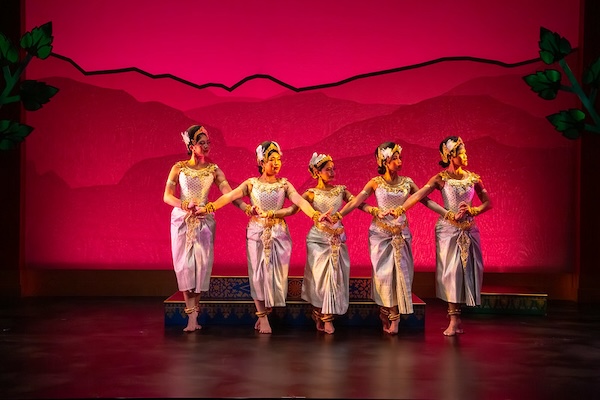
A scene from Angkor Dance Troupe’s A Khmer Swan Lake. Photo: Meg Moore
A Khmer Swan Lake demonstrates how comprehensively Cambodian classical dance has been resurrected across the United States. The cast of dancers brought together from their homes as far away from Lowell as Miami and Hawaii are the children and grandchildren – and with the youngest members of the ADT Youth Ensemble, possibly even the great-grandchildren – of Cambodian genocide survivors.
Transposing Swan Lake into a Cambodian key isn’t so far-fetched. First of all, this is a match-up between two types of aristocratic classicism whose practitioners typically begin their study in childhood and understand themselves as part of a stylistic legacy. The magicked swans are proximate to the benevolent creatures, half-human, half-bird that populate the Robam Kenore repertory. If classical ballet represents lightness and avian flight by a ballerina’s ability to “float” on the tips of her toe shoes, the barefoot Cambodian dancers, with their gold-braceleted ankles, convey the same thing with the celestial apsara’s lifted, flexed foot indicating the space between the ground and air. Turn the lake into a lotus pond, and you can take it from there.
Huy and Sot Somaly, listed in the program as responsible for A Khmer Swan Lake’s book and the pinpeat score recorded in Cambodia, reimagine Swan Lake by way of a narrative that has been tweaked for its Cambodian content. Odette Davy (a mostly sorrowful and serene Channa Sath) rejects the intrusive advances of the bird-god Garuda King (Peter Veth, fantastically expressive), who curses her. Prince Siegfried Voraman, who inherits his father’s gracefully bent bow and his servant Bunret (both danced by women, forceful Virginia Prak alongside appropriately modest Theresa Tha) spy the flock of swans in the forest, as the original scenario would have them do. This forest, though, is lusher than its European counterpart: monkeys scamper through its undergrowth, and two young girls add color, dressed as beautiful butterflies.
At the palace ball, regionally-relevant princesses from Indonesia (Sophori Ngin) and Laos (Stephanie Seng) are appraised as likely daughters-in-law by the Queen Mother (Monica Veth). Odeo Devi (a flashing-eyed Malene Sam) impersonates the Swan princess although, frankly, she and Odette, and the costumes they are wearing, couldn’t look more different. There’s also a Garuda Krut (Chummeng Soun) – I believe he’s another incarnation of the Garuda King, but now wearing a sharp-beaked eagle’s mask topped with a scary-looking spire. I thought his sword-spinning clash with Siegfried, to the wailing sound of the oboe-like sralai, was the highlight of the production. Mannered and restrained as it is, this fight conveyed that violence between matched adversaries can be an entanglement every bit as intimate as love.
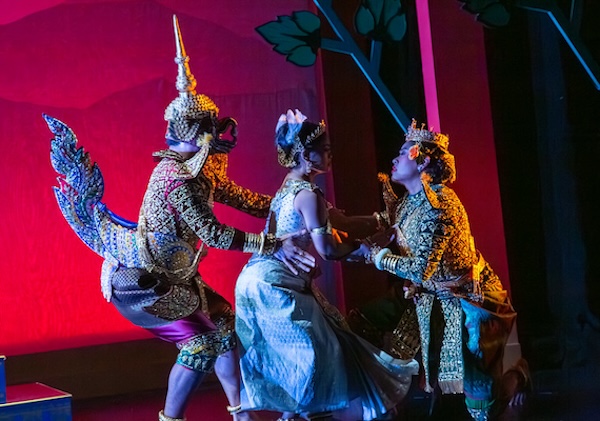
A scene from Angkor Dance Troupe’s A Khmer Swan Lake. Photo: Meg Moore
The most inspired merger of ballet and Cambodian dance in A Khmer Swan Lake comes in the big Act 1 ensemble dance for the swan maidens. A recording of Tchaikovsky’s theme, which has blared a few measures in its conventional western orchestral setting at the top of each scene, now returns, reimagined pentatonically, in the voices of roneat xylophones and gongs. The dancers, wearing white, criss-cross their hands like Ivanov’s famous cygnets, but their hands are splayed backwards. Stretching out and hyperextending their elbows, their arms turn into wings and their open-palms and scything fingers shape themselves into wingtips.
Kakada Nim’s glorious gold-encrusted costumes for A Khmer Swan Lake were designed and sewn in Cambodia. Anshuman Bhatia’s well-placed lighting scheme does them justice.
A Khmer Swan Lake was funded in part by a grant from the New England Foundation for the Arts’ National Dance Project. The man whose vision sparked the National Dance Project was NEFA’s then-director Sam Miller, who from the 1980s onward was also deeply engaged in bringing together refugee Cambodian-American teachers and artists with those at RUFA and elsewhere. As Judy Hussie-Taylor wrote in an appreciation after his too-early death in 2018, Sam “understood that dance is a political, precarious art form, one that requires a person-to-person transmission of knowledge.”
Sam wasn’t much of a classical ballet – much less a Swan Lake – type of guy. But if he ascended to the celestial realm where Odette Davy and her prince are reunited, and where soft flower petals float down on the rest of us as a blessing, A Khmer Swan Lake is making him smile.
Debra Cash is a Founding Contributing Writer to the Arts Fuse and a member of its Board. In early 1980, as a young reporter, she spent a number of weeks at the U.N.-managed Khao-I-Dang Cambodian refugee camp in Thailand.
Tagged: "A Khmer Swan Lake", Angkor Dance Troupe, Kakada Nim, Merrimack Repertory Theatre