
Book Review: “A Life of Peter Hujar and Paul Thek” — The Ascent of Two Queer Outsiders
By Trevor Fairbrother
For biographer Andrew Durbin, Peter Hujar and Paul Thek are historical figures from a lost era that he wants to discover on his own terms.
The Wonderful World That Almost Was: A Life of Peter Hujar and Paul Thek by Andrew Durbin. Farrar, Straus and Giroux, 496 pages, $36.
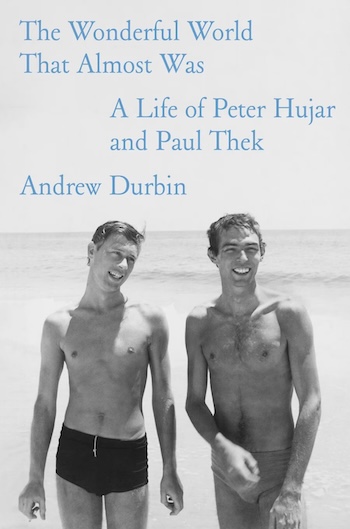
Cover of Durbin’s dual biography. Jacket design by Alex Merto
The Wonderful World That Almost Was: A Life of Peter Hujar and Paul Thek is the first non-fiction book by Andrew Durbin, a poet and novelist. Hujar (1934-1987) was a photographer associated with the New York downtown scene, best known for portraits and nudes. Thek (1933-1988) was a painter and sculptor who influenced the “installation art” movement.
The sensuous cover of Durbin’s book features a 1961 photograph of the subjects at the beach, grinning boyishly. This will encourage the reading public to assume it is about a happy gay couple. Colm Tóibín’s golden endorsement on the jacket states, “This is a great American love story that is also an indispensable account of the growth and emergence of Peter Hujar and Paul Thek as influential artists.” Durbin says that, on first impression, people usually felt Hujar was shy, dignified, and remote, whereas Thek radiated affection and sensuality. But he stresses that Thek “could be as mistrustful and indelicate as he was sweet and generous,” and his angry outbursts soon made acquaintances wary. In fact, both subjects had prickly, volatile personalities and they spurned commercial success.
Here’s my take on the basics:
- Hujar, who came from a poor Ukrainian family, was raised by his grandparents on a farm in New Jersey, then by his abusive mother in Manhattan; in his mid-teens he left home and became an apprentice photographer. Thek grew up in a middle-class German/Irish household in Brooklyn. Both were Catholic.
- After studying art at Cooper Union (1951-54) Thek moved to Miami. He made art and supported himself doing shop window displays and other casual jobs. He promptly fell in love with Peter Harvey, a scenery and costume designer.
- In 1956 Hujar began a relationship with a painter Joseph Raffael, a recent graduate of Yale University Art School. On a visit to Miami in the winter of 1956-57 they socialized with Thek and Harvey.
- In 1958 Harvey and Thek moved to New York. Thek took a full-time job working for gay textile designer (Jack Prince Studio). He had sex with some women and a lot of men, and soon walked out on Harvey. In 1958, after Raffael was awarded a Fulbright Scholarship, Hujar accompanied him on sojourns in Florence then Rome. Each took a new lover in 1959 and they separated when they returned to New York at the end of the year.
- By the summer of 1960 Hujar and Thek were a couple. The relationship became consensually non-monogamous.
- Funded by a Fulbright Scholarship, Hujar sailed to Europe in the summer of 1962; Thek joined him at the end of the year. Hujar took classes at film school in Rome, and Thek made paintings and sculptures.
- Back in New York in 1964, Hujar found a job in the studio of commercial photographer Harold Krieger. Susan Sontag, a divorced, covertly bisexual writer, befriended Hujar and Thek; their conversations had an impact on her breakout essay “Notes on ‘Camp'” (Partisan Review, Fall 1964). That same year Sontag, Hujar and Thek individually participated in Andy Warhol’s ongoing Screen Test film project, in which each subject was asked sit alone and face his camera with a steady gaze for about 4 minutes.
- Thek had a solo exhibition at a Manhattan gallery every year from 1964 to 1967. He made a splash with hyperreal sculptures of raw meat presented in customized Plexiglas vitrines. His most famous work was The Tomb: a pyramidal structure with a sculpture of his corpse laid out for viewing, everything rendered in pale pink tones. From late 1967 to 1976 he led a peripatetic life in Europe assembling immersive installations that blurred the lines between workaday and fantasy realms. The Stedelijk Museum, Amsterdam, gave Thek a solo exhibition in 1969 and he was included in the momentous German exhibition Documenta 5 in 1972.
- Hujar’s career took off in 1967 after he participated in a private master class taught by Richard Avedon and art director Marvin Israel; the guest speakers included mavericks Diane Arbus, Danny Lyon, and Lucas Samaras and fashion photographers Alexey Brodovitch and Hiro.
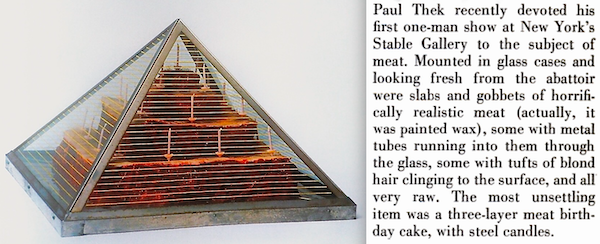
Left: Paul Thek, Birthday Cake, 1964. Right: Detail of an article by Calvin Tomkins, Life, November 20, 1964. Images paired by the author.
- He opened his own commercial photography studio in 1968. His pictures appeared in Harper’s Bazaar, GQ, and Rock Scene as well as Newspaper, a large-format underground photography periodical. The only book Hujar created during his lifetime – Portraits in Life and Death – was published by Da Capo Press in 1976; it presented 29 recent images of contemporaries followed by 11 pictures of semi-preserved corpses in the catacombs of a Capuchin church in Palermo (the latter all taken when Hujar and Thek lived together in Italy in 1963).
- The rapport between the men faded in the 1970s. Thek was reluctant to be photographed for Portraits in Life and Death, but his participation proved important. His last known letter to Hujar, written in 1975, includes the remark, “Anytime you want to make love, just ask me,” and it is signed, “Paul, the meddler.”
- In 1977 the Institute of Contemporary Art, Philadelphia, presented Paul Thek: Processions, which was the artist’s only solo exhibition in an American museum in his lifetime.
- Despite mounting cynicism about the hypocrisy and shenanigans of the art world, the artists remained productive in the 1980s. Thek represented the U.S. at the 1985 São Paolo Biennial. Hujar’s solo exhibition at Gracie Mansion Gallery in 1986 confirmed he was a legend amongst young artists in the burgeoning East Village scene.
- Both men died from AIDS within a year of each other.
I don’t envy Durbin the task of portraying and differentiating this charismatic duo, each prone to pot-fueled craziness and professional self-sabotage. His book runs to 496 pages, over 50 of them devoted to notes. Its more obvious shortcoming is the visual component. As in many mass-market biographies, the illustrations are confined to an insert on coated paper. Here, the publisher has crammed 34 black and white images, each with a caption, into 16 pages.
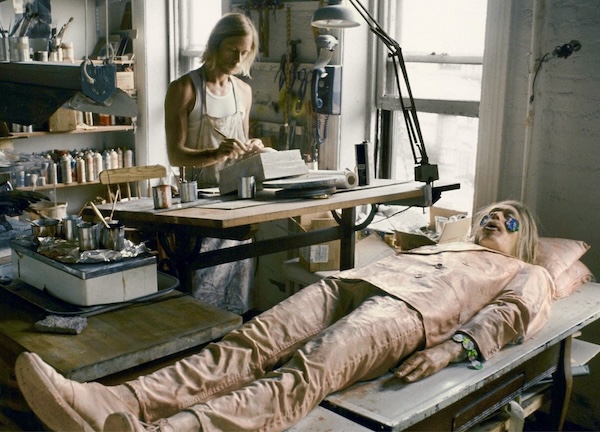
Peter Hujar, Paul Thek Working on the Tomb Figure, 1967. Thek poses in his studio with the effigy he created for the interior of his sculpture The Tomb.
Durbin takes no interest in the curatorial networks that fostered Thek’s remarkable successes in Europe; a consideration of Jean-Christophe Ammann, the Swiss art historian and curator, would have strengthened the narrative. His coverage of both artists becomes unexpectedly hasty after 1975. He disregards Hujar’s connections to the work of Robert Mapplethorpe (a despised rival), Chris Makos (a more colleague–like), and Nan Goldin (a true fan). He also ignores Thek’s 1984 solo show at the Barbara Gladstone Gallery, New York. Richard Flood, who organized that ill-fated enterprise, narrates the saga in bittersweet detail in an essay for the catalogue accompanying the traveling retrospective organized by Rotterdam’s Witte de With Center in 1995.
Susan Sontag was an important benchmark in the lives of both men, and Durbin mentions her countless times. She slept with Thek and in 1966 dedicated her book Against Interpretation to him. She wrote a short introduction for Hujar’s 1976 book, Portraits in Life and Death. In 1978, Thek sent her a long letter begging for money, floating the idea of marriage, and deriding her greedy literary ambition; there’s no evidence of a response. Sontag reentered his life after he tested positive for HIV; her letter of recommendation helped secure a Pollock-Krasner Foundation grant for him in 1988.
Sontag died of cancer at the end of 2004. She had always protected her private life fiercely, confident that her prestige would secure the establishment’s silence about her lesbianism. Durbin’s book inspired me to revisit “Notes on ‘Susan’,” by Michael Bronski (Bay Windows, January 6, 2005). It was a compelling response to the fact that all the obituaries focused on her 9-year marriage to sociologist Philip Rieff and omitted her much longer association with photographer Annie Leibovitz. Bronski states, “The mainstream press, out of a misplaced sense of decorum, will often not speak of the homosexual romantic lives of certain well-liked public figures and simply ignore the obvious.”
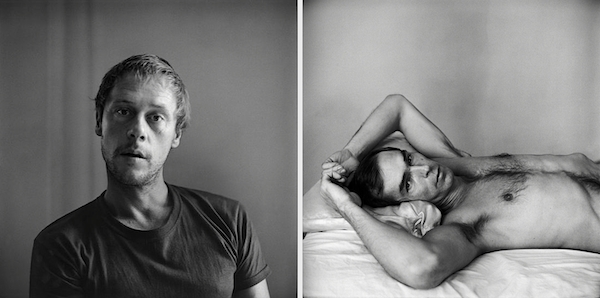
Left: Peter Hujar, Paul Thek, 1975. Right: Peter Hujar, Self Portrait, 1975. Both images appeared in Hujar’s 1976 book Portraits in Life and Death. Images paired by the author.
A comparable revelation occurred in the wake of the first American museum retrospective devoted to Thek (Paul Thek: Diver, Whitney Museum, 2010). That exhibition was well-received at the time, but revisions were in order 3 years later when another Manhattan institution, the Leslie-Lohman Museum of Gay and Lesbian Art, presented Paul Thek and His Circle in the 1950s. Thanks to the participation of set designer Peter Harvey, Thek’s first inamorato, the 2013 project was a case study of queer lives in a homophobic decade.
In the New York Times, Holland Cotter extolled “the much smaller institution” and its efforts to “fill out, for the first time, a very early, formative phase [when Thek] drew his primary influences from a network of young gay men in the arts.”
As a Millennial, Durbin is relatively detached from the turf wars just discussed. For him, Hujar and Thek are historical figures from a lost era that he wants to discover on his own terms. His first encounter with one of Hujar’s pictures occurred in 2005 when he was in high school in South Carolina. The vehicle was the cover image on the second album by Anthony and The Johnsons, and the work was Hujar’s famous portrait Candy Darling on her Deathbed (1974). Durbin moved to London in 2019 to be editor-in-chief of the contemporary art magazine frieze, and he probably began his research for this project soon thereafter. The PR campaign for this book heralds “The cinematic, never-before-told story of two intimately entangled artists who redefined queer art.” Indeed, Durbin has produced a clamorous combination of biographical bushwhacking and ardent writing.
Trevor Fairbrother is a writer and curator. He once wrote an essay titled “Andy and Mick” for freize‘s Warhol-themed edition (frieze, Issue 16, May 1994).
Tagged: "The Wonderful World That Almost Was: A Life of Peter Hujar and Paul Thek", Andrew Durbin, Paul Thek
2 Comments
Leave a Comment
Nice piece! Did you see Peter Hujar’s Day?
Thank you, Peter. No, I didn’t see it. I read Durbin’s long essay about the film in The New York Review of Books and I sensed his reservations about how Ben Wishaw characterized Hujar. Then, after finding the takedown in the Boston Globe (“… a raging, unwatchable bore”), I decided to stick with books. My best surprise, which I didn’t mention in the review, was Paul Thek and Peter Hujar: Stay away from nothing (2025). It is a visual feast of a book edited by Francis Schichtel and published by Primary Information. The layout evokes the rapport between the artists by interspersing full-page photographs of Thek’s handwritten, typed, and playfully annotated letters to Hujar with photographs of both men.