Visual Arts Review: Derrick Adams Turns Black Joy Into an Expansive World
By Lauren Kaufmann
Jubilant collages, TV motifs, and immersive rooms celebrate 25 years of Black artist Derrick Adams’s inventive practice.
Derrick Adams: View Master at The Institute of Contemporary Art, Boston. On view through September 7.
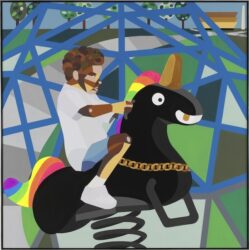
Derrick Adams, Braving the Path, 2023. Photo: courtesy of the ICA.
Derrick Adams: View Master is a dazzling display of work by a multitalented creative force. The exhibition gives the artist a big platform, and he fills it with more than 100 works of art spanning 25 years. The exhibit is his first mid-career survey, and it offers a sweeping view of his main artistic concerns: Black history, family, and the role of mass media.
Adams is equally comfortable with a variety of genres. He’s a painter, photographer, collage artist, sculptor, puppeteer, and performance artist. Much of his work is informed by the influence of TV, but Adams is also concerned with everyday domestic experiences, particularly those of African Americans.
In remarks to the media at a press opening, Adams scanned the gallery and exclaimed, “This is my brain, exploded!” That sense of joy permeates the exhibit, offering viewers a fresh vocabulary for understanding the Black experience.
In addition to conveying his sense of wonder, Adams’s art exudes a keen sense of play. He gambols with three-dimensional forms and consumerism. He has fabricated brightly colored popsicles that lie sideways on the gallery floor, welcoming places for museum visitors seeking a spot to rest. One of the popsicles is red, black, and green—the colors of the African American Heritage Flag. It’s a joyful statement that connects Black culture to pop culture.
With his expansive mind and inquisitive approach, Adams is constantly tinkering. Maybe that’s because he began his career as an art educator. He values the role of questioning and pushing boundaries. His exuberant artistic wanderings spring from a mysterious source of restless imaginative energy — and these explorations are almost always stirring.
Born in Baltimore in 1970, Adams has long been interested in how TV and mass media penetrate our everyday lives. TV color bars are a recurring visual theme. He uses them as a background motif, a nod to TV’s ubiquitous presence in our lives. In the coming weeks, the exterior of the ICA will be wrapped in TV color bars; this commission will remain on view until April 2027. Beginning this June, Funtime Unicorns will be installed outside the museum doors; these kid-friendly pieces will remain on view until September.
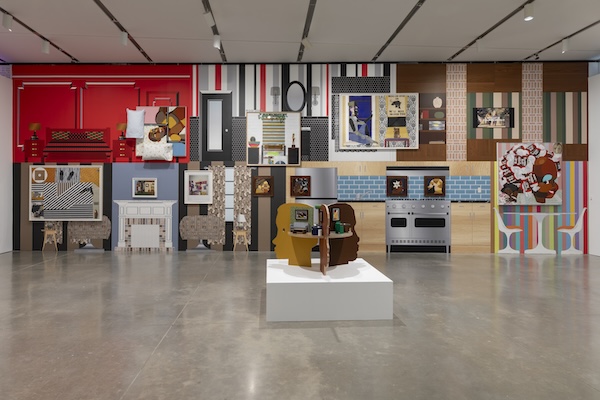
Derrick Adams, Domestic Space & Family Life, 2026. Photo: courtesy of Mel Taing
The exhibition is arranged thematically and breaks down into the following categories: The Urban Landscape; Domestic Space & Family Life; Play; Performance; Television & Media.
Adams sets “Domestic Space & Family Life” against the backdrop of boldly patterned wallpaper that simulates a homey interior. This floor-to-ceiling installation features a kitchen, living room, and bedroom. Several works of art, primarily collage pieces, are hung on top of the wallpaper. These framed works capture Black people at home, relaxing with a cat, hanging out with family and friends.
Independent curator Dexter Wimberly organized the exhibition along with ICA assistant curator Tessa Bachi Haas. Wimberly explains that first Adams designs the wallpaper and then he contracts with a company that produces and installs it. Given how many different genres Adams works in, it’s not surprising that he relies on others to fabricate parts of his work.
Adams collaborated with industrial designer Michael Chaupoco to make Modular Head Space, 2014, a three-dimensional mixed media piece that’s part of the “Domestic Space & Family Life” section. This freestanding dollhouse whose sides are cutouts of Black faces contains miniature furniture and small-scale versions of Adams’s artwork.
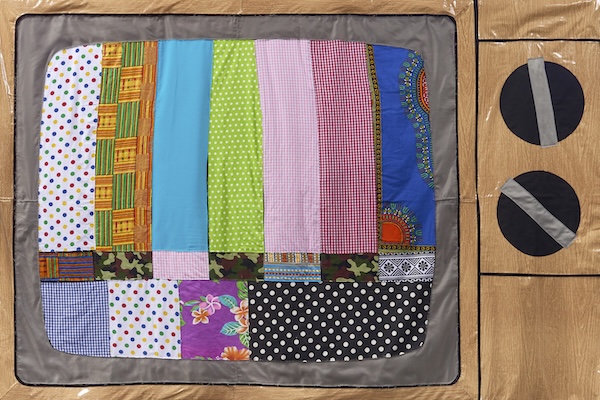
Derrick Adams, Fabrication Station 4, 2016. Photo: courtesy of the ICA
Feed Them With a Long Spoon (2010), is featured in this section. The subject of this 31-minute video is the challenge two people face trying to eat with unusually long utensils. The topic is inspired by the 14th-century English proverb, “He who sups with the Devil should have a long spoon.” The saying is a warning to keep a safe distance from those who might do us harm. Adams extends the metaphor to reference the intrusive role that screens play in our lives, particularly our personal relationships.
In What Are They Doing in Heaven Today? (2018), Adams layers a photographic portrait of family members, superimposing one image on top of another. Above the frame, Adams attaches a brass piece with a setting sun, adorned with birds in flight. It’s a fitting expression of his appreciation of deep family ties, as well as the power of religion, which is embodied by the rays of light, a motif often used in religious iconography.
“The Urban Landscape” section is dominated by a large wall installation about the Negro Motorist Green Book — the guidebook for safe travel for Black Americans, published during the Jim Crow era. The wallpaper contains lists of businesses that serve African American patrons, collaged images of Black faces, and pages pulled directly from the Green Book. It’s a powerful reminder of the decades when African Americans traveled at great peril. Victor Hugo, a US Postal Service employee, published The Green Book from 1936 until 1966. Even after the Civil Rights Act was passed in 1964, Hugo continued to maintain the Green Book for two years after the law’s passage.
The “Play” section of the exhibition features paintings and collages of people engaged in play and relaxation. In 2024, Adams was invited to design a playground on the National Mall in Washington, DC, and it was a poignant assignment, given that he was working on the site of the first integrated playground in the country. Adams has strong feelings about playgrounds, believing that they are spaces where children first test rules and configure their identities.
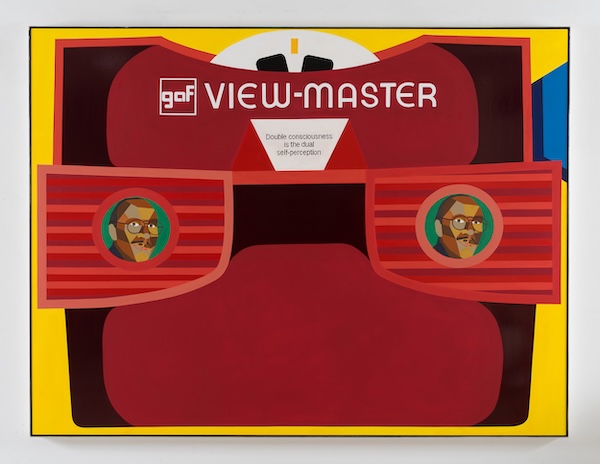
Derrick Adams, View Master, 2025. Photo: courtesy of the ICA
The “Play” section includes View Master, 2025, the work that inspired the title of the exhibition. This painting/collage piece pays homage to Charles Harrison (1931-2018), the Black man whose redesign of the portable photo viewer transformed the item into a huge success. Harrison’s life story is emblematic of the struggle facing so many African Americans. Although he graduated with a BFA from the School of the Art Institute of Chicago, Harrison had difficulty finding work. As a freelance designer, he was assigned the job of remaking the 1939 design of the View-Master. Harrison refashioned it in lightweight red plastic, and it was an instant hit. Eventually, Harrison was hired by Sears, where he designed hundreds of consumer products, including the first plastic trash can! His redesign of the View-Master was inducted into the National Toy Hall of Fame in 1999.
The “Performance” section of the exhibition is composed of photographs and videos from the early part of Adams’s career, when he focused almost exclusively on theatricality. As a poet, hip-hop artist, and puppeteer, Adams spent 20 years engaged in various forms of performance art. In several of his videos, Adams plays with shadows. In talking about these works, Adams remarked that he was tacitly acknowledging others whose work influenced his own.
“Television & Media” presents a number of works that address the powerful presence of media in our cultural landscape. Several of the pieces are framed by a TV set, complete with old-school antennae. Adams examines the ways in which the media shape our ideas about identity, beauty, and power. Adams calls TV his “first classroom,” and for many of us, our childhood TV viewing taught us a lot about our world, even if the programming lacked diversity and nuance.
Derrick Adams: View Master provides museum visitors with a glimpse into Adams’s creative quest for joy through an understanding of the Black experience. The exhibition offers a thorough look at the exhilarating work of one of the country’s most inventive contemporary artists.
Lauren Kaufmann has worked in the museum field for the past 14 years and has curated a number of exhibitions.