
Theater Review: Standing Alone Among the Herd — Yale Rep’s Darkly Hilarious Revival of “Rhinoceros”
By Bill Marx
Rhinoceros is a powerful wake-up call that, whether we like it nor not, we are writhing on the horns of a dilemma.
Rhinoceros by Eugene Ionesco. Translated by Derek Prouse. Adapted by Frank Galati. Directed by Liz Diamond. Staged by Yale Rep at 1120 Chapel Street, at the corner of Chapel and York Streets, New Haven, through March 28.
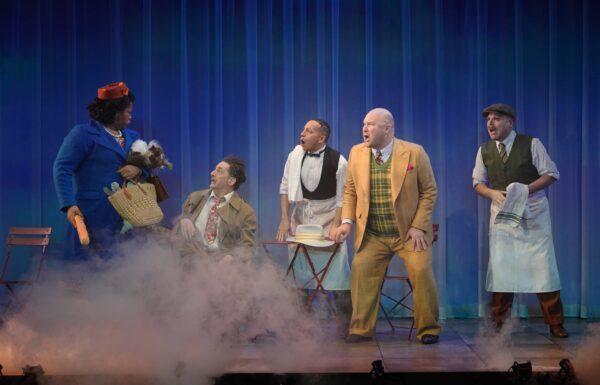
Nicole Michelle Haskins, Reg Rogers, Jeremy A. Fuentes, Phillip Taratula, and Tony Manna in the Yale Rep production of Rhinoceros. Photo: Carol Rosegg
On its most elemental level, Eugene Ionesco’s Rhinoceros is a tragicomic parable about the existential agonies of nonconformity. Berenger, the play’s alcoholic, unkempt antihero, watches in panicked befuddlement and growing horror as the inhabitants of his small provincial town are transformed into a crash of snorting, rampaging rhinos. The upstanding citizens, those committed to following the bourgeois order, to making sensible calculations, to thinking things through, are the first to metamorphose into pachyderms. The next to morph into animality are those who deny that any radical changes are taking place (“fake news”), as well as those who figure that if they ignore an expanding monstrous reality, they will benefit. The thundering, blaring beasts eventually gather together and emit a siren-like song, a (triumphant?) tune that Berenger finds somewhat alluring. But he refuses to join the armored throng. “People who hang onto their individuality always come to a bad end,” he laments.
Why is Berenger immune? Too eccentric? Too marginal? Too bohemian? At the end, the guy is alone, experiencing the hellish fate that awaits those who stand apart from the contagious groupthink, with its nonstop commitment to “move fast and break things.” Conflicted between despair and defiance, Berenger resolves to confront a society gone mad — “to put up a fight against the lot of them.” For Ionesco, the world’s savior will be a social misfit.
All of this may sound like a heavy-handed fable, but Ionesco’s absurdism, at its best, balanced wry humor with an acute sense of the terror of existence. In her 20th production at Yale Rep, director Liz Diamond and adapter Frank Galati have wisely streamlined the three-act play into roughly 90 minutes of satisfying comic business — elegantly orchestrated slapstick with burlesque-inspired japes — that is executed by a highly adept cast. The show’s emphasis on physicality is also expressed through its choreography: set changes become dances, at one point by performers in rhino masks. We don’t see the critters on the run, but Diamond supplies all the dust clouds, galloping hooves, and earthy bellows necessary to let your imagination goggle at what the sight must be like — particularly, in a memorable scene, at the visual of a woman riding on the back of her rhinoceros hubby. To the company’s credit, the production gradually sheds its zaniness for an indelibly frightening wind-up.
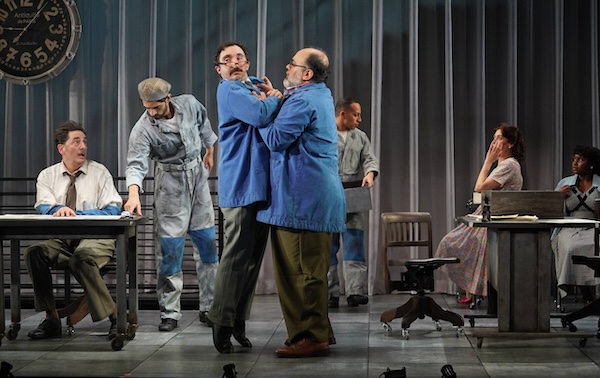
Will Dagger and Richard Ruiz Henry (foreground) and members of the cast in the Yale Rep production of Rhinoceros. Photo: Carol Rosegg
The performances are vibrant, with Phillip Taratula doing wonderfully right by Berenger’s ultra-fussy, condescending friend Gene, whom we watch turn from man to rhino in a showy scene of cartoon grotesquerie that earned Zero Mostel a Tony Award when he played the role on Broadway in 1961. Taratula offers a well-crafted exercise in deftly modulated belligerence, using an increasingly growly voice to apt militant effect. As Berenger, Reg Rogers serves up a colorful succession of frazzled reactions to the insanity around him — he doesn’t come off as an idealist who is in over his head, but as a raffish free spirit who would prefer to be let alone, responsible for nothing but himself. That means that the romantic relationship between Daisy and Berenger is attenuated in this version, but Elizabeth Stahlmann makes the most of the woman’s self-assuredness. As Dulard, Will Dagger proffers a masterfully deadpan-ish portrait of opportunistic complicity — this educated, ambitious coworker at Berenger’s office sees that catastrophic things are happening and decides that he can make the most of the chaos — for himself. Hey, who’s to say it’s bad to be a rhino? It’s all relative, after all.
It is tempting to belabor at least one of Ionesco’s targets in this play — the dangers of brute political homogeneity. Yes, the thuggish mindsets of fascism and authoritarianism, whether of the German or Russian variety, are attacked. Ionesco insisted in interviews that he was thoroughly disgusted by the ideological oppression practiced on the Right and on the Left. When Rhinoceros premiered in London, the latter position propelled the prickly dramatist into a journalistic tiff with Brechtian theater critic Kenneth Tynan. (The full debate, known as the “London Controversy,” appears in Ionesco’s book Notes and Counter-Notes: Writings on the Theatre.) It is a fascinating polemical exchange, the kind one wishes we had more of now — should we fault a playwright for glorifying individuality? — rather than the fear-driven silence of today’s cultural discourse.

Reg Rogers and Elizabeth Stahlmann in the Yale Rep production of Rhinoceros. Photo: Carol Rosegg
The Yale Rep program for the production accurately points out that dehumanization across the board — not just politics — was on Ionesco’s mind, though it is just as correct to suggest that the dramatist was warning against the mechanized isolation now eroding our social selves. (The rhinos as the relentless advance of AI, people trapped in the estranging armor of virtual existence.)
However you look at it, the play appears to be didactic, leading some reviewers, such as the respected theater critic Richard Gilman (a professor at the Yale School of Drama from 1967 until his retirement in 1998), to conclude that the script was among Ionesco’s weakest. But scripts don’t exist out of time: literature may be news that stays news, but some of it becomes more urgent in periods of crisis, particularly in a public-facing art like theater. And that is certainly the case with Rhinoceros in an era of autocracy on the global march. Also, I would argue that the play’s message is not as cookie-cutter as everyone thinks. Here is Ionesco in his book Fragments of a Journal, written in the mid-’60s:
I am limited and alienated, others are limited and alienated, and all forms of action, of revolution, of literature are the only ways of forgetting alienation for a moment, not remedies for alienation. The end of it all can only be an even more lucid, hence more desperate, awakening.
There are those who are ignoring mounting threats to the future of democracy and humanism, who want us to “forget” what is happening around us and to us in order to maintain business as usual. Rhinoceros is a powerful wake-up call that, whether we like it nor not, we are writhing on the horns of a dilemma.
Bill Marx is the editor-in-chief of The Arts Fuse. For over four decades, he has written about arts and culture for print, broadcast, and online. He has regularly reviewed theater for National Public Radio Station WBUR and The Boston Globe. He created and edited WBUR Online Arts, a cultural webzine that in 2004 won an Online Journalism Award for Specialty Journalism. In 2007 he created The Arts Fuse, an online magazine dedicated to covering arts and culture in Boston and throughout New England.
Tagged: Derek Prouse, Eugène Ionesco, Frank Galati, Liz Diamond, Reg Rogers
A fine review, Bill Marx happily in sync with a production he admires of a play he admires, but marred by the world’s worst concluding sentence. “RHINOCEROS is a powerful wake-up call” (Cliche, cliche!) … “writhing on the horns of a dilemma.” (Oy, oy, oy!)
In truth, you go me one better for the world’s most clichéd sentence — last or otherwise. “The world’s worst … [fill in the blank]”.
I’m writhing on the horns of a dilemma in shame.
You may now pull yourself off of the rhino’s horns.