
Arts Commentary: These Goose Steps Don’t Lie — Shakira in El Salvador and the “New Security” Aesthetic
By Jeremy Ray Jewell
The artist is a glitzy ribbon that ties together incompatible images — the mega-prison and the megastar.
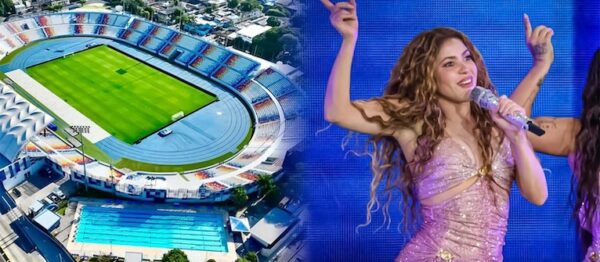
Shakira brought her Las Mujeres Ya No Lloran world tour to El Salvador.
In 1936, Walter Benjamin wrote that fascism “sees its salvation in giving [the] masses not their right, but instead a chance to express themselves.” Colombian singer Shakira’s five-concert “Central American Residency” in El Salvador’s capital as part of her Las Mujeres Ya No Lloran (Women No Longer Cry) world tour was a contemporary illustration of this fascist invitation. Her stadium residency, February 7 through 15 of this year, showed how celebrity presence can function as a geopolitical instrument in an increasingly authoritarian world. Government messaging gleefully emphasized a reported US $110 million in economic impact. President Nayib Bukele seized on rapid ticket sales — for what was initially only three dates — as proof that “El Salvador is changing.” Shakira publicly thanked him while announcing two additional dates. Whether spontaneous or strategically timed, the exchange was a mutually reinforcing gesture.
The residency took place during El Salvador’s ongoing state of exception, now in its fourth year. The country holds the highest incarceration rate in the world — approximately 1,086 prisoners per 100,000 inhabitants. The detainees are overwhelmingly young men from informal settlements and working-class neighborhoods. Some also arrive through the United States’ deportation pipeline, intensified during the Trump administration’s hard-line migration policies. Human rights organizations warn that many detainees are being held in overcrowded prisons with limited access to legal counsel and allegations of abuse, torture, and arbitrary detention. The prison system itself has become a stage for political messaging: in March 2025, former US Secretary of Homeland Security Kristi Noem filmed a “warning” video inside El Salvador’s massive CECOT prison while she was touring the facility. Critics charged that the footage used detainees as a backdrop for immigration deterrence. They also pointed out that Noem was wearing an 18-karat gold Rolex Cosmograph Daytona estimated at about $50,000.
Inside the Jorge “Mágico” González stadium, another scene took place: 144,000 fans over five nights — lights, choreography, and empowerment anthems. Outside: a militarized security perimeter and a prison system that critics say operates under extraordinary powers. Human Rights Watch and Amnesty International described the event’s juxtaposition of repression and diversion as the projection of a “veneer of normalcy,” of a “mirage of peace.” The spectacle, they critiqued, was aimed at normalizing the erosion of judicial power and due process. Looked at from this perspective, the residency was not just welcomed by the administration; it had been orchestrated to produce an aesthetic cover for the abuses of the Bukele security state. As post-9/11 security theater, the residency played the role the 1937 Paris World’s Fair once did: projecting the aesthetic of state power.
The Movimiento de Víctimas del Régimen (MOVIR) (“Movement of Victims of the Regime”) published an open letter timed to the concerts. Satirizing the title of Shakira’s album, the group stated: “In El Salvador, women also cry — mothers and relatives of innocent victims who suffer prison, torture, and death.” Their request of the artist was modest but pointed: do not allow your presence to become encubrimiento — “a cover-up” — for injustice. The Mesa del Exilio Salvadoreño (“Salvadoran Exile Roundtable”) similarly warned Shakira not to “validate with your voice a reality that cannot be known in a brief visit.” The organization referred to human-rights reporting that detailed that thousands of minors have been detained during Bukele’s state of exception, and that many families have been destabilized by mass incarceration.
The response from Shakira was silence. There was no public acknowledgment of the letters. Instead, there were celebratory posts as well as an acceptance of a guest of honor distinction along with the key to the city of San Salvador, presented by the Mayor of San Salvador, Mario Durán. The latter is not only a member of Bukele’s political party, he is also widely considered to be one of the president’s closest protégés: a key architect of the “Bukelismo” movement. In cultural politics, silence is not neutrality. It is complicity. It is support for the state of exception — popular spectacle that undergirds strong-armed repression.
The contrast with Shakira’s earlier role in El Salvador is stark. In 2006, as a UNICEF Goodwill Ambassador, she directly addressed youth violence by marching with students under the slogan “Make the difference by not being indifferent.” In 2026, there were no marches, no foundation announcements. Shakira’s Pies Descalzos (Barefoot Foundation) organization, a Colombian nonprofit founded in 1997 to improve education for vulnerable children affected by poverty and displacement, made no local humanitarian intervention. The decoupling was severed with diplomatic neatness. Her brands — engaged and showbiz — were operating in parallel universes. For critics, this signaled a transformation: from “activist of the impoverished” to “icon of the new security order.”
El Salvador is not the only example of this double-sided choreography. Similar dynamics have played out in the Gulf, where major entertainment events — from Formula One races to the Riyadh Comedy Festival — have drawn global performers and celebrities to serve governments wishing to promote narratives of modernization and cultural openness. Skeptics describe such spectacles as forms of cultural “sportswashing” or “artwashing.” High-profile events are used to reframe international perceptions of authoritarian states. When the Riyadh festival generated critiques, comedians, including Dave Chappelle, Andrew Schulz, and Bill Burr, dismissed the attacks as cultural prejudice rather than political critique. Schulz called out the “Western hypocrisy” of the festival’s critics. This is a strategy similar to how Bukele supporters dismiss the concerns of Western human rights organizations as “colonialist interference.” Time has shown that underlying messages of reassurance travel further than liberal reservations: normalcy achieved; investment welcome; dissent marginal.
Bukele and Shakira share a Levantine lineage, and that link signifies more than ethnicity; it evokes upward mobility and corporate wealth. This coupling of performer and president underlines a lineage of success — a materialistic pragmatism that discredits messy democratic contestation. Heritage prepares members of the elite for governance. In Latin America, “el turco” (“the Turk,” as Arab immigrants have historically been called) have wrapped themselves in the aura of the new-guard entrepreneur-statesman. Sound familiar?
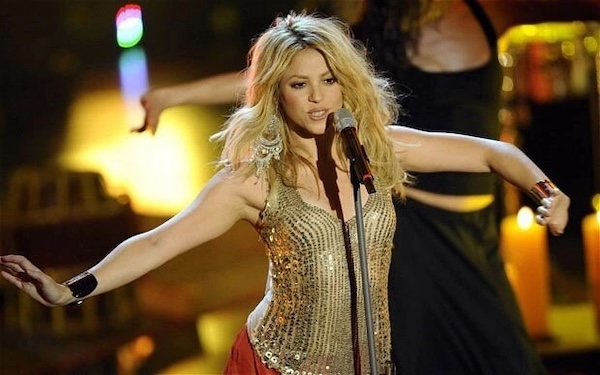
Shakira in performance. Photo: WikiMedia
When Amnesty International described Shakira’s Central American Residency as “security without justice,” it underlined the artist’s hypocrisy. Yes, the concerts were profitable and no doubt enjoyable. But they only consolidated the injustice of a government that was maintaining two very different El Salvadors: one luminous and exportable, the other incarcerated and powerless. Reporters followed Shakira as she received the key to the city; meanwhile, investigative journalists were forced to remain abroad to avoid prosecution. On stage, the performer sang about “resilience,” while families feared speaking out lest they be branded “gang apologists.” This is the kind of spectacle that contemporary authoritarianism is comfortable sponsoring. In 2026, the regime does not need to censor a superstar concert — it needs to host it. The boots around the stadium perimeter were calculated. They were a mise-en-scène — filmed in 4K and included in drone footage of the show. This is not old-world militarism; it is digitized praetorianism. The “New Security” is not just about enforcement — it is curated showbiz.
The artist is a ribbon that ties together incompatible images — the mega-prison and the megastar. The relief felt by the segments of the population that still support Bukele is understandable. In 2015, El Salvador’s homicide rate exceeded 100 per 100,000 inhabitants — among the highest in the world. For decades, extortion and gangs infested daily life. That said, while the homicide rate has plummeted, the incarceration rate has zipped upward, earning the country the label of “prison capital of the world.” The safety is real, but it will last only as long as the state maintains its total grip on the streets. This is where spectacle plays such a valuable role. The Bukelistas feel that popular theater in the state of exception serves as a trade-off for mass repression.
The hips do not lie. Neither do the goose steps. When global icons dance on a stage that reinforces a state of exception, they cannot claim neutrality. They become part of what Benjamin called the aestheticization of politics: it is a world where authoritarian governments support entertainment that’s tailored to help people forget that they have no rights. In Bukele’s El Salvador, rhythm is policy. It is what Benjamin saw as a “triumphal procession,” where victors parade their “cultural treasures” over the defeated. It is the beat of barbarism.
Jeremy Ray Jewell writes on class and cultural transmission. He has an MA in history of ideas from Birkbeck College, University of London, and a BA in philosophy from the University of Massachusetts Boston. His website is www.jeremyrayjewell.com.
4 Comments
Leave a Comment
What a bunch of bull shit….Shakira brings joy to a troubled world ..it’s not her fault the world is not perfect.
Never brought me any joy
Great article. Great point of view. But at the end of the day, it was just about music, joy, and a celebration of life.
…unless you were one of the false positives swept up by the authoritarian state that she is artwashing. Remember Víctor Jara? Now Shakira performs an Uribista “Centro Democratico” slight-of-hand, making concentration camps out to be a non-issue for her supposed “empowerment” brand. She’s a Gwyneth Paltrow selling the cultural capital of 700 million people as her own lifestyle brand.
They keep saying she’s out there doing some vague, anomalous “thing” for Latinos, like they should all be grateful for something. What? What has she done that Los Gaiteros de San Jacinto or Los Tigres del Norte or a million other artists couldn’t and haven’t done better, and without support fascism? Proof, if more was needed, that in the final analysis gringo intervention is inconsequential given Latin America’s own endemic authoritarian tendencies. The fact is no Marco Rubio schmuck is going to come to a comment section like this to stick up for poor migrant families because they, like Rubio, want to reinstate the ecomiendas and re-enslave people. And that’s Shakira as well, isn’t it. Nah, miss us with this phony “fun” shit, Nazi scum.