
Stage Interview: Scott Edmiston on Boston’s Changing Theater Scene
By Robert Israel
“Achieving some sort of balance is key; to capture the heart and soul of who we are, and to present that on our stages, so that we continually challenge audiences and surprise ourselves.” — Director Scott Edmiston

Director Scott Edmiston
It’s an annual rite of spring: thespians, set and lighting crews, costume designers, marketers, directors, and administrators haggle over play selections, weigh these choices against budgets, and emerge from these confabs with newborn seasons.
Over the years, these nascent seasons have often included underperformed or forgotten classics of the American stage. In 2019, for example, after an absence of many decades from Boston stages, playwright Lillian Hellman’s The Little Foxes took Boston’s Lyric Stage by storm. Under Scott Edmiston’s direction, it was a critical and box office success. But Hellman’s Foxes companion piece Another Part of the Forest — despite this critic’s recommendation that it be included in the next season with the same director and stellar cast — was not revived.
To gain a perspective on our changing theater scene, Arts Fuse met up with Scott Edmiston, Immediate Past Dean of Theater at the Boston Conservatory at Berklee. In addition to teaching, Edmiston is currently directing a dramatization of a time-honored American novel — To Kill a Mockingbird — in Concord. He has directed over 60 productions for theaters, universities, and opera companies across New England.
Arts Fuse: What elements do you attribute to the changes in theater seasons? They used to feature at least one American classic but nowadays that’s not the case.
Scott Edmiston: Regional theaters are still going through a lot of changes ever since the Covid pandemic. Add to that the racial unrest that flared up after George Floyd’s murder, Donald Trump’s social changes, the influence of AI, and the heavy hand of streaming services that continue to overwhelm our entertainment field. Theaters are trying to take the lead, but they are struggling to achieve a foothold. Add to this mix the changes that are going on in Boston, which used to be known as a theater tryout town, but no longer carries that distinction. When I was at the Huntington Theatre Company, audiences were always asking me, “So when is this play going to New York?” The expectation was that our productions had either been in New York or we were preparing them to be trucked there. Also, at that time we had the subscription model in place — it had been successful for 30 years — wherein audiences committed to a certain number of plays each year. That structure is now gone. All of these changes have shaped what we’re seeing on our local and national stages.
AF: Have classic American plays that used to be included in theater seasons become the casualties of this transformation?
Edmiston: It’s hard to say. It was assumed that these plays were meant to be kept alive and that we would see revivals of these plays all the time. For example, there’s a revival coming to Broadway of Arthur Miller’s Death of a Salesman starring Nathan Lane. The last time that play was revived in New York was in 2022, only 4 years ago. Some theatergoers might say, “Well, we’ve just seen a revival, why do we need another?” Of course, we could ask the same question of the MFA if they mount yet another show of Monet’s paintings. People might say, “Well, we’ve seen the Water Lillies before, do we need to see them again?” Great classics are meant to endure. They should be seen again and again. Another reason for the dearth of some of these classic productions: the cost involved. Staging Mockingbird, for example, I have a cast of 19 performers. That is expensive, and many theaters just don’t have those resources.
AF: We’ve also had a sea change in leadership at many local theaters.
Edmiston: When I was at the Huntington, we were known for mounting productions of William Shakespeare, George Bernard Shaw, Tom Stoppard, and August Wilson. Now that has shifted — there’s an emphasis on new play development. The American Repertory Theatre was known for presenting avant-garde plays — now they’re focused on musicals bound for Broadway. In the past, SpeakEasy Stage presented plays for a gay audience, but that focus is changing, too. American culture is in transition, and theaters are not immune to that. We live in a segmented culture.
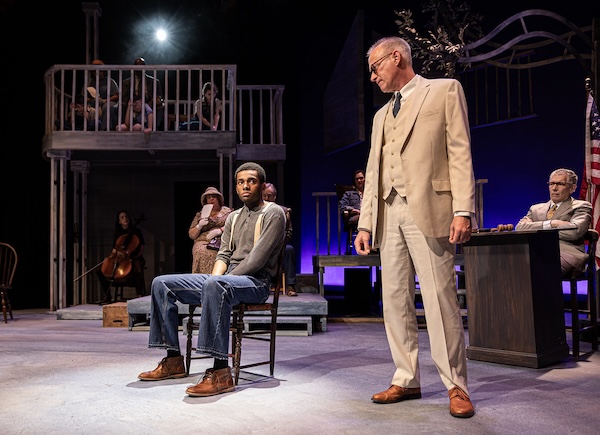
A scene from To Kill a Mockingbird, featuring Bryce Mathieu and Barlow Adamson, at The Umbrella Arts Center. Photo: Jim Sabitus
AF: All these transitions have ushered in seismic changes in American culture.
Edmiston: Exactly. We are not a shared culture. We are a segmented culture. Everyone these days has their own streaming service; it’s not like the old days when there were only three channels to choose from and everyone watched Humphrey Bogart in The African Queen. I was surprised when folks came up to me and said they hadn’t recalled To Kill a Mockingbird. They had read it in high school, and some said, “Wasn’t that a movie starring Jimmy Stewart?” I teach dramatic literature at Berklee and my students are not aware of many of the classic plays. At the Kennedy Center in Washington, the awards ceremonies of the past honored Marion Anderson and Martha Graham, but this past year’s awardees were Sly Stallone and the Village People.
AF: So, where do you see our American culture heading?
Edmiston: I was struck by a comment by Diana Vreeland, the fashion icon, who said that the 02th century didn’t begin until the 1920s. In the 2020s, we’re just now beginning to define ourselves. We are examining our history and how much we want to embrace and celebrate what happened before, what’s happening now, and what’s happening next. Achieving some sort of balance is key — to capture the heart and soul of who we are, and to present that on our stages, so that we continually challenge audiences and surprise ourselves.
Robert Israel, an Arts Fuse contributor since 2013, can be reached at [email protected].
1 Comment
Leave a Comment
Some good points are made here; however, I would like to point out a contradiction—and expand on one idea. Regarding the “short circuit,” Edmiston says that to define ourselves, stages need to examine our history and “how much we want to embrace and celebrate what happened before, what’s happening now, and what’s happening next.” Yet he rightly underlines how little of the past is appearing on our stages—this neglect is symptomatic of what Gore Vidal called the “United States of Amnesia,” and it is happening throughout our culture today. (The all-mighty algorithm, customer-friendly to its core, follows Henry Ford’s adage: “History is more or less bunk.”) It will take a brave commitment—in vision and resources—to stage the best (or at least the most provocative) of what has come before. Where will that come from? Our larger stages have become increasingly commercialized and risk-adverse.
Local theaters must become open to a wider range of scripts—by women, marginalized populations, writers of color, the working class, and dramatists from diverse backgrounds around the world. Finally, Boston should break away from the iron grip of New York theater, Broadway and off-Broadway. Stage economics in NYC are beginning to collapse, for some of the reasons stated by Edmiston. It’s time for local stages to assert their independence, to respond to community needs and to take a stand against rising political repression. Some “classic” plays manage to do both …