
Film Review: “The Social Reckoning” — The Gospel According to Sorkin
By Neil Giordano
Mikey Madison shines as whistleblower Frances Haugen, but Aaron Sorkin’s Facebook drama preaches more than it provokes.
The Social Reckoning, written and directed by Aaron Sorkin. Screening at the Alamo Drafthouse Cinema Boston and elsewhere in New England.
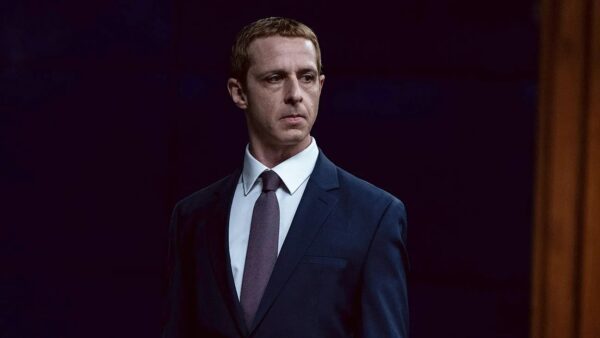
Mark Zuckerberg (Jeremy Strong) in Columbia Pictures’s The Social Reckoning. Photo: Sony Pictures
Not many films have generated the contemporary legacy of The Social Network. The 2010 David Fincher-directed story has become the ur-text of our modern media universe, dramatizing the shift of our eyes from the silver screen to smaller screens, first on computers and eventually on the devices we carry around in our pockets. That film, a tech bro origin story of sorts, charted the rise of Facebook from Harvard dorm rooms to the lawyers’ suites where a peevish and socially awkward Mark Zuckerberg fought off those who dared to claim any credit for what he saw as his innovative genius in creating nascent social media.
In the years since Facebook’s creation and Fincher’s film, social media has only become more ubiquitous and insidious in our lives. And tech bros have metastasized into cinematic fodder: there are no fewer than four films coming out later this year (fictionalized and documentary) about their rise to power. In their own minds, they are the saviors of our world (or would that be the masters of Mars?). Or, as many skeptics see them, are they supervillains peddling the next big thing for the sake of limitless money and unquestionable control?
Aaron Sorkin, Oscar-winning screenwriter of The Social Network, decided to write the next chapter in the saga, and move into the director’s chair as well, to examine the goings-on at Facebook circa 2019–2021. Zuckerberg himself (Jeremy Strong, replacing the original film’s Jesse Eisenberg) ends up being reduced to a supporting role, even though he is overseeing the corporate behemoth that Facebook has become. In his place as the protagonist is whistleblower Frances Haugen (Mikey Madison), who, working with Wall Street Journal investigative reporter Jeff Horwitz (Jeremy Allen White), is out to expose all of Facebook’s toxic business practices. At first, Haugen loves her job as a data scientist and she wants to make Facebook better. But her hopes crash once she realizes that the company no longer has much interest in social good. Profit—well, that is another matter.
Sorkin’s writerly indulgences, for better and worse, are on full display. His literate, snappy dialogue keeps the movie from sinking into a talky morass. Running jokes about Chicken Little and Cassandra serve as the comic backbone for the theme, while pointed gibes at journalists supply extra laughs. There’s even a sly wink at Mikey Madison’s Oscar-winning role in Anora: Haugen disguises herself as a prostitute to slip into meetings with Horwitz.
But, as in Sorkin’s The Newsroom, if not his entire oeuvre, the story pits high-minded, conscientious people against larger malevolent forces. The moral high ground is never in question, only underlined. Sorkin’s last feature as writer-director, The Trial of the Chicago 7, suffered from the same assumption: the audience will, as a matter of course, know who is right and who is wrong. Sorkin’s sanctimonious approach, at first kept in check by the patent nastiness of social media’s worst manifestations, eventually spills over into the middle act, culminating in a final scene that feels as if it was lifted from a West Wing sequel.
Not that any empathy is extended to Facebook’s side of the equation. Strong plays Zuckerberg as a petulant android. Eisenberg tempered Zuckerberg’s awkwardness with a touch of humanity; here, the Facebook leader is a megalomaniac who refuses to hear bad news and barely looks up from his laptop to acknowledge anyone. The bottom line is his siren call; nothing must impede his platform’s march toward world domination. Ethics and the public good are shunted into teams with Orwellian labels like “Civic Integrity,” where Haugen worked. Their Sisyphean assignment: police the damage inflicted by the platform they serve. The movie effectively dramatizes how alt-right bad actors weaponized Facebook, with their efforts culminating in January 6. It uses blunt language and imagery to connect social media posts with real-world violence.

Mikey Madison and Jeremy Allen White in a scene from The Social Reckoning. Photo: Sony Pictures
A strength of The Social Reckoning is a refreshing change for Sorkin: prominent women characters are given voice and agency. Madison’s nerdy and hyper-intelligent Haugen shines with awkward expressiveness. She is the smartest person in the room by far, but she also has a soul, in contrast to Zuckerberg’s amoral egomania. At Facebook’s office, Wunmi Mosaku (Sinners) stands out as Raya, the only truth-teller on the premises, a wise fool to Zuckerberg’s mad king. She coaches Zuckerberg for his upcoming congressional testimony, urging him to refer to the business’s customers as people, not as “humans” in a lab experiment or as “Facebook users.” Predictably, he finds the advice objectionable and disregards it. Meanwhile, at the Journal, bureau chief Kris (Betty Gilpin) turns out to be a compassionate shepherd for Horwitz — assuring the paper’s success.
Men don’t get much to do in The Social Reckoning. White plays Horwitz with his usual slackerish appeal, though his delivery may be too mumbly and slow for Sorkin. Mostly, he consults his notes and makes phone calls—the standard cinematic repertoire for journalists. Among the ancillary tech bros, Billy Magnusson plays Haugen’s boss in the Civic Integrity group. Usually a goofy, innocuous presence, Magnusson lends menace to an otherwise benign fleece-vested figure. Finally, comedian and actor Bill Burr cameos as a Facebook advisor and another truth-teller. God help us if Bill Burr is the only man who can speak truth to power.
Comparisons to The Social Network are inevitable, and the new film falls short of the taut, nasty drama at the heart of Fincher’s opus. Cinematographer Jeff Chenoweth gives it a similar visual texture, but the film has little of the original’s editorial snap—the work that won Kirk Baxter and Angus Wall Oscars. One exception is a deft sequence that introduces the January 6 insurrection in fragments before we grasp what we’re seeing. Alexandre Desplat’s score, meanwhile, echoes the civic uplift of The West Wing, a notably incongruous register for this drama.
Do we need a movie about events since overshadowed by Facebook’s—and now Meta’s—further mind-numbing weaponization of civic life? Sure. Nothing wrong with reminders of how insidiously social media has pursued its dream of ever more clicks and cycles of unbreakable “engagement.” But reminders aren’t revelations, and Sorkin offers little of his earlier film’s freshness or bite. To wrench our attention from Facebook’s nonstop doomscrolling, The Social Reckoning needed to show us something we hadn’t already seen. Instead, it gives us more reasons to despair—and little sense of how to fight back.
Neil Giordano teaches film, creative writing, and journalism in Newton, MA. His work as an editor, writer, and photographer has appeared in Harper’s, DoubleTake, Newsday, Literal Mind, and other publications. He is currently in production on a documentary film, Betweens, about artist Michael C. Thorpe.
Tagged: Aaron Sorkin, Facebook, Frances Haugen, Jeremy Allen White, Jeremy Strong, Mikey Madison, The Social Network, film reviews