Rock Album Review: The Smiths’ Best I and Best II Compilations– Revisited in a Warholian Light
By Trevor Fairbrother
Rhino’s reissues of Best I and Best II reveal the breadth of the band’s music and the striking parallels between Steven Morrissey and Andy Warhol.
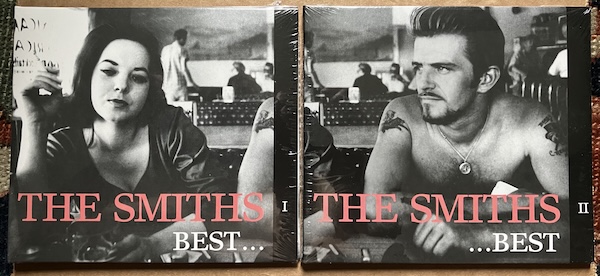
The Smiths: Best … I and … Best II as reissued by Rhino in the US in 2026.
In 1982 four Englishmen in Manchester, all with Irish Catholic roots, formed The Smiths: Steven Morrissey (vocals), Johnny Marr (guitar), Mike Joyce (drums), and Andy Rourke (bass). They skirted trends of the moment — Post-Punk, New Wave, Synthpop and New Romanticism – while savoring ’60s mavericks, from The Rolling Stones and The Byrds to The Velvet Underground. The London-based independent record label Rough Trade Records released their debut album, The Smiths, in 1983. The content ostensibly celebrated outsiders, and disaffected young adults heeded the call and formed a cult. The band’s fourth and last studio album, Strangeways, Here We Come, went on sale a few months after the band’s acrimonious breakup in 1987.
Following the 1989 bankruptcy of Rough Trade Records, WEA Records purchased the Smiths’ back catalogue. In 1992 they skimmed the cream from the studio albums and singles and released Best … I and … Best II. There were 28 tracks, all written by Morrissey and Marr, including the instrumental (“Oscillate Wildly,” 1985). These “posthumous” albums were the band’s first “greatest hits” compilations. Best … I was no. 1 on the UK Albums Chart, and its follow-up reached no. 29. A few weeks ago, Rhino Entertainment, a subsidiary of Warner, made them available again on vinyl and CD. The Smiths’ classic catalogue currently attracts millions of monthly listeners on streaming services. Clearly Rhino sees a crop of new fans that is ready to buy new physical objects as well as digital music.
I never previously owned Best … I and … Best II, and I’m happy that Rhino’s reissues inspired me to revisit the band. I quickly concluded that the collection nailed the excellence and breadth of The Smiths’ music. The sequencing of the tracks is nonchronological and intuitive, and the shifts between musical styles and tempos never jar. The first track of the first album (“This Charming Man,” 1983) and the last track on the second album (“There Is a Light That Never Goes Out,” 1986) make perfect bookends. “This Charming Man” was a perky landmark single about an older man in a nice car who offers to assist a lad stranded on a hillside with a broken bike. It earned the band an appearance on the TV teenybop staple, Top of the Pops: in magenta light, beneath a mirror ball, the musicians looked streetwise and laddish. Morrissey wore a shiny loose shirt and several necklaces and flaunted a bunch of gladioli. “There Is a Light” — the concluding track on these compilations — was a rhapsodic and doomy love song that became the anthem for hardcore fans. It has served Morrissey well in his solo career, most especially as a vividly choreographed finale for his shows in 2004.
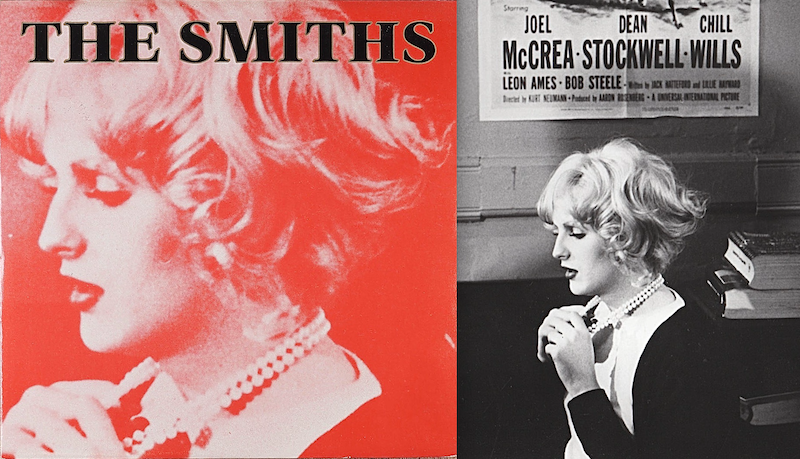
Left: “Sheila Take a Bow,” 1987 single on Rough Trade Records. Right: detail of the film still for Women in Revolt that inspired Morrissey’s record sleeve.
Topical and edgy, The Smiths couched their subjects in an array of musical styles, which could make it hard to place their work. Morrissey and Marr were always confident; their scavenging was eclectic and unpredictable. Consider the following songs. “Please, Please, Please, Let Me Get What I Want” (1984) is a short and incredibly gentle ballad with the self-evident title: it offers a prayer in a melancholic register (“Haven’t had a dream in a long time / See, the life I’ve had can make a good man bad”). “Nowhere Fast” (1985) is a barreling rockabilly song with lyrics referencing cheerless provincial existence and a bitterness about the Royal Family (“And if the day came when I felt a natural emotion / I’d get such a shock I’d probably jump in the ocean”). “How Soon Is Now?” (1984) addresses more acute social paralysis through a different musical idiom; it is a shuddery dirge with otherworldly slide-guitar wails (“I am human and I need to be loved / Just like everybody else does … I’ve already waited too long / And all my hope is gone”).
Countering the varieties of miserabilism are numerous breezy and ebullient songs about resisting hard times. “Sheila Take a Bow” (1987) encourages its subject to be true to herself and not be cowed by the expectations of others; the music’s upbeat slouchy swagger brilliantly emulates T. Rex’s glam rock (“Boot the grime of this world in the crotch, dear / And don’t go home tonight … Throw your homework onto the fire / Come out and find the one that you love”).
Spending time with the Rhino reissues had me thinking about Andy Warhol, and I offer my thoughts about his bearing on The Smiths phenomenon. Let it first be noted that covers of the Rhino reissues have a Warholian vibe: they show the left and right halves of Biker Couple, a 1961 photograph by Dennis Hopper. Greg Jakobek, who worked for Warner UK, created them in 1992 for the European release of Best … I and … Best II. He dutifully followed the look associated with The Smiths’ record sleeves from the beginning. As Mike Joyce recently noted in his autobiography, “You can identify a Smiths album at a glance: the font, the duotone color palette, the long-forgotten cover star. There are very few bands whose albums have that same sense of instant identity.”
Dennis Hopper’s portrait of the splendiferous, unidentified bikers resonated well with the charismatic personalities and working-class heroes pictured in close-up on the Smiths’ record sleeves, including Elvis Presley, James Dean, Billie Whitelaw, and Viv Nicholson. It is important to know that, in addition to his acting career, Hopper was an artist and a serious collector of contemporary art; he photographed Warhol in 1963 when he visited Los Angeles for his exhibition of silver Elvis paintings.
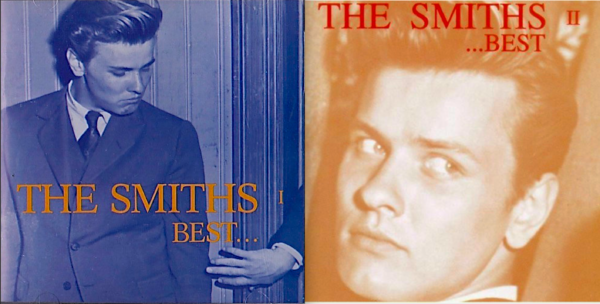
The Smiths: Best … I and … Best II, as released by Sire Records in the US in 1992.
The sleeves of the 1992 US versions of Best … I and … Best II (released on Sire Records) were entirely different. Morrissey took credit for them and acknowledged Jakobek and Linda Cobb for working on the layout and design. His chosen “cover star” was the young American actor Richard Davalos, glimpsed in his role as the brother of the moody rebellious character played by James Dean in the 1955 film East of Eden.
Morrissey’s devotion to Warhol was evident by 1984. The band’s first album featured a tightly cropped image of the naked torso and lowered head of the protagonist of the film Flesh. The sleeve caption noted, “Cover Star: JOE DALLESSANDRO culled from Andy Warhol’s FLESH (directed by Paul Morrrissey, 1968).” The chorus of the 1984 song “Reel Around the Fountain” hints at Warhol’s most famous maxim when Morrissey sings “Fifteen minutes with you / well I wouldn’t say no.” In 1987, Morrissey’s choice for the cover of the single “Sheila Take a Bow” was the profile of a blonde transgender superstar in the 1971 film Women in Revolt. The caption noted: “Cover Star: CANDY DARLING, Courtesy Andy Warhol Studios.”
The sleeve of The Smiths’ second studio album, Meat Is Murder (1985), did not directly quote Warhol, but it channeled his practice. It features a grid of four identical photographs of a young American Marine corporal in Vietnam in 1967. The source was a publicity image for the scathing 1969 documentary In the Year of the Pig, directed by Warhol’s long-time friend Emile de Antonio. In the original photograph, MAKE WAR NOT LOVE is inscribed on the soldier’s helmet; for the album sleeve Morrissey replaced those words with MEAT IS MURDER, as a statement in support of animal rights and vegetarianism.
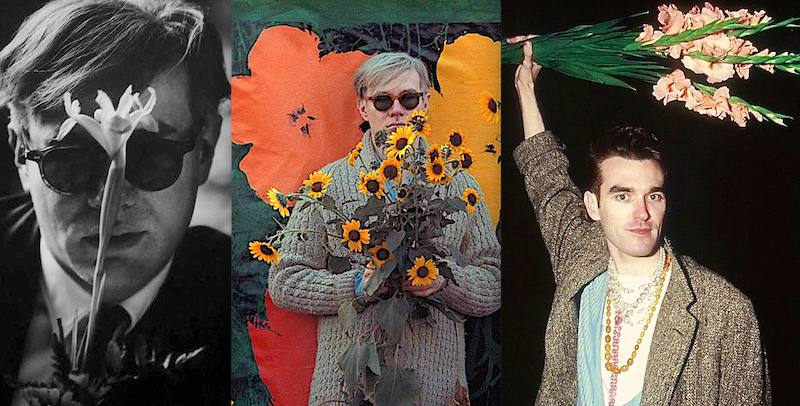
Details of photographs, left to right: Warhol with iris (Dennis Hopper, 1963); Warhol with Flowers painting (William John Kennedy, 1964); Morrissey with gladioli (Paul Slattery, 1983). Image montage by the author.
Another correspondence: Warhol and Morrissey both posed with flowers for photo portraits. Their gestures signaled an appreciation of the feminine and an interest in nontraditional masculinity. Mindful of Oscar Wilde’s use of sunflowers and green carnations to garner attention for the Aesthetic Movement, Warhol drew a great deal of attention in 1964 with paintings titled Flowers; likewise, Morrissey’s stage antics with bouquets was a sensation that paid off for The Smiths. But, hoping to sustain the interest of the general public — and to protect their business interests — each man cultivated a degree of ambiguity around sexuality and public identity. When an acolyte asked Walt Whitman about homoeroticism in his poems, he famously ducked the question. In their respective heydays, Warhol and Morrissey followed suit. While both made numerous works that flirted heavily with gay audiences, they preferred not to discuss their intentions. In an interview published in 1989 Morrissey remarked “I don’t fit into any sexual category at all.” While the other members of The Smiths generally maintained more conventional public personal lives, Morrissey cultivated an ambiguous and solitary persona. To his credit, he used art to reflect on this: “Will Never Marry” (co-written with Stephen Street, 1988) is a stunning song supported by a heartbreaking video montage.
Morrissey may well have known Warhol’s 1980 book POPism: The Warhol ’60s, in which he made the following statement about the assistants and habitués at his Manhattan studio nicknamed The Factory: “We were all odds-and-ends misfits, somehow misfitting together.” The artist was a misfit from blue-collar Pittsburgh whose family were members of a Byzantine Catholic Church that served East Slavic immigrants; Morrissey and the other Smiths may be regarded as his Irish counterparts raised in Manchester’s poorer districts. Like Warhol, each Smith was driven by a desire to be recognized and to stand apart from their hardscrabble, monotonous roots. Their music, as represented on Best … I and … Best II, often spoke to their hopes and trials as working-class creatives, and, in that light, its Warholian tie-ins are meaningful.
Trevor Fairbrother is a curator and a writer. He dedicates this essay to the memory of Monique van Dorp-Berkowitz.
Tagged: "... Best II", Andy Rourke, Johnny Marr, Mike Joyce, Rhino Entertainment, Steven Morrissey, The Smiths