Visual Arts Review: Elsie Kagan’s Uncanny Waters
By Yvonne Owens
In the drop falls at 3S Artspace, the artist’s lush hybrid paintings bring Virginia Woolf, artificial intelligence, and ecological collapse into a seductive, disquieting flow.
the drop falls, Elsie Kagan. At 3S Artspace, 319 Vaughan St., Portsmouth, NH, through September 27.
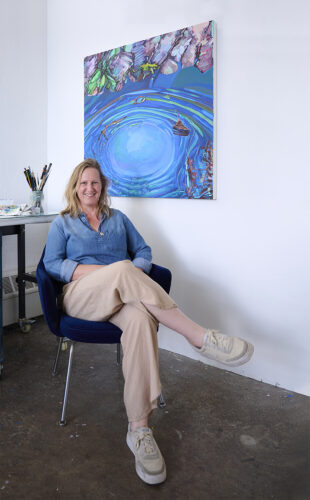
Painter Elsie Keagan. Photo: courtesy of the artist
“The drop falls; another stage has been reached.” Virginia Woolf’s famous line comes from her experimental novel The Waves, which was published in October 1931. The sentiment is delivered by Bernard, one of the six central characters, near the end of the book. Bernard, an old man looking back at his life and pondering the nature of existence, uses the imagery of a water drop forming and falling as a metaphor for time passing, human consciousness, and the continuous movement from one phase of life to the next, “stage upon stage.” The phrase encapsulates a modernist’s exploration of time, memory, and how individual lives dissolve and renew in a cyclical pattern.
Elsie Kagan’s reasons for choosing to name her current show after Woolf’s quote are as complex and not a little mystical: “Virginia Woolf’s phrase ‘the drop falls’ from The Waves captures this process of creation and dissolution. The fluid boundaries of subjective experience in Woolf’s novel recall the porous borders my work investigates between human creativity and machine intelligence. Each painting completes one cycle while generating the conditions for the next: a continuous formation that mirrors both water’s natural cycles and the recursive loops of algorithmic processing.”
Water is the metaphorical medium of dreams and visions for the human psyche, and it has long fascinated poets, writers, and artists. Creators of both abstract and representational landscapes, in all media and disciplines, have given rapt attention to the action, dynamics, and allure of water. As Kagan describes it: “Water is both subject and metaphor; I consider its capacity to be transparent, reflective, life-giving, and destructive. The work explores the tension between material mark-making and spatial illusion—where paint exists both as material on the surface and as depth and light.”
Of course, questions of environmental destruction can fairly be centered on water as well. Vast interrelated and interdependent living systems depend on the smooth functioning of the globe’s ecosystems. Essential roles are played by forests, soils, and bodies of water in carbon capture and in maintaining the soundness and breathability of the air, integral to life on Earth itself. Avian and insect pollinators are part of that scenario, key ingredients in the survival of both flora and fauna.
Kagan’s painted queries and their beguiling perspectival seductions unsettle and intrigue us. Not a moment too soon, given that we, by and large, are sleepwalking into an unimaginable trans-human (if not post-human) future. Her climate-anxiety paintings have an organic, fleshly tone. It gives them an intimate, visceral quality — they are somewhat disturbing and creepy. They can be vaguely uncomfortable to look at; it is like watching a sequence in David Lynch’s Eraserhead. You see what appears to be a line-up of amorphous, ambiguous forms that vaguely resemble internal human organs. Experienced as discrete, externalized, and autonomous, these close-up images of innards come off as dramatic pictures: glyphs of the human psyche contemplating ecological collapse—vulnerable, dismembered, bewildered, and disoriented.
One image, Interface, is suggestive of being literally at sea on a tiny raft, rocked and threatened by overwhelming circumstance. The perception of being swamped by realities and events so totally beyond one’s control creates a psychological jungle of shapes, patterns, and delineations. Our comforting, homely world is far away. A large triptych titled neither here nor there shows sumptuous, deliriously lively, brilliantly colored landscapes and seascapes. But are these surreal, hybridized AI- and human-made images based on anything that actually exists on Earth? Writhing, dancing, and gesturing in our visual field, Kagan’s hybrid human- and machine-made forms call us to question our species’ march forward. Might the planet’s top predator—equipped with a mischief-oriented detached thumb and an ingenious bicameral brain—be the environment’s worst nightmare?
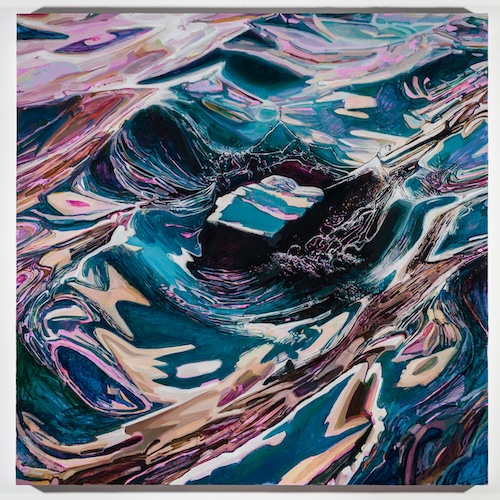
Elsie Kagan, interface, 2025. Flashe, acrylic, and tinted plaster on panel. 40” x 40”. Photo: courtesy of the artist
Kagan’s focus on oceans, rivers, lakes and streams is well chosen—and not just because of water’s historic role in human conceptualizations of art and poetry, mysticism and spirituality, intellectual borders and liminality. There is also water’s existential role in our planet’s survival, here and now, on the putative brink of a foundational, keystone species-wide extinction event. The irruption of the artificial into natural networks, including human systems, is perhaps best illustrated by the fact that microplastics (synthetic polymer particles ranging from one nanometer to five millimeters in size) have achieved near-universal infiltration across terrestrial, marine, and biological systems. Ubiquitous, they are found in remote soils, agricultural fields, mountain snowpacks, and the atmosphere (indoor and outdoor air). Wide-ranging, they are transported globally via wind and rain cycles, acting as carriers for heavy metals, persistent organic pollutants (POPs), and antibiotic-resistant bacteria (the “plastisphere”).
The world’s oceans present a critical case in point. If they die, societal collapse cannot be far behind. In the human body, micro- and nanoplastics cross biological barriers, and have been detected in human blood, lungs, breast milk, placenta, liver, kidneys, and arterial plaque. Recent autopsy and clinical studies confirm accumulation in deep tissue environments, including the brain and, while long-term toxicological outcomes are still being actively researched, clinical findings so far link microplastics to significantly elevated risks of heart disease, strokes, and body systemic inflammation.
The health of the world’s water is under immediate threat. Besides fossil-fuel pollution, overfishing, and sonar and sound pollution endangering marine mammals, the volume and scale of microplastic infiltration into the world’s water bodies is inestimable. Their oceanic and marine range is prodigious, with conservative estimates indicating nearly 200 trillion plastic particles circulating in surface waters alone, while millions of metric tons have settled on deep-sea floors and trenches. Microplastics have been detected from polar sea ice to depths of 2,000 meters, as well as in hydrothermal vents and the Mariana Trench. Over 1,300 marine species—ranging from surface phytoplankton to deep-diving whales—ingest these particles, disrupting marine food webs and biological carbon pumps. The tiniest of these life forms, plankton and microorganisms, ingest them and die, sinking to the ocean floor and creating a sterile bed where the nutrients that formed the basis of life on Earth once thrived.
The alarm bells cannot be rung loud enough. That is why Kagan’s vision—her siren song of beauty and destruction—is so key to our understanding of our predicament. Evocative, seductive to the eye, unsettling, and subtly disturbing to the spirit, her art is a warning.
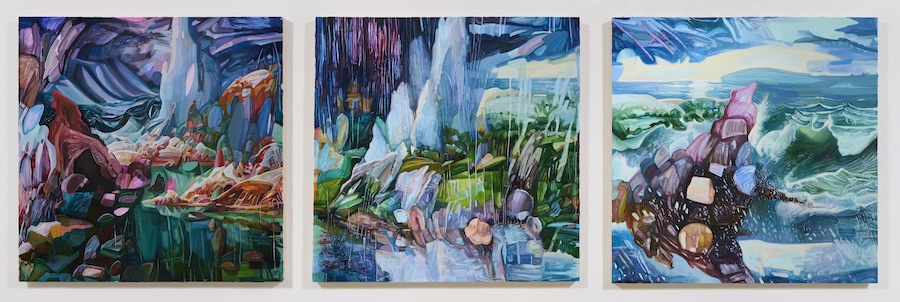
Elsie Kagan, neither here nor there, wide. 2026. Flashe, acrylic, oil, and tinted plaster on panel. Triptych, 40” x 40” each. Photo: courtesy of the artist
The artist’s choice of materials includes Flashe, a vinyl paint with a binder similar to acrylic’s but with an automatic smoothing-out action. It leaves the surface texture creamy and supple. The applied paint surface self-levels to eliminate visible brush marks, giving the work a machine-like, machine-made, artificial effect—like something from a 3D printer. There is no evidence of the human hand in its making. This compounds the uncanny-valley effect: you know you’re looking at a painting made by a human artist, but it so convincingly apes the AI artificiality that is its subject that one is left vaguely disturbed, ambiguously unsettled. The results are beautiful and beguiling while also being simultaneously unheimlich and subtly disorienting.
Art depends on playing with illusion, but where is the border between delusion and deception? At what point does the AI-fabricated image begin to intrude upon — even unhinge — the viewer’s reliance on personal perception? When do these kind of intrusions undercut collective cognitive coherence—nullify any unified agreement about what is real? Ultimately, how dangerous will undermining reality prove to be when it comes to collective objective assessment of—and action concerning—the climate crisis, human-made pollutants, environmental degradation, and ecological collapse? Kagan’s painterly interrogations of objectivity, subjectivity, and “reality” pose these difficult questions.
Yvonne Owens writes art and cultural criticism, exploring contemporary post-humanist discourses in art, literature and new media. She is author of Abject Eroticism in Northern Renaissance Art: The Witches and Femmes Fatales of Hans Baldung Grien (Bloomsbury, 2020), and Editor of Trans-Disciplinary Migrations: Science, the Sacred and the Arts (Cambridge Scholars, 2024). Earlier publications include The Witch’s Book of Days (Beach Holme, 1993), The Cup of Mari Anu (Horned Owl, 1994), The Journey of the Bard (Horned Owl, 1996), and The Saturnine History of Jews and Witches (Penn State University Press, 2014).
Tagged: 'the drop falls", Elsie Kagan, artificial intelligence, ecological collapse