Dance Review: Huang Yi’s “Ink” Writes the Body into Darkness
By Debra Cash
Animated calligraphy, dancers in half-shadow, and two industrial robots create an eerie, elegant theater of marks, motions, and metallic afterimages at Jacob’s Pillow.
Huang Yi: Ink, at The Doris Duke Theatre, Jacob’s Pillow, with audiovisual design by Ryoichi Kurokawa, August 19 through 23
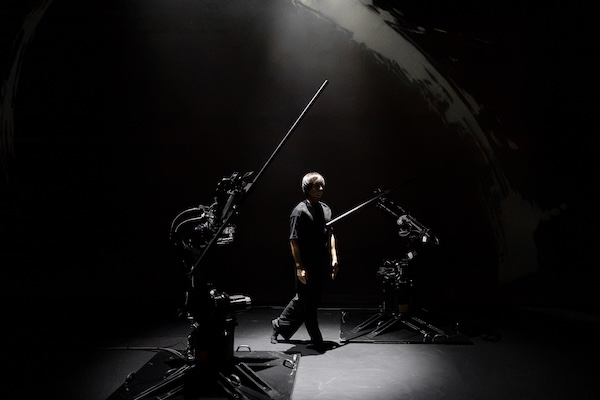
Huang Yi in Huang Yi’s Ink at Jacob’s Pillow Dance Festival 2026. Photo: Becca Oviatt
Chinese calligraphy has always had a dancing element. The forms of its semi-cursive and cursive scripts speak to the gesture of the calligrapher’s arm while the darkness and cohesion of its ink hold the pressure of the calligrapher’s brush and hand. No wonder, then, choreographers from nations where calligraphy is a prized art form as well as a refined hobby have often looked to calligraphy for inspiration.
Last week, Jacob’s Pillow presented the latest work in this gorgeous genre. Taiwanese choreographer Huang Yi was supposed to come to the Berkshires in 2025, but his company’s premier was delayed when the Pillow called off the last weeks of the season in the light of a tragic accident on its campus.
The renewed invitation was well deserved. Huang Yi: Ink is a work where dimensional projections by Ryoichi Kurokawa plant an ensemble in a shadowy, scrolling environment, “dismantled and reconstructed” from award-winning Taiwanese calligrapher Tong Yang-Tze’s Silent Music series.
Ink opens in moaning wind and low rumbling. The dancers, who remain in half-shadow throughout, stumble and collapse, yet despite their frailty, their gestures have undisclosed power: a thrown arm suddenly seems to have produced a white curve across the backdrop, the fall of a dancer’s hair as she leans against her partner is echoed in a rushing line. Later, when a group of men dance to a DJ’s scratching score, their b-boy backflips and eerily slow-motion somersaults chime perfectly with the energy behind a series of strokes that turn classical calligraphy into hip-hop graffiti tagging.
Not every gesture through this hour-long work has its analog. In one section, the white-on-black calligraphy is the complete performer, creating a series of rising and dissolving shapes like fireworks flashing in a dark summer sky. Sometimes the white paint splatters (eat your heart out, Jackson Pollack.) But when the dancers are juxtaposed with those shapes, the effect casts a spell: you not only see the calligraphy’s graphic beauty, but the movement below or alongside it is suddenly exposed in its detailed complexity. The projections, dissolving to mist, only to be replaced by other calligraphic shapes, become synecdoches for the precious ephemerality of human movement.
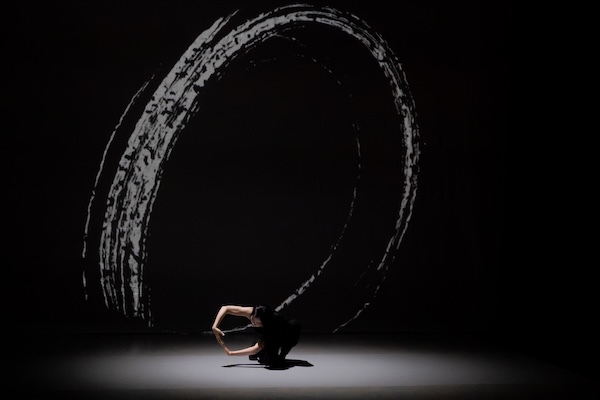
Yi-Fen Tai in Huang Yi’s Ink at Jacob’s Pillow Dance Festival 2026. Photo: Becca Oviatt
For me, the dancing and scenic elements would have been plenty. Yet the buzz around Ink is that it’s a work where a human being dances with industrial robots.
During the preshow talk, “choreoroboticist” Amy LaViers, who runs a robotics and dance lab in Philadelphia explained that programming a robot to “dance” leaves no room for improvisatory impulse: every degree of bend or torque in its apparatus has to be programmed in.
The question remains: what communicative language are such robots capable of “speaking”?
Two Techman robots, originally designed for manufacturing production line inspection, look like a single arachnid pile of metal, perhaps a Louise Bourgeois sculpture waiting to rise to its feet. Crouching amid the robots’ “limbs,” Huang Yi raises an arm, and one of the robots lifts a limb at the identical angle. The robots are fitted with poles that read as long batons. They elongate as if from unfurling spines. Their movements pass at a lyrical pace, perhaps the better to show those of us in the audience the sequence of their deliberations. That makes the movement less uncanny: these robots are servants, not masters, and they mean their human comrade no harm.
I kept asking myself whether the robots served as partners or props, and if, for example, I would be equally interested in seeing a man entangled with a couple of black motorcycles. I didn’t come up with an answer, but I learned after the show that the “full” version of Ink has four robots, with the two we saw at the edge of the Duke stage apron intended to rise from an orchestra pit, and two more robots positioned upstage. Given Huang Yi’s gifts at layering images, I imagine that two sets of robots would offer richer echoes and more intriguing implications.
As the dreamlike sequences of Ink come to a close, the robots get the last word. They lift their “arms” as if in a hurrah. Or maybe they are pleading to the dancers, and to the audience that has just met them, “don’t forget me.”
The duet of Huang Yi and Kuka, a robotic arm he conceptualized and programmed, will be presented by Vivo Performing Arts at the Boston Museum of Science from February 25-27, 2026
Debra Cash is a Founding Contributing Writer to the Arts Fuse and a member of its Board.
Tagged: Amy LaViers, Huang Yi, Ink, Jacobs-Pillow, Robots, Ryoichi Kurokawa