
Rock Album Review: The Cramps’ Lost Album, Unearthed
By Steve Erickson
A newly released 1977 collection documents the Cramps making the past feel dangerous again.
The Cramps, Gravest Gravy
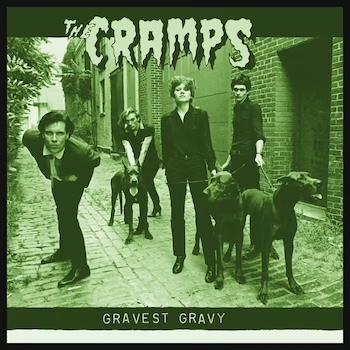 Gravest Gravy gives off a distinctive odor: mold from thrift store paperbacks, stale beer left over from nights in front of the TV glued to Ed Wood and Ray Dennis Steckler movies. Formed by longtime couple Lux Interior and Poison Ivy Rorshach, who moved to New York from Akron in 1975, the Cramps were kidding around, but only up to a point. Like many early American punk and New Wave bands, they sought to revive the primal spirit of early rock and roll. Their music was so stripped down that the band had no use for a bass player. (Second guitarist Bryan Gregory and drummer Nick Knox fleshed out Interior’s vocals and Rorshach’s guitar.) Much of Gravest Gravy, a 1977 album now getting its first official release, consists of covers.
It makes a great companion to the Ramones’ first album. The Ramones thought they were making pop music. With the passage of time, their edges have been sanded off. “Blitzkrieg Bop” is now regularly played at football games and eventually went gold. But back in the ’70s, their Beach Boys-meets-Stooges aesthetic came across as genuinely menacing to many. The ritualistic undertones of Gravest Gravy feel similarly real. It’s a spell cast to bring back rebellion.
In 2026, Larry Hardy, owner of the garage rock label In The Red, discovered the Gravest Gravy tapes in the Cramps’ archives. Their release brings the band’s story full circle. It marks the revival of their own Vengeance label, which put out their first two singles, “Surfin’ Bird” and “Human Fly,” in 1978. Those songs (and their B-sides) come from the same session as Gravest Gravy. One can speculate how the full album would have been received if it had came out at the time. The band took several years to build up a following, signing to I.R.S. Records in 1979 and releasing their debut album, Songs the Lord Taught Us, the following year. For their second album, Psychedelic Jungle, they rerecorded several songs from Gravest Gravy, although Kid Congo Powers had replaced Gregory.
The band’s sole constant members, Interior and Rorshach were old enough to have participated in the counterculture. On “Weekend on Mars,” he sings about “taking a real psychedelic trip.” The Cramps took a step forward by going backwards. Their minds were steeped in American trash culture — Interior’s voice quivered with lust. His vibrato derives from Elvis, but he brought a level of frenzy closer to prime Iggy Pop and James Brown. Although it’s not the same as seeing the band live in 1980, YouTube is full of clips of them in full form, with a shirtless Interior sticking the mic into his mouth. The presence of Roh ensures that songs like “Rocket in My Pocket” (or the later “Can Your Pussy Do the Dog?” and “What’s Inside a Girl?) don’t turn into cock rock. Even at their horniest, the band always retained a sly sense of humor. According to critic Tim Stegall, Rorshach was the band’s guiding force, taking charge of most of the Cramps’ decisions.
All of Chilton’s simple production choices enhance the music. He soaked Interior’s voice in reverb on “Can’t Find My Mind” and played organ on “Hungry.” “The Natives Are Restless” gives us Interior at his angriest, while in“Can’t Hardly Stand It” he grinds away in a stew of jealousy. “Jungle Hop,” which imagines Africans becoming devoted rockers and “[taking] the skin of ten giraffes/and trading them for one phonograph,” is an example of when the band’s devotion to the past could’ve been thought through further. It recycles stereotypes that must’ve sounded patronizing — even when Kip Tyler first recorded the tune in 1958.
The Cramps spawned many imitators, by launching the genre of psychobilly as well as inspiring the rockabilly/garage-rock compilation series, Songs The Cramps Taught Us. As with the Ramones, their conceptual brilliance proved harder to imitate than their sound. They made their covers and originals come together seamlessly, a trick most of their inheritors couldn’t pull off. At a time when the band had barely got off the ground, “Rockin’ Bones” gives a voice to their long-term impact: “my bones will keep rocking even after I’m gone.” They were right.
Steve Erickson writes about film and music for Gay City News, Slant Magazine, the Nashville Scene, Trouser Press, and other outlets. He also produces electronic music under the tag callinamagician. His latest album, Bells and Whistles, was released in January 2024, and is available to stream here. He presents a biweekly freeform radio show, Radio Not Radio, featuring an eclectic selection of music from around the world.
1 Comment
Leave a Comment

This release is genius from original Cramps and Alex Chilton to those that brought from the dustbin to our turntables! Thanks Henry Rollins et al!