
Concert Review: Jonathan Biss and the Brentano String Quartet Explore the Drama in Dvořák, Haydn, and Beethoven
By Aaron Keebaugh
Pianist Jonathan Biss and the Brentano String Quartet animated Dvořák, Haydn, and Beethoven with emotional urgency and tonal finesse.
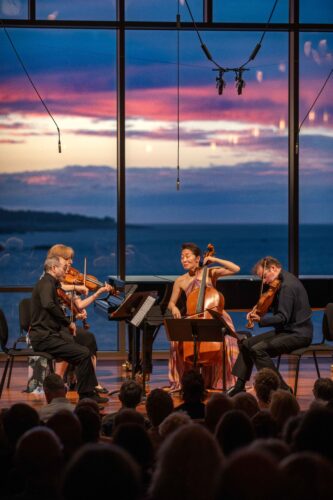
The Brentano String Quartet at the Rockport Chamber Music Festival. Photo: Julian Mendoza
Chamber music has always had a way of allowing the composer to express thoughts about problematic topics. For Antonin Dvořák, the subject was his support of Czech nationalism, played out through the vivid folk flourishes of his Piano Quintet No. 2 in A minor.
Completed in 1887, the score focuses on populist appeal without resorting to cheap polemical tricks. The music’s combination of longing and ferocity takes a fond look back at Dvořák’s cultural heritage. And, as pianist Jonathan Biss and the Brentano String Quartet illuminated last Thursday night at the Rockport Chamber Music Festival, nostalgia need not be frowned on — when it exudes infectious joy and good cheer.
Biss and the Brentano String Quartet were ideal partners when serving up Dvořák’s remembrance of things past. Each musician played off the other in terms of clarity and vitality. The strings performed with heartfelt immediacy, underlining the warmth and personality of Dvořák’s lines. Throughout, Biss reinforced and complemented his role with a sparkling effervescence that even buoyed solemn passages.
To open, Biss unfolded gently undulating chords against Nina Lee’s burnished cello solo. The result was, by turns, sumptuous and lyrical. But this was not merely a moody inward gaze: when called on, the strings’ sudden urgency burst forth with thunderous force. The Scherzo–an airy Czech furiant–pushed the tension forward. And the finale pulsed with the exuberance of a down-home party.
But the heart of this score is its Dumka. Here, Biss’s figures trickled over the dark ambiance generated by the strings. Yet even during this section–“dumka” is close to a Slavic term for meditation or recollection–the emotions were chafing at the shadows. In Thursday night’s reading, strings and piano figures danced in all the right places, suggesting that, for Dvořák, sentimentality never strays far from a sheer zest for life.
The concert’s other selections, consisting of string quartets by Haydn and Beethoven, also seized on opportunities for unexpected drama and dynamism.
Haydn’s String Quartet in D major, Op. 20, No. 4, doesn’t just lean into gloomy emotions — it all but embraces them in Romantic fashion. Passions shift about dramatically, though nothing ends up feeling out of sorts. It’s as if, for Haydn, a focus on clarity and precision can still yield plenty of psychological surprises.
The Brentano String Quartet generated whiffs of internal mystery by playing the opening bars at a cool distance. Warmth grew gradually, with each passing bar. That strategy of disinterest to embrace made the second movement feel ethereal, albeit still personal. That said, the musicians encouraged levity to rise naturally to the surface. The Minuet bounded gaily in its off-kilter rhythm. The finale, which the ensemble played with a slight edge of tone, stung the air like sly wit, the turmoil building to a din before the music faded into silence.
That mix of humor and darkness also made Beethoven’s String Quartet in F major, Op. 18, No. 1 buzz with unexpected nervous energy. Less emotionally contained than the Haydn, Beethoven’s first work in the genre — a half-hour long — lets its various tensions roil just beneath the surface.
Here, the Brentanos dug early on, going for a rich, rough-hewn sonority during the opening movement. Yet they still explored the music’s more intimate passages via a smooth treatment of motives that passed between violin and cello.
Elsewhere, the foursome brushed this musical canvas with bold colors. Warm phrases in the second movement generated bittersweet solace. The intensity of the performance never flagged as the strings bored into the tutti passages, as if ruminating on the predicament of the moment. The Scherzo–swift and dainty–provided a palette cleanser before the musicians charged headlong into the finale’s full-throttle fusion of grit and power.
Exploring serenity, verve, and every psychological state between, the Brentano Quartet revealed this music’s persistent truth: the result may be satisfying, but it’s the journey, taken by the musicians and listeners, that counts.
Aaron Keebaugh has been a classical music critic in Boston since 2012. His work has been featured in the Musical Times, Corymbus, Boston Classical Review, Early Music America, and BBC Radio 3. A musicologist, he teaches at North Shore Community College in both Danvers and Lynn.