
Doc Talk: Long Strange Trips at the Provincetown International Film Festival
By Peter Keough
Portraits of a legendary critic and modern Deadheads highlight what’s gained—and lost—when culture resists critique.
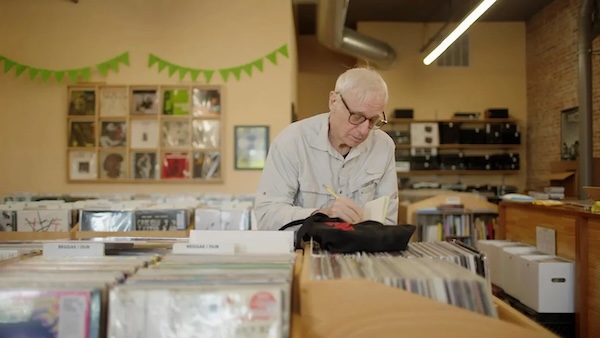
Veteran music critic Robert Christgau in The Last Critic. Photo: Past Prime Productions
One measure of a documentary’s success is whether it causes us to question something we have taken for granted. In Matty Wishnow’s The Last Critic (2026; screens June 10 at 5 p.m. and June 13 at 4 p.m. at the Waters Edge. The director will attend the June 10 show), that happened for me at the very beginning of the film, as the subject, legendary music critic Robert Christgau, is listening to the song “I Play My Bass Loud” by Gina Birch. “Sometimes I wake up,” go the lyrics. “And I wonder, what is my job?”
Indeed, I said to myself. Why was I spending my life watching, analyzing, and writing about movies? What was the point of criticism anyway? Luckily, Christgau, the self-proclaimed (semi-ironically and while semi-drunk) “Dean of American Rock Critics,” provides some insights into the purpose and necessity of the profession. “There are two parts about being a good critic,” he explains in an early interview. “First, you have to know what you like. Second, you have to be able to explain honestly why you like it, even if the reason is completely disgraceful.” So why go to all that trouble, which in Christgau’s case has taken up almost all of his adult life and involved listening to around 250,000 hours of sometimes not so great recordings? “I help people hear music,” he explains. “As well as understand it. That’s a pretty great mission as far as I’m concerned.”
So be it. But perhaps more inspiring than Christgau’s words of wisdom, or the tour of his Manhattan apartment crammed with racks and shelves and file cabinets full of CDs, LPs, books, and ephemera, or the visit to his equally crammed storage locker, or even the estimated 17,000 reviews he has written and continues to write at the age of 84 for his blog, is his relationship with his wife Carola Dibbel. Herself a writer as formidable as Christgau, she has spent much of the 52 years they have been together serving as his editor, muse, defender, and voice in the wilderness. Her bemused solicitation as she asks him if he has his glasses and his script with him as he heads out to a public speaking engagement may be the film’s most poignant moment. Or when Randy Newman relates how the couple were an inspiration for his 2017 song “Lost Without You.”
Nonetheless, I’m giving the film a B (“an admirable effort” in Christgau’s terminology). Though engaging and provocative, it lacks that one extra step needed to fully grasp its subject. For example, it lauds Christgau’s system of letter grading releases (from A+ to E-) in his “Consumer Guide” begun in 1969 in the Village Voice without considering the downside. As Christgau notes, it was revolutionary for the times and “pissed off” his peers as it revived interest in criticism. But its ultimate effect, once it was adopted by armies of imitators, was to degrade rock from art to product.
Like Siskel and Ebert’s similarly well-intended and transformative thumbs, his system has pretty much reduced criticism to semaphores. Except (perhaps) for Christgau’s own haiku-like capsules, I suspect most readers now will just look at a rating and skip the text, regardless of how cogent and penetrating it might be. Hence, we get the verdict but not, as Christgau deemed essential, the reasons why.
So, although the film includes some comments from those burned by Christgau’s caustic wit (including wry observations from the once panned, later lauded Sonic Youth leader Thurston Moore and a reference to the classic Lou Reed quip, “Can you imagine working for a fucking year and you get a B+ from some asshole in The Village Voice?”), The Last Critic, as the title suggests, remains, more or less, a hagiography. For a film about a critic, why is there no criticism?
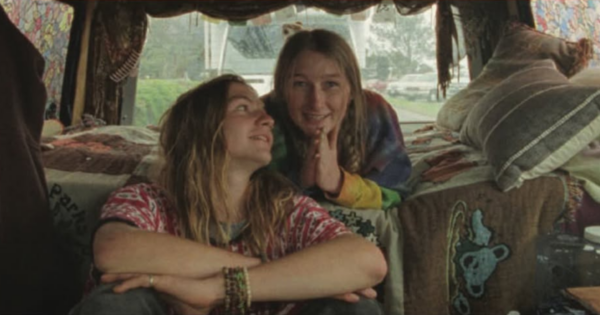
A scene from Summer Tour. Photo via Mischa Richter Instagram
Christgau’s “Consumer Guide” ratings of records by the Grateful Dead, of whom he was an early champion, range from A to C. The subjects in Provincetown native Mischa Richter’s feature Summer Tour (2025; screens June 12 at 4 p.m. at the Town Hall with the director, producer Chloë Sevigny, and editor Jay Rabinowitz in attendance) would no doubt have rated them all A+. The film accompanies two young Deadheads, Jerry and Anna, as they drive cross-country in 2023 following the final tour of Dead & Company, the most recent incarnation of the band. As one of the kids who accompany them part of the way remarks, the couple at first don’t seem for real: they’re too nice! Plus, they are beautiful, with identical long blond hair, and he’s a talented guitarist to boot. But they prove to be genuinely decent and joyful souls.
Much of the film unfolds with the incantatory pace of an extended Grateful Dead instrumental (underscored by the wall-to-wall Dead music on the soundtrack). There are lots of montages, arty shots of sunsets, skinny-dipping at idyllic, woodsy swimming holes, dissolves from one sublime 16 mm shot to the next, with not much of a sense of direction except an animated map that follows the tour from California and around the country and back again (with a shout-out shot of Jerry busking outside the House of Blues on Lansdowne street).
Though Annie’s mother, herself a longtime Deadhead, explains that she has at times seen a dark side to the movement, not much of that comes through in the film. Aside from, perhaps, the raffish but charming tour follower who, like many others, is a gate crasher (his method of slow walking backwards into the arena past the guards is worth noting for those so inclined). He makes ends meet by playing blackjack with the crowds. Another gatecrasher is on crutches, having miscalculated a fence he was jumping over. Later he gets busted and beaten up by the cops.
One thing the film lacks is actual performances by the musicians. It’s like Woodstock without the acts. Instead, we get shots of audience members dancing, spinning like whirling dervishes—an activity Annie says induces a near-mystical state, not always enhanced by drugs. But who needs the actual performers? One fan explains how he saved up all year for the 2020 tour. When it was cancelled because of Covid, he decided to take the tour anyway, driving from site to site and playing the music himself at the empty venue. It reminded me of the closing scene of Blowup.
With this film, I also had a preconception overturned – that Deadheads were superannuated hippies clinging to the past. There are many of those, and more power to them, but most seem to be vibrant, adventurous young people who might be our best bet for the future.
Peter Keough writes about film and other topics and has contributed to numerous publications. He was the film editor of the Boston Phoenix from 1989 to its demise in 2013 and has edited three books on film, including Kathryn Bigelow: Interviews (University Press of Mississippi, 2013) and For Kids of All Ages: The National Society of Film Critics on Children’s Movies (Rowman & Littlefield, 2019).
Tagged: "Summer Tour", "The Last Critic", Chloë Sevigny, Grateful Dead, Matty Wishnow, Mischa Richter
4 Comments
Leave a Comment

On the one hand, what’s so wrong with a documentary that is worshipful of a hard-hitting critic and of the indispensable role of critique in culture? There aren’t many examples of those around—arts critics are usually treated as the Snidely Whiplashes of their time.
On the other hand, I completely agree with you about the harm done when critics assign letter grades to what they review. Not only do readers skip the reasoning behind the judgments, but haven’t you noticed that too many critics can no longer explain their verdicts? Once the job is reduced to doling out letter grades, the brain decays—and criticism dies. There is a direct link between the atrophying of evaluative language and the transformation of art into product.
agreed on both points. hence the B.
The Christgau documentary has such great examples of his opinion writing (with some hilarious “F”s ) that I’ll take the letter grades with a grain of salt and a dose of humor. When I was with Robin Lane and the Chartbusters, his terse review of our first album read:
“Robin Lane sings as if she’s telling you something she hasn’t quite admitted to herself yet—and the band frames that hesitation so neatly you only notice it after the song is over.” The grade was “B”. I’m not sure I get it, but heck, we’ll take it!
As for Summer Tour, after barely making it through the dreadful Deadoid ramblings of a band you never see, and I hoped to never hear again, my reaction was, “That was not a movie. It was just pictures.”
Unfortunately most people do the opposite with Christgau’s system, noting the grade and not the text, hence the diminishment of criticism. So an F for the Dead? As for C’s assessment of the Chartbusters, that reads like an A+!