Book Review: “My Year in Paris with Gertrude Stein” — Looking for “It” in All the Wrong Places
By Joan Frank
Deborah Levy’s playful Parisian fiction delivers vivid reflections on Gertrude Stein but it is in danger of stumbling over its own cleverness.
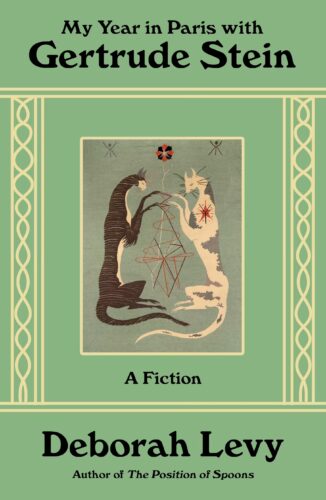 My Year in Paris with Gertrude Stein: A Fiction by Deborah Levy. Farrar, Straus and Giroux, 240 pages, $27.
A helpful subtitle for Deborah Levy’s My Year in Paris with Gertrude Stein: A Fiction could be: “Searching for a Lost Cat in Paris with Two Loopy Girlfriends While Struggling to Write about Gertrude Stein (and Reeling from the Catastrophic Results of the 2024 Election).”
A mouthful, yes—but an accurate preview.
The book’s actual subtitle, “a fiction,” suggests that readers should decide for themselves how much of its story may come from Levy’s own life.
To be clear: all the Stein material is solidly researched, and fascinating. Moreover, My Year’s voice is winning: fresh, brash, pithy in its pronouncements—many by Stein, many by Levy, whom I generally admire. Her work has been bravely various; her mind wide-open; her prose clean and crisp—here sounding directly infiltrated by Stein’s bold, childlike style: “Eva was my new friend in Paris. We liked not knowing much about each other because there was so much to find out.”
My Year opens by date, like a journal: “Paris. November 2024.” Its present-tense players, three women, share a close friendship: Eva, a Danish graphic novelist; Fanny, a French finance broker busy with multiple female lovers; and the nameless, London-based narrator, a writer chafing under assignment to write about Stein.
The triggering event: “Eva called to say she had lost it.”
“It”—oh, alas—is Eva’s name for her cat. And though Fanny nicknames the creature “Bob” for easy reference, throughout the book our (unnamed) narrator utilizes the word “it” in two ways: sometimes meaning the lost cat, and sometimes referring to other things or concepts that may fairly be considered lost. This conceit quickly annoys: one finds oneself re-reading lines; the language backs up on itself.
That said, the women’s friendship is acted out amid pleasant Paris locales and alongside tasty bits of the city’s history. Ah, Paris: what’s not to enjoy? The friends eat, drink, squabble, and gossip, wander the city seeking Bob/It, and briefly meet an older gentleman who may or may not know something about Bob/It and may or may not be interested in Levy’s narrator. That’s the scaffolding: for me, it’s hard to care about.
The book’s true substance, which indeed compels, lies in the narrator’s efforts to understand Stein’s dramatic life, riddling work, and multifarious personality. Levy’s narrator hides nothing. “Sometimes, when I read her baffling and beguiling writing I wanted to smack it in the chops. She longed for readers to find her, yet there was a part of her that could not bear to be found. She was ashamed of her bestselling autobiography because it was so understandable. When I look at photographs of her, I cannot get into her eyes.”
Levy’s narrator groans and kvetches—but duly sets about recounting Stein’s life: time in medical school, studying under William James, clearing off to Paris, starting an art collecting enterprise there with her brother Leo, becoming a maven of artistic circles, and commencing life partnership with the canny, loyal Alice B. (for Babette) Toklas.
Levy’s narrator thinks hard about art and art-makers, and those passages give the book redeeming richness. “I had to remind myself that to collect art you have to see something new that has not been seen before. Above all, you must know how to defend it, how to talk about it, and, as Stein insisted, you have to love something that your own generation might find ugly.” When Leo and Gertrude set up shop on the Rue de Fleurus, Levy reckons, “Stein listened to her brother until she knew how to work with this new visual language…It was not just about owning art and displaying it, but owning its radical way of seeing.”
Allusions to the shock and horror of America’s 2024 election filter through: “Like the rise of fascism everywhere, the pigeons were out in full.” While that event doesn’t quite rhyme with the foreground activities, it feels grimly real. A vague echo of it stirs us when, in Stein’s history, Nazis and the Vichy regime come to power: Bernard Faÿ, “a queer Catholic fascist with avant-garde tastes who admired Gertrude’s writing,” protected Stein and Toklas. “His support provided coal. Rations. Driving privileges. Bread.” Nudged by Picasso, Faÿ also ensured Stein’s art collection went unmolested by the Nazis.
So much immersion in Stein depresses Levy’s narrator, as her girlfriends point out. “Why don’t I read Michel Foucault instead? Or at least buy a new hat? Or even light a candle at Notre-Dame?…It’s true that Gertrude transmits some sort of misery to me. The exhaustion of reading her prose. The never getting to the it of it. Somehow, it is my destiny to defend her.”
This she accomplishes ably and with compassion, albeit via her strange admixture of Paris, eccentric friends, and a ghostly cat. Reading and contemplating Stein’s difficult works, Levy’s narrator gleans insights, including respect for Stein’s steady courage. “She plays very precisely with the limits of language…way ahead of her time as she always knew.” Despite Levy’s narrator’s ordeal—or maybe because of it—the reader receives a uniquely flavorful, condensed biography, and perhaps even better, a sensitive writer’s meditation on its significance.
Joan Frank‘s latest books are Late Work: A Literary Autobiography of Love, Loss, and What I Was Reading and Juniper Street: a Novel. Her new novella, “Troldhaugen,” appears in the online literary zine Failbetter.
Tagged: "My Year in Paris with Gertrude Stein: A Fiction", Deborah Levy