Theater Review: “Bad Books,” Worse Behavior
By David Greenham
Sharon Rothstein’s sharp drama shifts the focus from censorship to the corrosive culture of public shaming.
Bad Books by Sharyn Rothstein. Directed by M. Bevin O’Gara. Scenic design by Dahlia Al-Habieli. Costume design by Chelsea Kerl. Lighting design by Karen Perlow. Sound design by Zoe Stanton-Savitz. Produced by Gloucester Stage, 267 East Main Street, 267 East Main Street, through June 27.
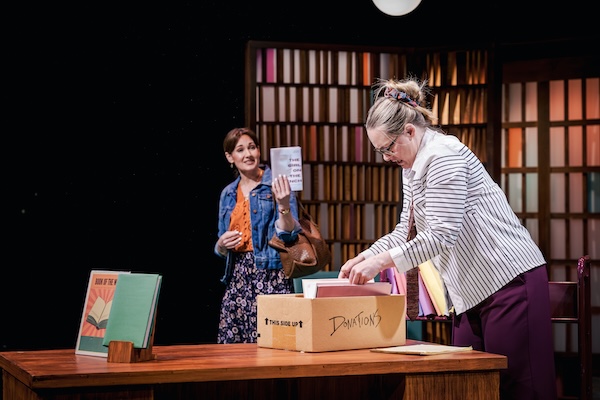
Aimee Doherty and Therese Plaehn in the Gloucester Stage production of Bad Books. Photo: Jeff Bousquet photography
You don’t have to consult A.I. to locate websites that blame all the ills of our society on the increased screen time that occupies many hours of the average day, particularly among adolescents. Among their many merits and demerits, the powerful computers we carry around in our pockets are tools for facts, purposeful misinformation, and blissful escape.
Where do you best learn about yourself and the world? The argument is ancient, at least as old as books. In the 18th and early 19th centuries, the young people who had the resources and time to bury their minds in books alarmed many. “Reading fever,” they called it, and it was blamed for sending those kids to the local library rather than leading them outside to do their profitable chores. One opposition leader charged that reading books can “become a kind of alcoholism under which work is neglected, and there is no mental energy for anything serious.” While that sentiment is reminiscent of current arguments about the threat posed by screen time, Sharon Rothstein’s nifty drama Bad Books targets the other side of our fears about enlightenment via words — and the irrational actions that can follow. Books are dangerous because they fill children’s minds with challenging ideas.
The play’s Mother (Aimee Doherty) seems innocent enough when she wanders into her local library as the Librarian (Therese Plaehn) grouchily prepares for her day of answering the usual array of informed and ignorant questions from patrons. The exchange between Mother and Librarian begins blandly enough. The Librarian sets the tone through humor. “I’m a real grouch. That’s the joy of being a librarian. You get to tell people to shut up all day,” she jokes.
It turns out the mother is on a mission to confront the Librarian for recommending a book to her 15-year-old son, Jeremy. The Librarian’s mood lightens when she recalls the boy, one of those curious and thoughtful young people who loves books —an entertaining tool for learning, a way to discover things about himself.
Mother has found the disturbing book, provocatively entitled Boob Juice, in her son’s room. She doesn’t need to peruse it to know that she is opposed to his having the volume. Jeremy’s reading too much as it is, she explains, but the fact that he’s reading books that can be judged just by glancing at their covers is highly objectionable.
The Librarian tries to explain the book’s context. Her recommendation came because Jeremy was struggling with some challenges. The Librarian suggests to the Mother that there are parts of Jeremy’s life that she might not know about, which often happens in the complicated relationship that grows between parent and teenage child. But, when the Librarian goes so far as to suggest that it takes a village to raise a child, Mother has had her ideological fill. She is a single mother, and has what it takes to be both his mother and father—and that’s all that Jeremy needs.
The conflict goes public when Mother posts an internet bomb that specifically targets the Librarian as a danger to children in the community. “I am a member of a lot of groups,” the mother threatens. Soon enough, an unseen crowd of protesters quickly assembles outside of the library, supplied with chants and cookies —they are prepared for a lengthy stand-off. We later learn that the Librarian has been fired.
The second scene finds the Mother at work; she is employed by a major pharmaceutical company. Her flighty manager (also Plaehn) does not want to initiate a serious confrontation but can’t avoid it. Since the incident at the library, things have escalated at home: Jeremy has disappeared. The boss has empathy for this loss, but she holds back her concern: “they tell us in management to be open, but not too open.” What the company is really concerned about, more than the Mother’s domestic trauma, is a recent revelation about the Mother’s past life as an author. Years before she had published an autobiography detailing her battle with illegal drugs; it became a short-lived sensation, but a tragic incident triggered by the book made the Mother regret having written it. She has done her best to bury the tome; she banned her own book, or so she thought. It has come out, and Mother’s past writings have been deemed out of line by the pharmaceutical firm —and she is laid off.
Scene 3 introduces us to an editor (also Plaehn) who, despite the downside of what has happened, suggests that Mother might want to consider reprinting her useful book—it might help others, the way Boob Juice might have helped her son.
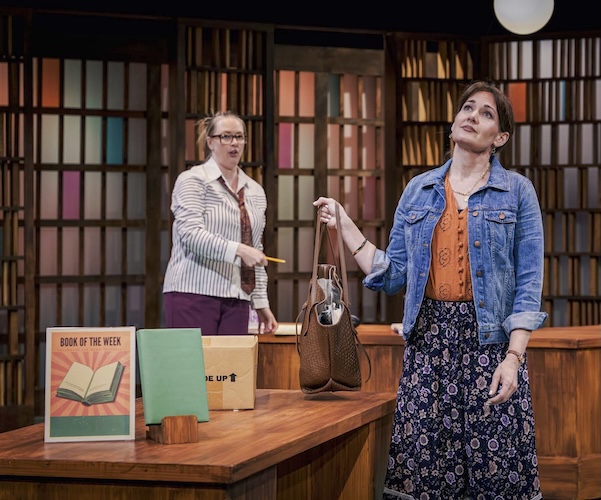
Aimee Doherty and Therese Plaehn in the Gloucester Stage production of Bad Books. Photo: Jeff Bousquet photography
By the final scene, Mother and Librarian face off again, their lives completely upturned. The pair now see clearly how actions can have intended and unintended consequences.
Running a taut 90 minutes, with no intermission, Rothstein’s gem of a play is receiving a rolling opening via the National New Play Network. It will be seen in productions across the country this year. This is a story worth telling, and director M. Bevin O’Gara’s playful approach to what could be very earnest material is dramatically effective. The scenes move quickly and naturally; O’Gara uses the transitions to set a tone of absurdity in the conflict. As Doherty and Plaehn move the furniture, they create a stylishly silly dance of rivals who are preparing for battle.
The core of the storytelling rests on the shoulders of Plaehn, who plays the foil for Doherty’s headstrong and emotionally detached Mother. Her Librarian, in particular, is impressively nuanced, charmingly sensitive.
Dahlia Al-Habieli has created a clever and functional set. Her stylized back wall is a representation of stacks of books—it is a convincing visual motif. Chelsea Kerl’s simple costumes manage to suggest complication; there’s something more to these characters than meets the eye. Karen Perlow’s lights and Zoe Stanton-Savitz’s sound are spot-on.
Refreshingly, Bad Books moves beyond the now-routine handwringing over book banning to probe something more insidious. The drama may be contrived, but it remains a compelling vehicle for examining the virulent spread of public shaming in all its forms—name-calling, finger-pointing, scapegoating, the reflex to blame anything and anyone but ourselves for the precarious moment we inhabit. Rothstein suggests that this embrace of hostility to others is not merely corrosive but self-defeating, a cycle that edges us closer to collective ruin. Want to understand how we got here? There’s probably a book about it. You might start at your local library.
David Greenham is an arts and culture consultant, adjunct lecturer on Drama at the University of Maine at Augusta, and is the former executive director of the Maine Arts Commission. He can be found at https://davidgreenham.com/
Tagged: "Bad Books", Aimee Doherty, M. Bevin O'Gara, Sharyn Rothstein, censorship, libraries